



Carica il tuo foto e Video
Google image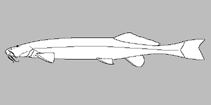 No image available for this species;
drawing shows typical species in Trichomycteridae.
Google image
drawing shows typical species in Trichomycteridae.
Classificazione / Nomi Nomi Comuni | Sinonimi | Catalog of Fishes(Genere, Specie) | ITIS | CoL | WoRMS | Cloffa
> Siluriformes (Catfishes) > Trichomycteridae (Pencil or parasitic catfishes) > Trichomycterinae
Etymology: Cambeva: Probably derived from the Tupi-Guarani, is a popular name for trichomycterid fishes in southern and south-eastern Brazil (Ref. 119381); perobana: Name 'perobana' from 'pero', an allusion to the conservation unit of Parana State named 'Reserva Biológica das Perobas' and '-ana', a feminine Latin suffix meaning 'pertaining to'.
Etymology: Cambeva: Probably derived from the Tupi-Guarani, is a popular name for trichomycterid fishes in southern and south-eastern Brazil (Ref. 119381); perobana: Name 'perobana' from 'pero', an allusion to the conservation unit of Parana State named 'Reserva Biológica das Perobas' and '-ana', a feminine Latin suffix meaning 'pertaining to'.
Ambiente: milieu / zona climatica / distribuzione batimetrica / gamma di distribuzione Ecologia
; acqua dolce demersale. Tropical
Distribuzione Territories | Aree FAO | Ecosistemi | Presenze | Mappa dei ritrovamenti | Introduzioni | Faunafri
South America: Brazil.
Dimensione / Peso / Età
Breve descrizione Chiavi di identificazione | Morfologia | Morfometria
Spine dorsali (totale) : 2; Raggi dorsali molli (totale) : 7; Spine anali: 2; Raggi anali molli: 5 - 6; Vertebre: 34 - 37. This species is distinguished by the following set of characters: six branched pectoral-fin rays; interopercular odontodes 28-29; vertebrae 34-37; opercular odontodes 13; branchiostegal rays 9; absence of conspicuous papillae on ventral region of head; presence of pelvic girdle and fin; long rictal barbel, 40.0-73.0% of HL; pelvic fins not reaching the urogenital opening; caudal fin truncate to rounded; first pectoral-fin ray not prolonged as a filament; color pattern of the caudal fin, presenting blotches, spots, or a homogeneous dark-brown or gray pattern in the proximal region; presence of a narrow mid-lateral stripe in some specimens; head, 17.2-20.6% of SL; pelvic fins 10.3-16.0%, pectoral fins 7.5-9.8% of SL; color pattern of some specimens, consisting in a dark-gray to dark-brown, becoming lighter towards ventral portion of the body and head, and absence of chromatophores, or some specimens with irregular dark-brown blotches on the inner skin layer, larger than two or three times the diameter of the orbit, sometimes coalescing and forming larger blotches, and an interrupted stripe in the mid-lateral region of the flank, over a plain yellowish to brown background; branchiostegal rays 9 (Ref. 137457).
Body shape (shape guide): elongated; Cross section: oval.
Body shape (shape guide): elongated; Cross section: oval.
This species is found in streams with sandy, rocky, and pebbly substrates, bordered by marginal vegetation consisting of bushes and grassy banks (Ref. 137457).
Ciclo vitale e comportamento di accoppiamento Maturità | Riproduzione | Deposizione | Uova | Fecondità | Larve
Riferimento principale
Caricare le referenze | Bibliografia | Coordinatore : Pinna, Mário de | Collaboratori
Martins, I.C., R.B. dos Reis, B.H.M Stabile and W.J. da Graça, 2024. Iterative taxonomy reveals a new species of Cambeva (Siluriformes: Trichomycteridae) with intraspecific variation from the rio Piquiri and Ivaí basin, upper rio Paraná basin, Brazil. Neotropical Ichthyology 22(3):e230140. (Ref. 137457)
CITES
Not Evaluated
Minaccia per l'uomo
Harmless
Usi umani
Pesca: di nessun interesse
FAO - Publication: search | FishSource |
Informazioni ulteriori
Ecologia trofica
Articoli alimentari (prede)
Alimentazione
Consumo di cibo
Razioni alimentari
Predatori
Articoli alimentari (prede)
Alimentazione
Consumo di cibo
Razioni alimentari
Predatori
Dinamica della popolazione
Parametri di crescita
Età massima / dimensioni massime
Rapporto lunghezza-peso.
Lunghezza-lunghezza rel.
Lunghezza-frequenze
Conversione di massa
Reclutamento
Abbondanza
Parametri di crescita
Età massima / dimensioni massime
Rapporto lunghezza-peso.
Lunghezza-lunghezza rel.
Lunghezza-frequenze
Conversione di massa
Reclutamento
Abbondanza
Ciclo di vita
Riproduzione
Maturità
Maturità/Gli occhielli sono relativi.
Fecondità
Deposizione
Aggregazioni riproduttive
Uova
Sviluppo delle uova
Larve
Dinamica popolazioni larvali
Riproduzione
Maturità
Maturità/Gli occhielli sono relativi.
Fecondità
Deposizione
Aggregazioni riproduttive
Uova
Sviluppo delle uova
Larve
Dinamica popolazioni larvali
Anatomia
Area branchiale
Cervello
Otolite
Area branchiale
Cervello
Otolite
Fisiologia
Composizione corporea
Nutrienti
Consumo di ossigeno
Tipo di nuoto
Velocità di nuoto
Pigmenti visivi
Suono del pesce
Malattie e parassiti
Tossicità (LC50)
Composizione corporea
Nutrienti
Consumo di ossigeno
Tipo di nuoto
Velocità di nuoto
Pigmenti visivi
Suono del pesce
Malattie e parassiti
Tossicità (LC50)
Genetica
Genome
Genetica
Eterozigosi
Ereditarietà
Diversità genetica
Genome
Genetica
Eterozigosi
Ereditarietà
Diversità genetica
Legato all'uomo
Sistemi di acquacoltura
Profili di acquacoltura
Varietà
Casi di Ciguatera
Francobolli, monete, materiale vario.
Sistemi di acquacoltura
Profili di acquacoltura
Varietà
Casi di Ciguatera
Francobolli, monete, materiale vario.
Strumenti
Libro elettronico | Giuda pratica | Generatore frequenze di lunghezza | Strumento Parametri Biologici | Mappa dei ritrovamenti |
Cattura-MSY |
Rapporti speciali
Controllo della manutenzione dell'acquario | Verificare la presenza di schede informative sulle specie | Verifica delle schede informative sull'acquacoltura
Scarica XML
Fonti Internet
AFORO (otoliths) | Aquatic Commons | BHL | Cloffa | Websites from users | Check FishWatcher | CISTI | Catalog of Fishes: Genere, Specie | DiscoverLife | ECOTOX | FAO - Publication: search | Faunafri | Fishipedia | Fishtrace | GloBI | Google Books | Google Scholar | Google | IGFA World Record | OneZoom | Open Tree of Life | Otolith Atlas of Taiwan Fishes | PubMed | Reef Life Survey | Socotra Atlas | TreeBase | Tree of Life | Wikipedia: Go, ricerca | World Records Freshwater Fishing | Zoobank | Record zoologico
Stime basate su modelli
Indice di diversità filogenetica (Fonte Biblio. 82804): PD50 = 0.5000 [Uniqueness, from 0.5 = low to 2.0 = high].
Bayesian length-weight: a=0.00759 (0.00337 - 0.01709), b=3.00 (2.81 - 3.19), in cm total length, based on LWR estimates for this (Sub)family-body shape (Ref. 93245).
Livello trofico (Fonte Biblio. 69278): 3.2 ±0.4 se; based on size and trophs of closest relatives