



Stalix albonotata Wada, Suzuki, Kobayashi & Senou, 2025
Snowflake jawfish
Hochladen Photos und videos
Google Bild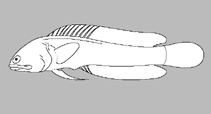 No image available for this species;
drawing shows typical species in Opistognathidae.
Google Bild
drawing shows typical species in Opistognathidae.
Klassifizierung / Names Namen | Synonyme | Catalog of Fishes(Gattung, Arten) | ITIS | CoL | WoRMS | Cloffa
> Ovalentaria/misc (Various families in series Ovalentaria) > Opistognathidae (Jawfishes)
Etymology: Stalix: Greek, stalix, -ikos = a stake used for holding nets (Ref. 45335); albonotata: Named for the fine white vermiculation on the body and the irregular white blotches on the dorsal fin of this species.
Etymology: Stalix: Greek, stalix, -ikos = a stake used for holding nets (Ref. 45335); albonotata: Named for the fine white vermiculation on the body and the irregular white blotches on the dorsal fin of this species.
Umwelt: Milieu / Klimazone / Tiefenbereich / Verbreitungsgebiet Ökologie
seewasser riff-verbunden; tiefenbereich 7 - 18 m (Ref. 137491). Temperate
Verbreitung Territorien | FAO Gebiete | Ökosysteme | Vorkommen | Punkt Karte | Einführungen | Faunafri
Northwest Pacific: Japan (Ryukyu Is.).
Größe / Gewicht / Alter
Kurzbeschreibung Bestimmungsschlüssel | Morphologie | Morphometrie
Rückenflossenstacheln (insgesamt) : 11; Rückenflossenweichstrahlen (insgesamt) : 11; Afterflossenstacheln: 2; Afterflossenweichstrahlen: 11. This species is distinguished by the following characters: D 11; pectoral fin 22-23; longitudinal scale rows 45-46; gill rakers on first gill arch of adults 15-16 + 25-26 = 40-42; orbit diameter 10.0-10.4 % of SL; sensory pores 2 (I4 and I5) present on the posterior half of the interorbital space; first 2 mandibular pores (M1 and M2) well-spaced, fifth pore (M5) with single opening;
lateral line terminating below the 2nd or 3rd dorsal-fin soft ray base (dorsal fin element 13 or 14); distal incision of 3rd to 5th dorsal-fin spines is moderate; anteroventral margin of upper lip crenulate. Colouration: body grayish-yellow, with fine brown and white vermiculations; lateral surface of the head grayish green, with rough gray vermiculation; dorsal-fin membrane is grayish-yellow, with several irregular white blotches when fresh; anterior gular region not pigmented (chin and area adjacent to anterior two mandibular pores with a few scattered melanophores (Ref. 137491).
Body shape (shape guide): elongated; Cross section: compressed.
Body shape (shape guide): elongated; Cross section: compressed.
Specimens were collected by handnet in an inner bay of the type locality with silty sand bottom. The paratype was also observed with five gobioids, Myersina nigrivirgata, Oplopomus oplopomus, Oxyurichthys papuensis, Taenioides kentalleni, and unidentified Tomiyamichthys species (Ref. 137491).
Lebenszyklus und Paarungsverhalten Geschlechtsreife | Fortpflanzung | Ablaichen | Eier | Fruchtbarkeit | Larven
Hauptreferenz
Laden Sie Ihre Referenzen hoch | Referenzen | Koordinator | Partner
Wada, H., T. Kobayashi, H. Suzuki and H. Senou, 2025. Two new jawfishes, Stalix albonotata sp. nov. and S. yanoi sp. nov., from the Ryukyu Islands, Japan (Perciformes: Opistognathidae). Bull. of the Kanagawa Prefectural Mus. (Natural Science) (54):205-217, (Ref. 137491)
CITES
Not Evaluated
Bedrohung für Menschen
Harmless
Nutzung durch Menschen
Fischereien: nicht kommerziell
FAO - Publication: search | FishSource |
Mehr Information
Trophische Ökologie
Lebensmittel (Beutetiere)
Nahrungszusammensetzung
Nahrungsaufnahme
Lebensmittelrationen
Räuber
Lebensmittel (Beutetiere)
Nahrungszusammensetzung
Nahrungsaufnahme
Lebensmittelrationen
Räuber
Ökologie
Ökologie
Ökologie
Populationsdynamik
Wachstumsparameter
Max. Alter/Größen
Länge-Gewicht-Rel.
Länge-Länge-Verhältnis.
Längenhäufigkeiten
Massenkonvertierung
Rekrutierung
Dichte
Wachstumsparameter
Max. Alter/Größen
Länge-Gewicht-Rel.
Länge-Länge-Verhältnis.
Längenhäufigkeiten
Massenkonvertierung
Rekrutierung
Dichte
Lebenszyklus
Fortpflanzung
Geschlechtsreife
Reifung/Kiemen rel.
Fruchtbarkeit
Ablaichen
Laichaggregationen
Eier
Eientwicklung
Larven
Larven Pop.Dyn.
Fortpflanzung
Geschlechtsreife
Reifung/Kiemen rel.
Fruchtbarkeit
Ablaichen
Laichaggregationen
Eier
Eientwicklung
Larven
Larven Pop.Dyn.
Anatomie
Kiemenoberfläche
Gehirn
Otolith
Kiemenoberfläche
Gehirn
Otolith
Physiologie
Körperliche Zusammensetzung
Nährstoffe
Sauerstoffverbrauch
Schwimmart
Schwimmgeschwindigkeit
Visuelle Pigmente
Fischgeräusche
Krankheiten und Parasiten
Toxizität (LC50s)
Körperliche Zusammensetzung
Nährstoffe
Sauerstoffverbrauch
Schwimmart
Schwimmgeschwindigkeit
Visuelle Pigmente
Fischgeräusche
Krankheiten und Parasiten
Toxizität (LC50s)
Genetik
Genom
Genetik
Heterozygotie
Vererbbarkeit
Genetische Vielfalt
Genom
Genetik
Heterozygotie
Vererbbarkeit
Genetische Vielfalt
Menschenbezogen
Aquakultur-Systeme
Aquakultur Profile
Zuchtlinien
Ciguatera-Fälle
Briefmarken, Münzen, Verschiedenes.
Aquakultur-Systeme
Aquakultur Profile
Zuchtlinien
Ciguatera-Fälle
Briefmarken, Münzen, Verschiedenes.
Tools
Zusatzinformationen
Download XML
Zusammenfassung | Punktdaten | Namen | Photos
Internet Quellen
AFORO (otoliths) | Aquatic Commons | BHL | Cloffa | Websites from users | FishWatcher Einträge suchen | CISTI | Catalog of Fishes: Gattung, Arten | DiscoverLife | ECOTOX | FAO - Publication: search | Faunafri | Fishipedia | Fishtrace | GloBI | Google Books | Google Scholar | Google | IGFA World Record | OneZoom | Open Tree of Life | Otolith Atlas of Taiwan Fishes | PubMed | Reef Life Survey | Socotra Atlas | TreeBase | Tree of Life | Wikipedia: Gehe zu, Suchen | World Records Freshwater Fishing | Zoobank | Zoologischer Rekord
Schätzungen auf der Grundlage von Modellen
Phylogenetischer Diversitätsindex (Ref. 82804): PD50 = 0.5001 [Uniqueness, from 0.5 = low to 2.0 = high].
Bayesian length-weight: a=0.00389 (0.00180 - 0.00842), b=3.12 (2.94 - 3.30), in cm total length, based on all LWR estimates for this body shape (Ref. 93245).
Trophische Ebene (Ref. 69278): 3.2 ±0.5 se; based on size and trophs of closest relatives