



Cambeva luteoreticulata Costa, Feltrin & Katz, 2024
Hochladen Photos und videos
Google Bild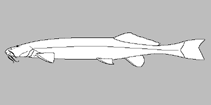 No image available for this species;
drawing shows typical species in Trichomycteridae.
Google Bild
drawing shows typical species in Trichomycteridae.
Klassifizierung / Names Namen | Synonyme | Catalog of Fishes(Gattung, Arten) | ITIS | CoL | WoRMS | Cloffa
> Siluriformes (Catfishes) > Trichomycteridae (Pencil or parasitic catfishes) > Trichomycterinae
Etymology: Cambeva: Probably derived from the Tupi-Guarani, is a popular name for trichomycterid fishes in southern and south-eastern Brazil (Ref. 119381); luteoreticulata: Name 'luteoreticulata' from the Latin words 'luteus' and 'reticulata', meaning 'yellow' and 'reticulated', in reference to the flank colour pattern of adult specimens.
Etymology: Cambeva: Probably derived from the Tupi-Guarani, is a popular name for trichomycterid fishes in southern and south-eastern Brazil (Ref. 119381); luteoreticulata: Name 'luteoreticulata' from the Latin words 'luteus' and 'reticulata', meaning 'yellow' and 'reticulated', in reference to the flank colour pattern of adult specimens.
Umwelt: Milieu / Klimazone / Tiefenbereich / Verbreitungsgebiet Ökologie
; süßwasser demersal. Subtropical
Verbreitung Territorien | FAO Gebiete | Ökosysteme | Vorkommen | Punkt Karte | Einführungen | Faunafri
South America: Brazil.
Größe / Gewicht / Alter
Kurzbeschreibung Bestimmungsschlüssel | Morphologie | Morphometrie
Rückenflossenstacheln (insgesamt) : 2; Rückenflossenweichstrahlen (insgesamt) : 7; Afterflossenstacheln: 2; Afterflossenweichstrahlen: 5; Wirbelzahl: 38 - 40. This species is distinguished from its congeners by the following set of characters: unique rounded, stapula-shaped caudal fin in specimens above about 40 mm SL; short barbels, with the nasal barbel not reaching the orbit in specimens above 60 mm SL and maxillary and rictal barbels not reaching the interopercular patch of odontodes; anterior segment of the infraorbital series absent; procurrent caudal-fin rays 21 or 22 dorsal and 15 or 16 ventral; opercular odontodes 10-12; hypertrophied papillae on the head surface absent; narrow nasal barbel; unique pattern of ontogenetic colouration change consisting of flank pale yellow with irregularly shaped and arranged; dark brown to black blotches in specimens below about 40 mm SL, dark brown, with small, irregularly shaped pale yellow marks forming reticulate pattern in larger specimens; 7 pectoral-fin rays; anterior infraorbital absent; posterior margin of the caudal fin convex; pectoral-fin filament absent; 9 or 10 opercular odontodes; 29-32 interopercular odontodes; 15 or 16 ventral procurrent caudal-fin rays; dorsal-fin origin at a vertical through the centrum of the 21st or 22nd vertebra; jaw teeth incisiform, teeth arranged in rows; and 38-–40 vertebrae (Ref. 137708).
Body shape (shape guide): elongated; Cross section: oval.
Body shape (shape guide): elongated; Cross section: oval.
Lebenszyklus und Paarungsverhalten Geschlechtsreife | Fortpflanzung | Ablaichen | Eier | Fruchtbarkeit | Larven
Hauptreferenz
Laden Sie Ihre Referenzen hoch | Referenzen | Koordinator : Pinna, Mário de | Partner
Costa, W.J.E.M., C.R.M Feltrin, J.L.O Mattos and A.M. Katz, 2024. Top mountain areas of subtropical southern Brazil sheltering four new small-ranged catfishes (Siluriformes, Trichomycteridae): relationships and taxonomy. Evolutionary Systematics. 8:199-218. (Ref. 137708)
CITES
Not Evaluated
Bedrohung für Menschen
Harmless
Nutzung durch Menschen
Fischereien: nicht kommerziell
FAO - Publication: search | FishSource |
Mehr Information
Trophische Ökologie
Lebensmittel (Beutetiere)
Nahrungszusammensetzung
Nahrungsaufnahme
Lebensmittelrationen
Räuber
Lebensmittel (Beutetiere)
Nahrungszusammensetzung
Nahrungsaufnahme
Lebensmittelrationen
Räuber
Ökologie
Ökologie
Ökologie
Populationsdynamik
Wachstumsparameter
Max. Alter/Größen
Länge-Gewicht-Rel.
Länge-Länge-Verhältnis.
Längenhäufigkeiten
Massenkonvertierung
Rekrutierung
Dichte
Wachstumsparameter
Max. Alter/Größen
Länge-Gewicht-Rel.
Länge-Länge-Verhältnis.
Längenhäufigkeiten
Massenkonvertierung
Rekrutierung
Dichte
Lebenszyklus
Fortpflanzung
Geschlechtsreife
Reifung/Kiemen rel.
Fruchtbarkeit
Ablaichen
Laichaggregationen
Eier
Eientwicklung
Larven
Larven Pop.Dyn.
Fortpflanzung
Geschlechtsreife
Reifung/Kiemen rel.
Fruchtbarkeit
Ablaichen
Laichaggregationen
Eier
Eientwicklung
Larven
Larven Pop.Dyn.
Anatomie
Kiemenoberfläche
Gehirn
Otolith
Kiemenoberfläche
Gehirn
Otolith
Physiologie
Körperliche Zusammensetzung
Nährstoffe
Sauerstoffverbrauch
Schwimmart
Schwimmgeschwindigkeit
Visuelle Pigmente
Fischgeräusche
Krankheiten und Parasiten
Toxizität (LC50s)
Körperliche Zusammensetzung
Nährstoffe
Sauerstoffverbrauch
Schwimmart
Schwimmgeschwindigkeit
Visuelle Pigmente
Fischgeräusche
Krankheiten und Parasiten
Toxizität (LC50s)
Genetik
Genom
Genetik
Heterozygotie
Vererbbarkeit
Genetische Vielfalt
Genom
Genetik
Heterozygotie
Vererbbarkeit
Genetische Vielfalt
Menschenbezogen
Aquakultur-Systeme
Aquakultur Profile
Zuchtlinien
Ciguatera-Fälle
Briefmarken, Münzen, Verschiedenes.
Aquakultur-Systeme
Aquakultur Profile
Zuchtlinien
Ciguatera-Fälle
Briefmarken, Münzen, Verschiedenes.
Tools
Zusatzinformationen
Download XML
Zusammenfassung | Punktdaten | Namen | Photos
Internet Quellen
AFORO (otoliths) | Aquatic Commons | BHL | Cloffa | Websites from users | FishWatcher Einträge suchen | CISTI | Catalog of Fishes: Gattung, Arten | DiscoverLife | ECOTOX | FAO - Publication: search | Faunafri | Fishipedia | Fishtrace | GloBI | Google Books | Google Scholar | Google | IGFA World Record | OneZoom | Open Tree of Life | Otolith Atlas of Taiwan Fishes | PubMed | Reef Life Survey | Socotra Atlas | TreeBase | Tree of Life | Wikipedia: Gehe zu, Suchen | World Records Freshwater Fishing | Zoobank | Zoologischer Rekord
Schätzungen auf der Grundlage von Modellen
Phylogenetischer Diversitätsindex (Ref. 82804): PD50 = 0.5000 [Uniqueness, from 0.5 = low to 2.0 = high].
Bayesian length-weight: a=0.00759 (0.00337 - 0.01709), b=3.00 (2.81 - 3.19), in cm total length, based on LWR estimates for this (Sub)family-body shape (Ref. 93245).
Trophische Ebene (Ref. 69278): 3.2 ±0.4 se; based on size and trophs of closest relatives