



Beobachtung melden im Fish Watcher
| Native range | All suitable habitat | Point map | Year 2050 |

|
| This map was computer-generated and has not yet been reviewed. |
| Oxynotus centrina AquaMaps Data sources: GBIF OBIS |
Klassifizierung / Names Namen | Synonyme | Catalog of Fishes(Gattung, Arten) | ITIS | CoL | WoRMS | Cloffa
Elasmobranchii (Haie und Rochen) (sharks and rays) > Squaliformes (Sleeper and dogfish sharks) > Oxynotidae (Rough sharks)
Etymology: Oxynotus: oxys (Gr.), sharp; notos (Gr.), back, referring to its keeled back (“dorso carenato”) (See ETYFish); centrina: From “Centrina,” name for this shark dating to at least Giovio’s De romanis piscibus (1524), presumably derived from centrum (L.), prickle or sharp point, referring to spines on both dorsal fins (See ETYFish).
More on author: Linnaeus.
Etymology: Oxynotus: oxys (Gr.), sharp; notos (Gr.), back, referring to its keeled back (“dorso carenato”) (See ETYFish); centrina: From “Centrina,” name for this shark dating to at least Giovio’s De romanis piscibus (1524), presumably derived from centrum (L.), prickle or sharp point, referring to spines on both dorsal fins (See ETYFish).
More on author: Linnaeus.
Umwelt: Milieu / Klimazone / Tiefenbereich / Verbreitungsgebiet Ökologie
seewasser bathydemersal; tiefenbereich 60 - 1309 m (Ref. 128029). Deep-water; 70°N - 17°S, 25°W - 36°E (Ref. 54693)
Verbreitung Territorien | FAO Gebiete | Ökosysteme | Vorkommen | Punkt Karte | Einführungen | Faunafri
Eastern Atlantic: Bay of Biscay and Mediterranean Sea to Senegal, north to Cornwall, England (apparently as a stray). Compagno et al. (Ref. 5578) reports this species as ranging south to Cape Point, South Africa but Springer 1990 (Ref. 10718) notes Bass et al. 1976 as considering specimens from Walvis Bay distinct from Oxynotus centrina calling attention to the considerably greater distance between dorsal fins in Mediterranean specimens than in specimens taken south of the equator.
Länge bei der ersten Reifung / Größe / Gewicht / Alter
Geschlechtsreife: Lm ?, range 50 - ? cm
Max length : 150 cm TL Männchen/unbestimmt; (Ref. 247); common length : 55.0 cm TL Männchen/unbestimmt; (Ref. 26999)
Max length : 150 cm TL Männchen/unbestimmt; (Ref. 247); common length : 55.0 cm TL Männchen/unbestimmt; (Ref. 26999)
Kurzbeschreibung Bestimmungsschlüssel | Morphologie | Morphometrie
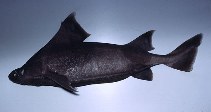
Rückenflossenstacheln (insgesamt) : 2; Afterflossenstacheln: 0. A small bizarre-looking shark with an unmistakable high body and bristly textured skin (Ref. 5578). Uniformly grey to grey-brown (Ref. 5578).
Body shape (shape guide): elongated.
Body shape (shape guide): elongated.
Found on the outer continental shelf and upper slope (Ref. 5578). Depth range from 60-660 m (Ref. 247) and from 549-777 m in the eastern Ionian Sea (Ref. 56504), and 818-1309 m NW Africa (Ref. 128029). Feeds on polychaetes (Ref. 247) and sipunculids (apparenly a suction feeder which mainly feeds on worm-like prey), which are rapidly digested, and the rapid gastric evacuation could partially explain the vacuity of several guts; teleosts, crustaceans and echinoderms are considered as accessory prey items, thus recorded predation on egg cases of the smallspotted catshark Scyliorhinus canicula remains an occasional phenomenon (Ref. 81816). Ovoviviparous (Ref. 205). Utilized for fishmeal, oil, and smoked and dried salted for human consumption (Ref. 247).
Lebenszyklus und Paarungsverhalten Geschlechtsreife | Fortpflanzung | Ablaichen | Eier | Fruchtbarkeit | Larven
Ovoviviparous, without a placenta, with about 7 or 8 young in a litter (Ref. 247). Distinct pairing with embrace (Ref. 205).
Hauptreferenz
Laden Sie Ihre Referenzen hoch | Referenzen | Koordinator | Partner
Compagno, L.J.V., 1984. FAO Species Catalogue. Vol. 4. Sharks of the world. An annotated and illustrated catalogue of shark species known to date. Part 1 - Hexanchiformes to Lamniformes. FAO Fish. Synop. 125(4/1):1-249. Rome, FAO. (Ref. 247)
IUCN Rote Liste Status (Ref. 130435: Version 2025-2 (Global))
stark gefährdet (EN) (A2d); Date assessed: 31 August 2020
CITES
Not Evaluated
Bedrohung für Menschen
Harmless
Nutzung durch Menschen
Fischereien: weniger kommerziell
FAO - Fischereien: landungen, Artbeschreibung; Publication: search | FishSource | Das Meer um uns herum
Mehr Information
Trophische Ökologie
Lebensmittel (Beutetiere)
Nahrungszusammensetzung
Nahrungsaufnahme
Lebensmittelrationen
Räuber
Lebensmittel (Beutetiere)
Nahrungszusammensetzung
Nahrungsaufnahme
Lebensmittelrationen
Räuber
Populationsdynamik
Wachstumsparameter
Max. Alter/Größen
Länge-Gewicht-Rel.
Länge-Länge-Verhältnis.
Längenhäufigkeiten
Massenkonvertierung
Rekrutierung
Dichte
Wachstumsparameter
Max. Alter/Größen
Länge-Gewicht-Rel.
Länge-Länge-Verhältnis.
Längenhäufigkeiten
Massenkonvertierung
Rekrutierung
Dichte
Lebenszyklus
Fortpflanzung
Geschlechtsreife
Reifung/Kiemen rel.
Fruchtbarkeit
Ablaichen
Laichaggregationen
Eier
Eientwicklung
Larven
Larven Pop.Dyn.
Fortpflanzung
Geschlechtsreife
Reifung/Kiemen rel.
Fruchtbarkeit
Ablaichen
Laichaggregationen
Eier
Eientwicklung
Larven
Larven Pop.Dyn.
Anatomie
Kiemenoberfläche
Gehirn
Otolith
Kiemenoberfläche
Gehirn
Otolith
Physiologie
Körperliche Zusammensetzung
Nährstoffe
Sauerstoffverbrauch
Schwimmart
Schwimmgeschwindigkeit
Visuelle Pigmente
Fischgeräusche
Krankheiten und Parasiten
Toxizität (LC50s)
Körperliche Zusammensetzung
Nährstoffe
Sauerstoffverbrauch
Schwimmart
Schwimmgeschwindigkeit
Visuelle Pigmente
Fischgeräusche
Krankheiten und Parasiten
Toxizität (LC50s)
Menschenbezogen
Aquakultur-Systeme
Aquakultur Profile
Zuchtlinien
Ciguatera-Fälle
Briefmarken, Münzen, Verschiedenes.
Aquakultur-Systeme
Aquakultur Profile
Zuchtlinien
Ciguatera-Fälle
Briefmarken, Münzen, Verschiedenes.
Tools
E-Book | Feldführer | Bestimmungsschlüssel | Längenhäufigkeits Tool | Lebensdaten Tool | Punkt Karte |
Catch-MSY |
Zusatzinformationen
Download XML
Zusammenfassung | Punktdaten | Namen | Photos
Internet Quellen
AFORO (otoliths) | Aquatic Commons | BHL | Cloffa | Websites from users | FishWatcher Einträge suchen | CISTI | Catalog of Fishes: Gattung, Arten | DiscoverLife | ECOTOX | FAO - Fischereien: landungen, Artbeschreibung; Publication: search | Faunafri | Fishipedia | Fishtrace | GloBI | Google Books | Google Scholar | Google | IGFA World Record | Nationale Datenbanken | OneZoom | Open Tree of Life | Otolith Atlas of Taiwan Fishes | PubMed | Reef Life Survey | Socotra Atlas | TreeBase | Tree of Life | Wikipedia: Gehe zu, Suchen | World Records Freshwater Fishing | Zoologischer Rekord
Schätzungen auf der Grundlage von Modellen
Bevorzugte Temperatur (Ref. 123201): 9.5 - 15.3, mean 13.3 °C (based on 283 cells).
Phylogenetischer Diversitätsindex (Ref. 82804): PD50 = 0.5625 [Uniqueness, from 0.5 = low to 2.0 = high].
Bayesian length-weight: a=0.00363 (0.00158 - 0.00837), b=3.15 (2.94 - 3.36), in cm total length, based on LWR estimates for this (Sub)family-body shape (Ref. 93245).
Trophische Ebene (Ref. 69278): 3.1 ±0.3 se; based on diet studies.
Widerstandsfähigkeit (Ref. 120179): sehr niedrig, Verdopplung der Population dauert mehr als 14 Jahre. (Fec=7).
Nährstoffe (Ref. 124155): Calcium = 5.91 [1.03, 31.36] mg/100g; Iron = 0.271 [0.065, 0.929] mg/100g; Protein = 18.7 [16.8, 20.5] %; Omega3 = 0.229 [0.074, 0.746] g/100g; Selenium = 18.8 [5.3, 65.9] μg/100g; VitaminA = 5.9 [1.1, 30.1] μg/100g; Zinc = 0.392 [0.185, 0.747] mg/100g (wet weight);