>
Gobiiformes (Gobies) >
Gobiidae (Gobies) > Gobiinae
Etymology: Valenciennea: From Achille Valenciennes 1794-1865; he worked with Duméril, Cuvier and Lacepède since 1815; malacologist, author of a "Histoire naturelle des poissons" (Ref. 45335).
Eponymy: Achille Valenciennes (1794–1865) was a French zoologist; primarily an ichthyologist and conchologist. [...] (Ref. 128868), visit book page.
More on author: Valenciennes.
Environment: milieu / Klimaatzone / Diepte / distribution range
Ecologie
marien rifbewoner; diepte 1 - 15 m (Ref. 90102). Tropical; 30°N - 24°S
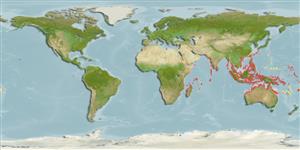
Indo-West Pacific: widely distributed in the eastern Indian Ocean and western tropical Pacific.
Lengte bij maturiteit / Grootte / Gewicht / Leeftijd
Maturiteit: Lm 5.4 range ? - ? cm
Max length : 16.0 cm SL mannelijk / geslacht onbekend; (Ref. 48637); max. gerapporteerde leeftijd: 0.75 Jaren (Ref. 56281)
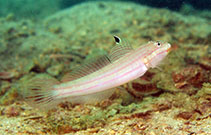
Dorsale stekels (totaal) : 7; Dorsale zachte stralen (totaal) : 12; Anale stekels: 1; Anale zachte stralen: 12. Has 2 to 3 blue-bordered red longitudinal stripes on the head that extends faintly on the body, as well as red basal stripes on the dorsal and anal fins, a dark tip on the first dorsal fin, and red ocelli on the caudal fin; characterized further by pale grey body color on back, grading to white on lower side; without filamentous dorsal spines; rhomboid caudal fin, longer than head; length of caudal fin 2.8-3.5 in SL; longitudinal scale series 73-94; ctenoid body scales, becoming cycloid anteriorly below anterior part of fist of first dorsal fin; head or midline of nape without scales; side of nape with scales extending forward above middle to front of operculum; base of pectoral fin scaleless; usually partly scaled prepelvic area in adult; depth of body 5.1-6.2 in SL (Ref. 90102).
Body shape (shape guide): elongated.
Inhabits shallow coastal sand and rubble flats, often near mangroves (Ref. 48637). Occur in areas of fine sand in shallow lagoon reefs. Adults occur in pairs while juveniles were often seen in small groups. Feed on small invertebrates by sifting mouthfuls of sand. Monogamous (Ref. 52884). Oviparous (Ref. 205). Breeding pairs are commonly found sharing a single burrow (Ref. 56281).
Levenscyclus en paargedrag
Maturiteit | Voortplanting | Paaien | Eieren | Fecunditeit | Larven
Oviparous, distinct pairing during breeding (Ref. 205). Pairs form upon maturation for breeding purposes (Ref. 56281, 58559). Monogamous mating is observed as both obligate and social (Ref. 52884).
Hoese, D.F. and H.K. Larson, 1994. Revision of the Indo-Pacific gobiid fish genus Valenciennea, with descriptions of seven new species. Indo-Pac. Fish. (23):71 p. (Ref. 8527)
Status op de Rode Lijst van het IUCN (Ref. 130435: Version 2025-1)
Gevaar voor de mens
Harmless
Gebruik door de mens
Visserij: commercieel; Aquarium: Commercieel
Tools
Speciale rapporten
Download XML
Internetbronnen
Estimates based on models
Preferred temperature (Ref.
123201): 25.4 - 29.3, mean 28.6 °C (based on 2988 cells).
Fylogenetische diversiteitsindex (Ref.
82804): PD
50 = 0.5000 [Uniqueness, from 0.5 = low to 2.0 = high].
Bayesian length-weight: a=0.00676 (0.00404 - 0.01131), b=3.03 (2.89 - 3.17), in cm total length, based on LWR estimates for this species & (Sub)family-body (Ref.
93245).
Trofisch niveau (Ref.
69278): 3.5 ±0.37 se; based on food items.
Generation time: 0.4 ( na - na) years. Estimated as median ln(3)/K based on 2
growth studies.
Weerstandsvermogen (Ref.
120179): Hoog, minimale populatieverdubbelingstijd minder dan 15 maanden (Preliminary K or Fecundity.).
Fishing Vulnerability (Ref.
59153): Low vulnerability (10 of 100).
🛈
Nutrients (Ref.
124155): Calcium = 163 [78, 439] mg/100g; Iron = 1.44 [0.62, 2.88] mg/100g; Protein = 18.9 [16.8, 20.8] %; Omega3 = 0.127 [0.048, 0.327] g/100g; Selenium = 48.1 [17.0, 126.1] μg/100g; VitaminA = 28.2 [6.1, 118.0] μg/100g; Zinc = 2.32 [1.33, 3.79] mg/100g (wet weight);