>
Anguilliformes (Eels and morays) >
Muraenidae (Moray eels) > Muraeninae
Etymology: Gymnothorax: Greek, gymnos = naked + Greek, thorax, -akos = breast (Ref. 45335).
More on author: Cuvier.
Environment: milieu / Zona climática / intervalo de profundidade / distribution range
Ecologia
marinhas associadas(os) a recifes; intervalo de profundidade 0 - 200 m (Ref. 9710), usually 0 - 35 m (Ref. 40849). Subtropical; 37°N - 26°S, 98°W - 5°W
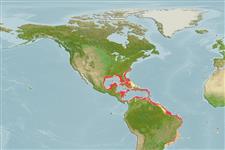
Western Atlantic: North Carolina, USA and Bermuda to Brazil, including the Gulf of Mexico, the Caribbean to southeastern Brazil. Eastern Atlantic: Ascension and St. Helena (Ref. 4450). Mid- and eastern Atlantic islands (Ref. 26938).
Tamanho / Peso / Idade
Maturidade: Lm ? range ? - ? cm
Max length : 200 cm TL macho/indeterminado; (Ref. 57911); common length : 60.0 cm TL macho/indeterminado; (Ref. 5217); peso máx. publicado: 2.5 kg (Ref. 40637)
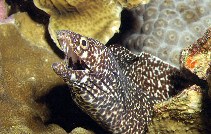
Moderate-size moray with a pattern of distinct small, round, overlapping dark brownish to purplish-black spots on white or pale yellow background (Ref. 26938).
Body shape (shape guide): eel-like.
A benthic and solitary species (Ref. 26340) abundant in shallow rocky and grassy areas and on coral reefs; less common in turbid bays or harbors. Its bite is very dangerous (Ref. 5217). Active during the day, sometimes together with other predators. Feeds on fish and crustaceans (Ref. 42064). Usually seen with its head protruding from a hole and the rest of its body concealed (Ref. 26938). Observed to be unusually aggressive towards man (Ref. 86997). It has been traded as aquarium fish at Ceará, Brazil (Ref. 49392). Marketed fresh and salted (Ref. 5217).
Ciclo de vida ou comportamento de acasalamento
Maturidade | Reprodução | Desova | Ovos | Fecundidade | Larvas
Spawning migrations, leptocephalus larvae.
Robins, C.R. and G.C. Ray, 1986. A field guide to Atlantic coast fishes of North America. Houghton Mifflin Company, Boston, U.S.A. 354 p. (Ref. 7251)
Status na Lista Vermelha da UICN (Ref. 130435: Version 2025-1)
Ameaça para os humanos
Traumatogenic (Ref. 5217)
Uso pelos humanos
Pescarias: pouco comercial; Aquário: Espécies comerciais
Ferramentas
Relatórios especiais
Baixar XML
Fontes da internet
Estimates based on models
Preferred temperature (Ref.
123201): 23.3 - 28, mean 26.5 °C (based on 630 cells).
Índice de diversidade filogenética (Ref.
82804): PD
50 = 0.5000 [Uniqueness, from 0.5 = low to 2.0 = high].
Bayesian length-weight: a=0.00056 (0.00037 - 0.00085), b=3.27 (3.15 - 3.39), in cm total length, based on LWR estimates for this species & Genus-body shape (Ref.
93245).
Nível Trófico (Ref.
69278): 4.5 ±0.8 se; based on diet studies.
Resiliência (Ref.
120179): Baixo, tempo mínimo de duplicação da população 4,5 - 14 anos (Assuming tmax>10).
Fishing Vulnerability (Ref.
59153): Very high vulnerability (90 of 100).
🛈
Nutrients (Ref.
124155): Calcium = 10.1 [4.9, 20.1] mg/100g; Iron = 0.399 [0.211, 0.819] mg/100g; Protein = 19.5 [17.2, 22.0] %; Omega3 = 0.161 [0.064, 0.501] g/100g; Selenium = 32.8 [15.0, 68.8] μg/100g; VitaminA = 41.4 [10.9, 160.5] μg/100g; Zinc = 0.431 [0.281, 0.657] mg/100g (wet weight);