



Masukkan pemerhatian anda di Fish Watcher
| Native range | All suitable habitat | Point map | Year 2050 |

|
| This map was computer-generated and has not yet been reviewed. |
| Lamna ditropis AquaMaps Data sources: GBIF OBIS |
muatnaik fotos/gambar dan video
Gambar | imej Google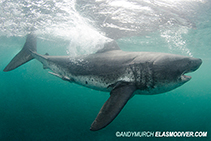 Lamna ditropis
foto/gambar oleh Murch, A.
Gambar | imej Google
foto/gambar oleh Murch, A.
klasifikasi / Nama Nama-nama umum | Sinonim (persamaan) | Catalog of Fishes(Marga, Jenis) | ITIS | CoL | WoRMS | Cloffa
Ikan bertulang rawan (sharks and rays) > Lamniformes (Mackerel sharks) > Lamnidae (Mackerel sharks or white shark)
Etymology: Lamna: From the Greek lamia, a large and voracious shark, originally from Lamia in Greek mythology, daughter of King Belos, who revenged the murder of her children by killing the children of others, and who behaved so cruelly that her face turned into a nightmarish mask (See ETYFish); ditropis: di-, from dis (L.), in two; tropis (Gr.), keel, i.e., double-keeled, referring to the rudder-like projections on either side of tail (See ETYFish).
Eponymy: The genus name comes from the Greek lamia, a large and voracious shark. [...] (Ref. 128868), visit book page.
More on authors: Hubbs & Follett.
Etymology: Lamna: From the Greek lamia, a large and voracious shark, originally from Lamia in Greek mythology, daughter of King Belos, who revenged the murder of her children by killing the children of others, and who behaved so cruelly that her face turned into a nightmarish mask (See ETYFish); ditropis: di-, from dis (L.), in two; tropis (Gr.), keel, i.e., double-keeled, referring to the rudder-like projections on either side of tail (See ETYFish).
Eponymy: The genus name comes from the Greek lamia, a large and voracious shark. [...] (Ref. 128868), visit book page.
More on authors: Hubbs & Follett.
Lingkungan: lingkungan / zona iklim / kisaran kedalaman / jangkauan distribusi Ekologi
laut pelagic-oceanic; oceanodromus (Ref. 87829); kisaran kedalaman 0 - 650 m (Ref. 50550), usually 0 - 152 m (Ref. 55221). Boreal; 66°N - 22°N, 120°E - 115°W
Penyebaran Wilayah | Daerah-daerah FAO | Ekosistem | Kemunculan | peta titik | Introduksi | Faunafri
North Pacific: Japan, Korea, and the Sea of Okhotsk to the Bering Sea and southward to southern California, USA (Ref. 247) and Baja California, Mexico (Ref. 9253).
Panjang pada saat jatuh tempo pertama / Ukuran / Berat / umur
Kematangan: Lm ? range ? - 221 cm
Max length : 305 cm TL jantan/; (Ref. 247); common length : 180 cm TL jantan/; (Ref. 9988); Berat maksimum terpublikasi: 175.0 kg (Ref. 9988); Umur maksimum dilaporkan: 27 Tahun (Ref. 119696)
Max length : 305 cm TL jantan/; (Ref. 247); common length : 180 cm TL jantan/; (Ref. 9988); Berat maksimum terpublikasi: 175.0 kg (Ref. 9988); Umur maksimum dilaporkan: 27 Tahun (Ref. 119696)
deskripsi pendek Kunci identifiaksi (pengenalan) | Morfologi | Morfometrik
Duri punggung (Keseluruhan (total)) : 0; Duri dubur: 0. First dorsal fin uniformly dark, no light rear tip; ventral surface of body white with dusky blotches (Ref. 247).
Body shape (shape guide): fusiform / normal.
Body shape (shape guide): fusiform / normal.
A coastal-littoral and epipelagic shark that prefers boreal to cool temperate waters, from the surface to at least 152 m, and is common in continental offshore waters but range inshore to just off beaches. Occurs singly or in schools or feeding aggregations of several individuals; feeds on fishes (Ref. 247). Seasonally migratory (following food prey) and segregate by age and sex where adults move further north than young (Ref. 58085). Ovoviviparous, embryos feeding on yolk sac and other ova produced by the mother (Ref. 50449). With up to 4 young in a litter (Ref. 247). Fast swimmer (Ref. 9988). Potentially dangerous but has never or seldom been implicated in human attacks (Ref. 247). Causes considerable damage to commercial catches and gear (Ref. 6885). Utilized fresh, dried or salted, and frozen; fins, hides and livers are also used, with fins having particular value; can be broiled and baked (Ref. 9988). Reported to attain at least 27 years of age and reach maximum depth of at least 792 m (in Ref. 119696).
Siklus hidup dan perilaku kawin Kematangan | Reproduksi, perkembang biakan | Pemijahan | telur-telur | Fekunditas | Larva
Exhibit ovoviparity (aplacental viviparity), with embryos feeding on other ova produced by the mother (oophagy) after the yolk sac is absorbed (Ref. 50449). Litter size is up to 4 young (Ref. 247). Distinct pairing with embrace (Ref. 205).
rujukan utama
Unggah referensi Anda | Acuan | Koordinator : Compagno, Leonard J.V. | mitra
Compagno, L.J.V., 1984. FAO Species Catalogue. Vol. 4. Sharks of the world. An annotated and illustrated catalogue of shark species known to date. Part 1 - Hexanchiformes to Lamniformes. FAO Fish. Synop. 125(4/1):1-249. Rome, FAO. (Ref. 247)
Status IUCN Red List (Ref. 130435: Version 2025-2 (Global))
kurang bimbang (LC) ; Date assessed: 06 November 2018
CITES
Not Evaluated
ancaman kepada manusia
Traumatogenic
penggunaan manusia
Perikanan: nilai komersial kecil; Ikan buruan: ya
FAO - Perikanan: profail spesis; Publication: search | FishSource |
informasi lanjut
Dinamika populasi
Parameter pertumbuhan
Maks. usia / ukuran
Panjang-berat rel.
Panjang-panjang rel.
ukuran frekuensi
Konversi massa
pemulihan
Kelimpahan
Parameter pertumbuhan
Maks. usia / ukuran
Panjang-berat rel.
Panjang-panjang rel.
ukuran frekuensi
Konversi massa
pemulihan
Kelimpahan
Siklus hidup
Reproduksi, perkembang biakan
Kematangan
Kedewasaan / insang rel.
Fekunditas
Pemijahan
Agregasi pemijahan
telur-telur
pekembangan telor
Larva
Dinamika larva
Reproduksi, perkembang biakan
Kematangan
Kedewasaan / insang rel.
Fekunditas
Pemijahan
Agregasi pemijahan
telur-telur
pekembangan telor
Larva
Dinamika larva
Anatomi
Area insang
Otak
Otolith
Area insang
Otak
Otolith
Fisiologi
Komposisi tubuh
Nutrisi
Konsumsi oksigen
Jenis renang
Kecepatan berenang
Pigmen visual
Suara ikan
Penyakit & Parasit
Toksisitas (LC50)
Komposisi tubuh
Nutrisi
Konsumsi oksigen
Jenis renang
Kecepatan berenang
Pigmen visual
Suara ikan
Penyakit & Parasit
Toksisitas (LC50)
Yang berhubungan dengan manusia
Sistem akuakultur
profil budidaya air
Strain
Kasus Ciguatera
Perangko, koin, dll.
Sistem akuakultur
profil budidaya air
Strain
Kasus Ciguatera
Perangko, koin, dll.
Alat, peralatan
E-book | Penuntun lapangan | Kunci identifiaksi (pengenalan) | tanda freqkuenci panjang | peringkat sejarah hidup | peta titik |
Tangkap-MSY |
laporan khas
muat turun XML
Sumber internet
AFORO (otoliths) | Aquatic Commons | BHL | Cloffa | Websites from users | semak peneliti ikan | CISTI | Catalog of Fishes: Marga, Jenis | DiscoverLife | ECOTOX | FAO - Perikanan: profail spesis; Publication: search | Faunafri | Fishipedia | Fishtrace | GloBI | Google Books | Google Scholar | Google | IGFA World Record | OneZoom | Open Tree of Life | Otolith Atlas of Taiwan Fishes | PubMed | Reef Life Survey | Socotra Atlas | TreeBase | Tree of Life | Wikipedia: pergi, Cari | World Records Freshwater Fishing | Zoobank | Catatan Zoologi
Estimasi berdasarkan model
Suhu yang disukai (Acuan 123201): 1.7 - 8.7, mean 4.7 °C (based on 832 cells).
Indeks keanekaragaman filogenetik (Acuan 82804): PD50 = 0.7813 [Uniqueness, from 0.5 = low to 2.0 = high].
Bayesian length-weight: a=0.00933 (0.00410 - 0.02122), b=3.04 (2.84 - 3.24), in cm total length, based on LWR estimates for this (Sub)family-body shape (Ref. 93245).
Tingkat Trofik (Acuan 69278): 4.5 ±0.80 se; based on food items.
Generation time: 6.5 ( na - na) years. Estimated as median ln(3)/K based on 2 growth studies.
Daya lenting (Acuan 120179): sangat rendah, Waktu penggandaan populasi minimum lebih dari 14 tahun (Fec=4).
Nutrisi (Ref. 124155): Calcium = 3.95 [1.03, 23.07] mg/100g; Iron = 0.366 [0.089, 1.235] mg/100g; Protein = 19.5 [17.2, 22.0] %; Omega3 = 0.396 [0.154, 1.000] g/100g; Selenium = 14.3 [3.8, 43.3] μg/100g; VitaminA = 5.42 [1.11, 26.30] μg/100g; Zinc = 0.185 [0.091, 0.353] mg/100g (wet weight);