This website uses cookies to enhance your browsing experience and ensure the functionality of our site. For more detailed information about the types of cookies we use and how we protect your privacy, please visit our Privacy Information page.
×
Cookie Settings
This website uses different types of cookies to enhance your experience. Please select your preferences below:
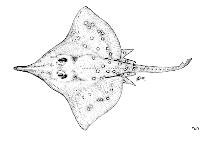
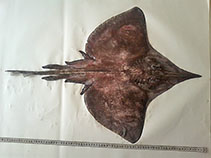
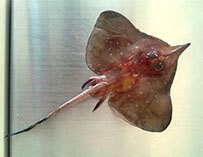
Elasmobranquios (tiburones y rayas) (sharks and rays) > Rajiformes (Skates and rays) > Rajidae (Skates)
Etymology: Dipturus:Greek, di = two + Greek, pteryx = fin (Ref. 45335). More on author: Linnaeus.
Entorno: milieu / zona climática / rango de profundidad / gama de distribución Ecología
marino batidemersal; rango de profundidad 70 - 1461 m (Ref. 114953), usually ? - 200 m (Ref. 114953). Deep-water; 65°N - 11°N, 19°W - 36°E (Ref. 114953)
Eastern Atlantic: central Norway to Senegal, including the Faeroes, Skagerrak, Mediterranean, and the Canary and Madeira islands.
Tamaño / Peso / Edad
Madurez: Lm? range ? - ? cm Max length : 150 cm TL macho / no sexado; (Ref. 4426)
Found in deeper slope waters (Ref. 4426), but mainly around 200 m (Ref. 3167, Ref. 114953). Found on sand and sand-rock bottoms (Ref. 6808). Feeds on all kinds of bottom animals (Ref. 3167), mainly cephalopods and crustaceans (Ref. 114953). Minimum depth reported taken from Ref. 6808. Become sexually mature at a length of about 120 cm (Ref. 35388); young hatch at ca. 17 cm TL (Ref. 114953). Breeds in spring and early summer (Ref. 114953). Oviparous. Distinct pairing with embrace. Young may tend to follow large objects, such as their mother (Ref. 205). Eggs are oblong capsules with stiff pointed horns at the corners deposited in sandy or muddy flats (Ref. 205). Egg capsules are 14.0-23.5 cm long and 11.0-12.0 cm wide (Ref. 41251, 41304).
Ciclo vital y comportamiento de apareamiento Madurez | Reproducción | Puesta | Huevos | Fecundidad | Larva
Oviparous, paired eggs are laid. Embryos feed solely on yolk (Ref. 50449). Egg cases laid from spring to early summer (Ref. 3167). Distinct pairing with embrace. Young may tend to follow large objects, such as their mother (Ref. 205).
Fisiología Composición corporal Nutrientes Consumo del oxígeno Tipo de natación Velocidad de natación Pigmentos visuales Sonido de peces Enfermedades y parásitos Toxicidad (CL50)