



Lägg till din observation i Fish Watcher
| Native range | All suitable habitat | Point map | Year 2050 |

|
| This map was computer-generated and has not yet been reviewed. |
| Raja undulata AquaMaps Data sources: GBIF OBIS |
Ladda upp din foton och Videor
Bilder | Google image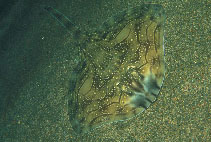 Raja undulata
Bild av Salesjö, A.
Bilder | Google image
Bild av Salesjö, A.
Klassificering / Namn Populärnamn | synonymer | Catalog of Fishes(Släkte, Arter) | ITIS | CoL | WoRMS | Cloffa
Elasmobranchii (hajar och rockor) (sharks and rays) > Rajiformes (Skates and rays) > Rajidae (Skates)
Etymology: Raja: Latin, raja, -ae = a sting ray (Raja sp.) (Ref. 45335).
More on author: Lacepède.
Etymology: Raja: Latin, raja, -ae = a sting ray (Raja sp.) (Ref. 45335).
More on author: Lacepède.
Miljö: miljö / Klimatzon / djupintervall / distributionsområde Ekologi
marina bottenlevande; djupintervall 20 - 200 m (Ref. 6808). Subtropical; 53°N - 10°N, 19°W - 36°E
Utbredning Territorier | FAO områden | Ekosystem | Förekomster | Prickkarta | Utplanteringar | Faunafri
Eastern Atlantic: from the southern British Isles to Guinea-Bissau, and east to Turkey, Mediterranean Sea.
Längd vid första mognad / Storlek / Vikt / Ålder
Found on sandy bottoms of shelf waters (Ref. 3167). Feed on all kinds of bottom animals (Ref. 3167). Oviparous. Distinct pairing with embrace. Young may tend to follow large objects, such as their mother (Ref. 205). Eggs are oblong capsules with stiff pointed horns at the corners deposited in sandy or muddy flats (Ref. 205). Egg capsules are 7.2-9.0 cm long and 4.2-5.2 cm wide (Ref. 41303 , 41251, 41304).
Livscykel och parningsbeteende Könsmognad | Reproduktion | Lek | Ägg | Fekunditet | Larver
Oviparous, paired eggs are laid. Embryos feed solely on yolk (Ref. 50449). Egg-cases laid from March to September (Ref. 3167). Distinct pairing with embrace. Young may tend to follow large objects, such as their mother (Ref. 205).
Huvudreferens
Ladda upp dina referenser | referenser | Koordinator : McEachran, John | Medarbetare
McEachran, J.D. and K.A. Dunn, 1998. Phylogenetic analysis of skates, a morphologically conservative clade of elasmobranchs (Chondrichthyes: Rajidae). Copeia 1998(2):271-290. (Ref. 27314)
Status på IUCN:s rödlista (Ref. 130435: Version 2025-2 (Global))
Near Threatened (NT) (A2bd); Date assessed: 15 April 2023
CITES
Not Evaluated
Hot mot människor
Harmless
Mänskliga användningsområden
Fiskeri: kommersiell; sportfisk: ja
FAO - Publication: search | FishSource | Havet omkring oss
Ytterligare information
Populationsdynamik
Tillväxtparametrar
Max. åldrar / storlekar
Längd-vikt rel.
Längd-längd rel.
Längd-frekvenser
Massakonvertering
Rekrytering
Abundans
Tillväxtparametrar
Max. åldrar / storlekar
Längd-vikt rel.
Längd-längd rel.
Längd-frekvenser
Massakonvertering
Rekrytering
Abundans
Livscykel
Reproduktion
Könsmognad
Mognad/Gills rel.
Fekunditet
Lek
Lekande aggregat
Ägg
Utveckling av ägg
Larver
Larvdynamik
Reproduktion
Könsmognad
Mognad/Gills rel.
Fekunditet
Lek
Lekande aggregat
Ägg
Utveckling av ägg
Larver
Larvdynamik
Fysiologi
Kroppssammansättning
Näringsämnen
Syreförbrukning
Typ av simning
Simhastighet
Visuella pigment
Ljud från fisk
Sjukdomar & Parasiter
Toxicitet (LC50)
Kroppssammansättning
Näringsämnen
Syreförbrukning
Typ av simning
Simhastighet
Visuella pigment
Ljud från fisk
Sjukdomar & Parasiter
Toxicitet (LC50)
Människorelaterad
Vattenbrukssystem
Vattenbruksprofiler
Avelslinjer
Ciguatera-fall
Frimärken, mynt, diverse.
Vattenbrukssystem
Vattenbruksprofiler
Avelslinjer
Ciguatera-fall
Frimärken, mynt, diverse.
Verktyg
Organisk frågesport | E-bok | Fälthandbok | Längdfördelnings-verktyg | Livshistorie-verktyg | Prickkarta |
Fångst-MSY |
Särskilda rapporter
Kontrollera för underhåll av akvarium | Kontrollera om det finns faktablad om arter | Kontrollera om det finns faktablad om vattenbruk
Ladda ner XML
Internet-källor
AFORO (otoliths) | Aquatic Commons | BHL | Cloffa | Websites from users | Check FishWatcher | CISTI | Catalog of Fishes: Släkte, Arter | DiscoverLife | DORIS | ECOTOX | FAO - Publication: search | Faunafri | Fishipedia | Fishtrace | GloBI | Google Books | Google Scholar | Google | IGFA World Record | Nationella databaser | OneZoom | Open Tree of Life | Otolith Atlas of Taiwan Fishes | Offentliga akvarier | PubMed | Reef Life Survey | Socotra Atlas | TreeBase | Tree of Life | Wikipedia: Go, sök | World Records Freshwater Fishing | Zoobank | Zoologiskt register
Uppskattningar baserade på modeller
Önskad temperatur (Ref. 123201): 9.8 - 17.1, mean 13.2 °C (based on 157 cells).
Index för fylogenetisk mångfald (Ref. 82804): PD50 = 0.5000 [Uniqueness, from 0.5 = low to 2.0 = high].
Bayesian length-weight: a=0.00309 (0.00199 - 0.00480), b=3.19 (3.07 - 3.31), in cm total length, based on LWR estimates for this species & Genus-body shape (Ref. 93245).
Trofisk nivå (Ref. 69278): 3.5 ±0.37 se; based on food items.
Resiliens (Ref. 120179): Låg, lägsta populationsfördubblingstid 4,5-14 år (Fec assumed to be <100).
Näringsämnen (Ref. 124155): Calcium = 11.4 [1.5, 220.4] mg/100g; Iron = 0.693 [0.064, 8.306] mg/100g; Protein = 17.2 [14.4, 19.5] %; Omega3 = 0.486 [0.222, 1.080] g/100g; Selenium = 28.1 [5.6, 137.4] μg/100g; VitaminA = 4.78 [0.40, 50.57] μg/100g; Zinc = 0.511 [0.033, 5.798] mg/100g (wet weight);