>
Pleuronectiformes (Flatfishes) >
Cynoglossidae (Tonguefishes) > Cynoglossinae
Etymology: Cynoglossus: Greek, kyon = dog + Greek, odous = teeth + Greek, glossa = tongue (Ref. 45335).
Eponymy: George François de Bruijn (or Bruyn) Kops (1820–1881) was a Dutch naval officer who was a friend of Peter Bleeker and who studied the geology, history and ethnography of the Riau Archipelago. (Ref. 128868), visit book page.
More on author: Bleeker.
Environment: milieu / climate zone / εύρος βάθους / distribution range
Οικολογία
Θαλασσινό(ά) βενθικό(ς); εύρος βάθους 24 - 204 m (Ref. 9494). Tropical
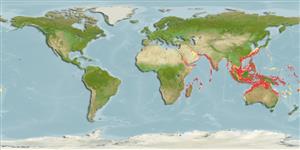
Indo-West Pacific: Persian Gulf to Taiwan.
Μέγεθος / Βάρος / Age
Γεννητική Ωρίμανση: Lm ? range ? - ? cm
Max length : 60.0 cm SL αρσενικό/απροσδιόριστο; (Ref. 48637)
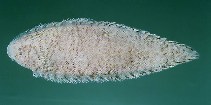
Eyes contiguous, or nearly so (Ref 9895).
Body shape (shape guide): short and / or deep.
Inhabits silty or muddy substrates in coastal waters to about 25 meters depth. Usually deeply burried in the substrate during the day, but out and hunting at night (Ref. 48637).
Life cycle and mating behavior
Γεννητική Ωρίμανση | Αναπαραγωγή | Γεννοβολία | Αβγά | Γονιμότητα | Προνύμφες
Menon, A.G.K., 1977. A systematic monograph of the tongue soles of the genus Cynoglossus Hamilton-Buchanan (Pisces: Cynoglossidae). Smithson. Contrib. Zool. (238):1-129. (Ref. 5297)
IUCN Red List Status (Ref. 130435: Version 2025-1)
Threat to humans
Harmless
Human uses
αλιεία: χωρίς ενδιαφέρον
Εργαλεία
Special reports
Download XML
Διαδικτυακές πηγές
Estimates based on models
Preferred temperature (Αναφ.
123201): 20.5 - 28.1, mean 26 °C (based on 915 cells).
Phylogenetic diversity index (Αναφ.
82804): PD
50 = 0.5000 [Uniqueness, from 0.5 = low to 2.0 = high].
Bayesian length-weight: a=0.01047 (0.00432 - 0.02536), b=3.04 (2.83 - 3.25), in cm total length, based on LWR estimates for this (Sub)family-body shape (Ref.
93245).
Τροφικό Επίπεδο (Αναφ.
69278): 3.6 ±0.4 se; based on size and trophs of closest relatives
Ελαστικότητα (Αναφ.
120179): Μεσαίο(α), ελάχιστος χρόνος για διπλασιασμό πληθυσμού 1,4 - 4,4 έτη (Preliminary K or Fecundity.).
Fishing Vulnerability (Ref.
59153): Moderate to high vulnerability (49 of 100).
🛈