This website uses cookies to enhance your browsing experience and ensure the functionality of our site. For more detailed information about the types of cookies we use and how we protect your privacy, please visit our Privacy Information page.
×
Cookie Settings
This website uses different types of cookies to enhance your experience. Please select your preferences below:
> Eupercaria/misc (Various families in series Eupercaria) > Labridae (Wrasses) > Hypsigenyinae
Etymology: Bodianus:Bodianus after Bodiano or Pudiano, from the Portuguese pudor, meaning modesty (Jordan & Evermann, 1896); perditio:Name from the masculine Latin noun perditis or destruction; referring to the precarious
position in which the vessel 'Astrolabe' found itself around the time the holotype was collected. More on authors: Quoy & Gaimard.
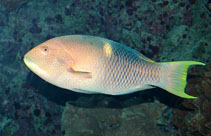
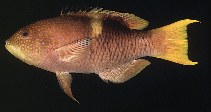
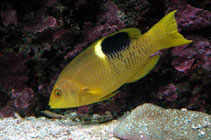
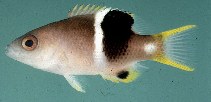
背面の脊椎 (合計) : 12; 背鰭 (合計) : 10; 肛門の骨: 3; 臀鰭: 11. This species is distinguished by the following characters: D XII,10; A III,11; pectoral rays 17; lateral line smoothly curved, following the dorsal contour of body, lateral pored scales 30-31; scales above origin of lateral line to origin of dorsal fin 8; small predorsal scales, becoming embedded anteriorly, ending in posterior interorbital; cheek with a patch of very small scales, posterior to center of eye, except for the broad naked flange of the preopercle; without scales on lower jaw; a broad sheath of scales basally on median fins; total gill rakers 20-23; dorsal profile of snout to above eye is straight, becoming smoothly convex on nape; snout length 2.7-3.0 in head length (HL); orbit diameter varying from 4.7 in HL in an 8.8-cm specimen to 9.3 in a 43.0-cm specimen; mouth is slightly oblique, forming an angle of about 20° to horizontal axis of body, the maxilla reaching to below anterior half of eye; front of jaws with 2 pairs of canine teeth that interdigitate when mouth closed, the middle pair of upper jaw and lateral pair of lower jaw are the largest and recurved, the middle pair of lower jaw about half length of lateral pair; side of jaws with a dental ridge of coalesced teeth bearing a row of small, stout, close-set, conical teeth, of which a series of 5 or 6 in middle of jaws are the largest; toothless palate; labial flaps are well-developed; dorsal spines progressively longer, with the last spine 2.0-2.2 in HL, the membranes deeply incised; 7th or 8th dorsal soft ray longest, 2.0-2.1 in HL; 3rd anal spine longest, about 2.0-2.4 in HL; caudal fin of juveniles is truncate, of adults double emarginate with long pointed lobes; pectoral-fin length of 15.9-32.0 cm SL individuals, 3.4-3.8 in SL, the fin length proportionately longer with growth; pelvic fins just reaching anus in 8.8-cm juvenile, reaching beyond third anal spine in a 36.0-cm adult; diagnostic color differences from B. astrolumbus include the central white bar of the juvenile diminishing to an oval yellow spot above the lateral line (vs. a spindle-shaped whitish to pink mark on the upper body extending below the lateral line (vs. ) and the caudal peduncle of the juvenile with a central white patch surrounded by dark (vs. a white bar extending full width) (Ref. 96378). Body shape (shape guide): fusiform / normal; Cross section: compressed.
This species is reported to be found on deep offshore reefs as adults, but juveniles may occur as shallow as 9 m (Ref. 75973). Also, adults inhabit the vicinity of coral and rocky reefs, often over sand or rubble in deeper water. Feed mainly on benthic invertebrates such as mollusks and crustaceans (Ref. 9823). Oviparous, distinct pairing during breeding (Ref. 205). An excellent food fish (Ref. 3132).
好ましい温度 (参照 123201): 21.6 - 27.8, mean 26.1 °C (based on 183 cells).
系統多様性指数 (参照 82804): PD50 = 0.5000 [Uniqueness, from 0.5 = low to 2.0 = high].
Bayesian length-weight: a=0.01000 (0.00623 - 0.01606), b=3.10 (2.96 - 3.24), in cm total length, based on LWR estimates for this species & Genus-body shape (Ref. 93245).
栄養段階 (参照 69278): 4.1 ±0.0 se; based on diet studies.
回復力 (参照 120179): 非常に低い, 14年以上の倍増期間の最小個体群 (Preliminary K or Fecundity.).
漁業の脆弱性 (Ref. 59153): High vulnerability (59 of 100). 🛈