



Fibramia amboinensis (Bleeker, 1853)
Amboina cardinalfish
Lägg till din observation i Fish Watcher
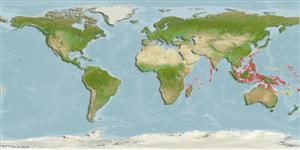
| Native range | All suitable habitat | Point map | Year 2050 |
|
| This map was computer-generated and has not yet been reviewed. |
| Fibramia amboinensis AquaMaps Data sources: GBIF OBIS |
Ladda upp din foton och Videor
Bilder | Google image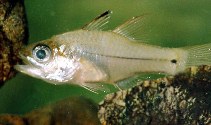 Fibramia amboinensis
Bild av Pöllabauer, C.
Bilder | Google image
Bild av Pöllabauer, C.
Klassificering / Namn Populärnamn | synonymer | Catalog of Fishes(Släkte, Arter) | ITIS | CoL | WoRMS | Cloffa
> Kurtiformes (Nurseryfishes, cardinalfishes.) > Apogonidae (Cardinalfishes) > Apogoninae
Etymology: Fibramia: Latin 'fibra' meaning thread or filament and the feminine Greek 'amia' often applied as an ending for some cardinalfish genera as well as an incorrect past usage as a cardinalfish genus. The name refers to two characteristics of the species in this genus, an elongate second dorsal spine in one species and the narrow, pale or dark mid-line on the body of two species.
More on author: Bleeker.
Etymology: Fibramia: Latin 'fibra' meaning thread or filament and the feminine Greek 'amia' often applied as an ending for some cardinalfish genera as well as an incorrect past usage as a cardinalfish genus. The name refers to two characteristics of the species in this genus, an elongate second dorsal spine in one species and the narrow, pale or dark mid-line on the body of two species.
More on author: Bleeker.
Miljö: miljö / Klimatzon / djupintervall / distributionsområde Ekologi
marina; sötvatten; brackvatten revassocierade; djupintervall 2 - 5 m (Ref. 11890). Tropical; 32°N - 23°S
Utbredning Territorier | FAO områden | Ekosystem | Förekomster | Prickkarta | Utplanteringar | Faunafri
Indo-West Pacific: Zanzibar (Tanzania) eastward to Southeast Asia, and north to Amami-ôshima (Japan) southward to Taiwan, Palau, Philippines and New Guinea east to the Solomon Island and New Caledonia.
Storlek / Vikt / Ålder
Kort beskrivning Bestämningsnycklar | Morfologi | Morfometri
Taggstrålar i ryggfenan (totalt) : 7; Mjukstrålar i ryggfenan (totalt) : 9; Taggstrålar i analfenan: 2; Mjukstrålar i analfenan: 8. Distinguished by having the following characteristics: dorsal-fin rays VI-I, 9; anal-fin rays II, 8; pectoral-fin rays 14; pelvic-fin rays I, 5; pored lateral-line scales 24; predorsal scales 7; circumpeduncular scales 12; total gill rakers 21-22, developed gill rakers 19-20; light brown body; two black stripes, one from snout to opercular margin through eye, and the second one on anterior portion of lateral line; blackish anterior part of first dorsal fin; base of caudal-fin with distinct black spot (Ref. 93839).
Body shape (shape guide): short and / or deep; Cross section: compressed.
Body shape (shape guide): short and / or deep; Cross section: compressed.
Found in brackish water at river mouths and among the mangroves. Also enters freshwater during low tide. Mouth brooding by males (Ref. 559).
Livscykel och parningsbeteende Könsmognad | Reproduktion | Lek | Ägg | Fekunditet | Larver
Huvudreferens
Ladda upp dina referenser | referenser | Koordinator | Medarbetare
Masuda, H., K. Amaoka, C. Araga, T. Uyeno and T. Yoshino, 1984. The fishes of the Japanese Archipelago. Vol. 1. Tokai University Press, Tokyo, Japan. 437 p. (text). (Ref. 559)
Status på IUCN:s rödlista (Ref. 130435: Version 2025-2 (Global))
Data deficient (DD) ; Date assessed: 15 August 2011
CITES
Not Evaluated
Hot mot människor
Harmless
Mänskliga användningsområden
FAO - Publication: search | FishSource | Havet omkring oss
Ytterligare information
Trofisk ekologi
Livsmedelsartiklar (preys)
Födosammansättning
Födointag
Matransoner
Predatorer
Livsmedelsartiklar (preys)
Födosammansättning
Födointag
Matransoner
Predatorer
Populationsdynamik
Tillväxtparametrar
Max. åldrar / storlekar
Längd-vikt rel.
Längd-längd rel.
Längd-frekvenser
Massakonvertering
Rekrytering
Abundans
Tillväxtparametrar
Max. åldrar / storlekar
Längd-vikt rel.
Längd-längd rel.
Längd-frekvenser
Massakonvertering
Rekrytering
Abundans
Livscykel
Reproduktion
Könsmognad
Mognad/Gills rel.
Fekunditet
Lek
Lekande aggregat
Ägg
Utveckling av ägg
Larver
Larvdynamik
Reproduktion
Könsmognad
Mognad/Gills rel.
Fekunditet
Lek
Lekande aggregat
Ägg
Utveckling av ägg
Larver
Larvdynamik
Anatomi
Gälyta
Hjärna
Otolit
Gälyta
Hjärna
Otolit
Fysiologi
Kroppssammansättning
Näringsämnen
Syreförbrukning
Typ av simning
Simhastighet
Visuella pigment
Ljud från fisk
Sjukdomar & Parasiter
Toxicitet (LC50)
Kroppssammansättning
Näringsämnen
Syreförbrukning
Typ av simning
Simhastighet
Visuella pigment
Ljud från fisk
Sjukdomar & Parasiter
Toxicitet (LC50)
Genetik
Genom
Genetik
Heterozygositet
Ärftlighet
Genetisk mångfald
Genom
Genetik
Heterozygositet
Ärftlighet
Genetisk mångfald
Människorelaterad
Vattenbrukssystem
Vattenbruksprofiler
Avelslinjer
Ciguatera-fall
Frimärken, mynt, diverse.
Vattenbrukssystem
Vattenbruksprofiler
Avelslinjer
Ciguatera-fall
Frimärken, mynt, diverse.
Verktyg
E-bok | Fälthandbok | Bestämningsnycklar | Längdfördelnings-verktyg | Livshistorie-verktyg | Prickkarta |
Fångst-MSY |
Särskilda rapporter
Kontrollera för underhåll av akvarium | Kontrollera om det finns faktablad om arter | Kontrollera om det finns faktablad om vattenbruk
Ladda ner XML
Internet-källor
AFORO (otoliths) | Aquatic Commons | BHL | Cloffa | Websites from users | Check FishWatcher | CISTI | Catalog of Fishes: Släkte, Arter | DiscoverLife | ECOTOX | FAO - Publication: search | Faunafri | Fishipedia | Fishtrace | GloBI | Google Books | Google Scholar | Google | IGFA World Record | Nationella databaser | OneZoom | Open Tree of Life | Otolith Atlas of Taiwan Fishes | PubMed | Reef Life Survey | Socotra Atlas | TreeBase | Tree of Life | Wikipedia: Go, sök | World Records Freshwater Fishing | Zoologiskt register
Uppskattningar baserade på modeller
Önskad temperatur (Ref. 123201): 25.4 - 29.3, mean 28.7 °C (based on 1895 cells).
Index för fylogenetisk mångfald (Ref. 82804): PD50 = 0.6250 [Uniqueness, from 0.5 = low to 2.0 = high].
Bayesian length-weight: a=0.01514 (0.00700 - 0.03275), b=3.07 (2.89 - 3.25), in cm total length, based on LWR estimates for this (Sub)family-body shape (Ref. 93245).
Trofisk nivå (Ref. 69278): 3.7 ±0.5 se; based on size and trophs of closest relatives
Resiliens (Ref. 120179): Hög, lägsta populationsfördubblingstid mindre än 15 månader (Preliminary K or Fecundity.).
Näringsämnen (Ref. 124155): Calcium = 197 [96, 370] mg/100g; Iron = 1.1 [0.6, 2.1] mg/100g; Protein = 18.9 [17.7, 20.1] %; Omega3 = 0.123 [0.061, 0.248] g/100g; Selenium = 20.7 [8.7, 45.5] μg/100g; VitaminA = 64.3 [17.4, 241.7] μg/100g; Zinc = 2.44 [1.47, 3.79] mg/100g (wet weight);