Ελασμοβράγχιοι (καρχαρίες και σαλάχια) (sharks and rays) >
Rajiformes (Skates and rays) >
Rajidae (Skates)
Etymology: Dipturus: Greek, di = two + Greek, pteryx = fin (Ref. 45335).
Eponymy: Stewart ‘Stew’ Springer (1906–1991) was a field naturalist who dropped out of Butler College (1929) but was awarded a baccalaureate by George Washington University (1964), by which time he was world-renowned as an expert on both the taxonomy and [...] (Ref. 128868), visit book page.
Environment: milieu / climate zone / εύρος βάθους / distribution range
Οικολογία
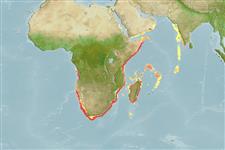
Θαλασσινό(ά) βαθύβιο(ς); εύρος βάθους 88 - 740 m (Ref. 11284), usually 400 - 500 m (Ref. 5578). Deep-water; 21°N - 37°S, 11°E - 77°E (Ref. 114953)
Southeast Atlantic and Western Indian Ocean: in scattered localities from Lüderitz, Namibia round the Cape (South Africa) to central Mozambique; also off Madagascar and Kenya; also found off India and Oman (Ref. 114953).
Μέγεθος / Βάρος / Age
Γεννητική Ωρίμανση: Lm ? range ? - ? cm
Max length : 192 cm TL αρσενικό/απροσδιόριστο; (Ref. 114953)
Short description
Κλείδες προσδιορισμού | Μορφολογία | Μορφομετρία
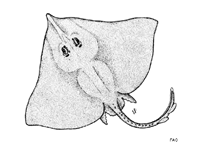
An all-dark longnose skate with its underside uniformly roughened by small denticles; snout acutely pointed and greatly elongated, and tail moderately stout and not conspicuously swollen; pectoral disc angular and broader than in other longnose skates in the area; no nape thorn (Ref. 5578). Dark grey to blackish above and below, ventral mucous pores black (Ref. 5578).
Body shape (shape guide): other.
Inhabits the outer shelf and upper slope (Ref. 5578). Rarely caught, probably inhabits hard bottoms that are seldom trawled (Ref. 114953). Feeds on bony fish, crabs and squid (Ref. 5578, Ref. 114953). Oviparous (Ref. 50449). Eggs have horn-like projections on the shell (Ref. 205). Males reaches maturity at 125-135 cm TL, females at 170-190 cm TL. Smallest known specimen at 27 cm TL (Ref. 114953) Probably caught by hake trawlers (Ref. 5578).
Life cycle and mating behavior
Γεννητική Ωρίμανση | Αναπαραγωγή | Γεννοβολία | Αβγά | Γονιμότητα | Προνύμφες
Oviparous, paired eggs are laid. Embryos feed solely on yolk (Ref. 50449). Eggs have horn-like projections on the shell (Ref. 205).
McEachran, J.D. and K.A. Dunn, 1998. Phylogenetic analysis of skates, a morphologically conservative clade of elasmobranchs (Chondrichthyes: Rajidae). Copeia 1998(2):271-290. (Ref. 27314)
IUCN Red List Status (Ref. 130435: Version 2025-1)
Threat to humans
Harmless
Human uses
αλιεία: χωρίς ενδιαφέρον
Εργαλεία
Special reports
Download XML
Διαδικτυακές πηγές
Estimates based on models
Preferred temperature (Αναφ.
123201): 6.4 - 12.5, mean 10.4 °C (based on 32 cells).
Phylogenetic diversity index (Αναφ.
82804): PD
50 = 0.5000 [Uniqueness, from 0.5 = low to 2.0 = high].
Bayesian length-weight: a=0.00275 (0.00175 - 0.00433), b=3.20 (3.07 - 3.33), in cm total length, based on LWR estimates for this species & Genus-body shape (Ref.
93245).
Τροφικό Επίπεδο (Αναφ.
69278): 4.3 ±0.69 se; based on food items.
Ελαστικότητα (Αναφ.
120179): Χαμηλό, ελάχιστος χρόνος για διπλασιασμό πληθυσμού 4,5 - 14 έτη (Fec assumed to be <100).
Fishing Vulnerability (Ref.
59153): Very high vulnerability (90 of 100).
🛈