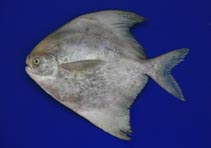
Environment: milieu / climate zone / rango de profundidad / distribution range
Ecología
marino; salobre bentopelágico; anfidromo (Ref. 51243); rango de profundidad 10 - ? m (Ref. 9811). Tropical; 32°N - 10°S, 48°E - 131°E
Indo-West Pacific: Persian Gulf to eastern Indonesia, north to Japan. Not recorded from Australia or New Guinea.
Tamaño / Peso / Age
Madurez: Lm ? range ? - ? cm
Max length : 40.0 cm TL macho / no sexado; (Ref. 3517); common length : 20.0 cm TL macho / no sexado; (Ref. 3517)
Espinas dorsales (total) : 0; Radios blandos dorsales (total) : 43 - 50; Radios blandos anales: 39 - 42; Vértebra: 33. Greyish to brownish dorsally, silvery white on sides. Covered in dark pigment spots. Fins silvery to greyish, darkest distally. Body firm, very deep, compressed. Caudal peduncle short, deep, strongly compressed, lacking scute-like scales or fleshy keels. Snout blunt, rounded, forehead almost straight. Eye small, central, much shorter than snout. Mouth small, subterminal, curved downward posteriorly, not reaching anterior margin of eye. Upper jaw covered with skin, joined to head, not movable. Jaw teeth minute, in a single series, flattened with 3 cusps (central cusp much larger than those adjacent). Gill membranes joined to belly. Gill slit short, its lower margin slightly below pectoral-fin base. Scales very small, cycloid, and deciduous, barely extending onto fin bases. Naked patch on head and nape with well-defined network of longitudinal sensory canals, patch not extending above pectoral-fin base. Lateral line high, following dorsal profile onto caudal peduncle (Ref 12928).
Body shape (shape guide): short and / or deep.
Occurs seasonally singly or in small schools over muddy bottoms; may enter estuaries. Feeds on ctenophores, salps, medusae, and other zooplankton groups but will also prey on small benthic animals. Sold fresh in markets (Ref. 9811).
Life cycle and mating behavior
Madurez | Reproducción | Puesta | Huevos | Fecundidad | Larva
Last, P.R., 1997. Stromateidae. Butterfishes, silver pomfrets. In K.E. Carpenter and V. Niem (eds.) FAO Identification Guide for Fishery Purposes. The Western Central Pacific. (in preparation). (Ref. 9811)
IUCN Red List Status (Ref. 130435: Version 2025-1)
Threat to humans
Harmless
Human uses
Pesquerías: escaso valor comercial
Herramientas
Special reports
Download XML
Fuentes de Internet
Estimates based on models
Preferred temperature (Referencia
123201): 24.8 - 29.2, mean 28.5 °C (based on 508 cells).
Phylogenetic diversity index (Referencia
82804): PD
50 = 0.5313 [Uniqueness, from 0.5 = low to 2.0 = high].
Bayesian length-weight: a=0.01738 (0.00822 - 0.03676), b=3.01 (2.83 - 3.19), in cm total length, based on LWR estimates for this species & (Sub)family-body (Ref.
93245).
Nivel trófico (Referencia
69278): 3.6 ±0.38 se; based on food items.
Generation time: 1.6 ( na - na) years. Estimated as median ln(3)/K based on 1
growth studies.
Resiliencia (Referencia
120179): Alto, población duplicada en un tiempo mínimo inferior a 15 meses (K=0.6).
Fishing Vulnerability (Ref.
59153): Low vulnerability (24 of 100).
🛈
Nutrients (Ref.
124155): Calcium = 58.5 [23.8, 140.8] mg/100g; Iron = 0.512 [0.256, 1.080] mg/100g; Protein = 17.4 [16.1, 18.7] %; Omega3 = 0.205 [0.109, 0.377] g/100g; Selenium = 124 [34, 456] μg/100g; VitaminA = 21.4 [6.9, 62.3] μg/100g; Zinc = 0.743 [0.449, 1.403] mg/100g (wet weight); based on
nutrient studies.