>
Eupercaria/misc (Various families in series Eupercaria) >
Haemulidae (Grunts) > Haemulinae
Etymology: Anisotremus: Greek, anisos = unequal + Greek, trema, -atos = hole (Ref. 45335).
More on author: Gill.
Environment: milieu / climate zone / rango de profundidad / distribution range
Ecología
marino asociado a arrecife; rango de profundidad 3 - 30 m (Ref. 5227), usually 3 - 12 m (Ref. 5227). Tropical; 22°N -
Eastern Pacific: Gulf of California to Peru, including the Galapagos Islands.
Tamaño / Peso / Age
Madurez: Lm ? range ? - ? cm
Max length : 51.0 cm TL macho / no sexado; (Ref. 55763); common length : 30.0 cm TL macho / no sexado; (Ref. 9114); peso máximo publicado: 3.6 kg (Ref. 40637)
Short description
Claves de identificación | Morfología | Morfometría
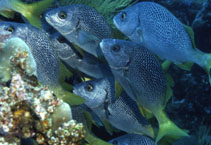
Body compressed and deep (depth contained 2.0 to 2.1 times in standard length); mouth small and terminal with thick, fleshy lips; dorsal fin with 12 to 13 spines and 16 to 17 soft rays (XII-XIII, 16-17); pectoral fins slightly longer than head, reaching origin of anal fin; lateral line with 46 to 50 scales; scale series above lateral line oblique; body silvery yellow to green; large scales above lateral line with a dark anterior border, resembling spots; fins yellowish brown (Ref. 55763).
Body shape (shape guide): short and / or deep.
Solitary and found hiding in reefs and caves during the day (Ref. 9114). Juveniles appear in late summer and swim in schools. A nocturnal feeder on reef invertebrates (Ref. 9114). Marketed fresh (Ref. 9114).
Life cycle and mating behavior
Madurez | Reproducción | Puesta | Huevos | Fecundidad | Larva
Distinct pairing during breeding (Ref. 205).
Thomson, D.A., 1987. Reef fishes of the Sea of Cortez. The rocky-shore fishes of the Gulf of California. The University of Arizona Press, Tucson. 302 p. (Ref. 5592)
IUCN Red List Status (Ref. 130435: Version 2025-1)
Threat to humans
Harmless
Human uses
Pesquerías: comercial; pesca deportiva: si
Herramientas
Special reports
Download XML
Fuentes de Internet
Estimates based on models
Preferred temperature (Referencia
123201): 23.5 - 29.1, mean 28 °C (based on 161 cells).
Phylogenetic diversity index (Referencia
82804): PD
50 = 0.5020 [Uniqueness, from 0.5 = low to 2.0 = high].
Bayesian length-weight: a=0.02512 (0.01403 - 0.04496), b=3.05 (2.89 - 3.21), in cm total length, based on LWR estimates for this species & (Sub)family-body (Ref.
93245).
Nivel trófico (Referencia
69278): 3.5 ±0.37 se; based on food items.
Generation time: 8.5 ( na - na) years. Estimated as median ln(3)/K based on 1
growth studies.
Resiliencia (Referencia
120179): Bajo, población duplicada en un tiempo mínimo de 4.5-14 años (K=0.13).
Fishing Vulnerability (Ref.
59153): High vulnerability (58 of 100).
🛈
Nutrients (Ref.
124155): Calcium = 27.6 [13.1, 55.2] mg/100g; Iron = 0.482 [0.246, 0.892] mg/100g; Protein = 18.8 [16.8, 20.8] %; Omega3 = 0.0898 [, ] g/100g; Selenium = 32.1 [17.0, 60.7] μg/100g; VitaminA = 58.3 [16.4, 196.7] μg/100g; Zinc = 1.02 [0.66, 1.52] mg/100g (wet weight);