>
Holocentriformes (Squirrelfishes, soldierfishes) >
Holocentridae (Squirrelfishes, soldierfishes) > Myripristinae
Etymology: Ostichthys: Greek,osteon = bone + Greek, ichthys = fish (Ref. 45335).
More on author: Cuvier.
Environment: milieu / climate zone / profondeur / distribution range
Écologie
marin récifal; profondeur 20 - 270 m (Ref. 119380). Tropical
Indo-Pacific: from the Andaman Sea to the Philippines; north to southern Japan, south to Australia, east to New Caledonia, Fiji, Tuvalu, and Vanuatu.
Taille / Poids / Âge
Maturité: Lm ? range ? - ? cm
Max length : 45.0 cm TL mâle / non sexé; (Ref. 2272); common length : 35.0 cm TL mâle / non sexé; (Ref. 9137)
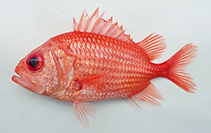
Épines dorsales (Total) : 11 - 12; Rayons mous dorsaux (Total) : 12 - 14. This species is distinguished by the following characters: D XI-XII,12-14 (modally XII,13); pectoral-fin rays 15-18 (17); pored lateral-line scales 27-29 (28); scale rows between lateral line and middle of spinous dorsal-fin base 3.5; lower gill rakers, including all rudiments 11-14 (13); middle dorsal-fin spines are relatively short, 7th dorsal-fin spine 11.8-15.0 (mean 13.8) % of SL in 10.0-19.0 cm SL specimens [11.8-22.3 (15.1) % of SL in all examined specimens (3.40-3.37 cm SL)]; the last 3 dorsal-fin spines are relatively short [10th dorsal fin spine 6.2-8.0 (7.2) % of SL, 11th (penultimate) dorsal-fin spine 5.1-6.4 (5.8) % of SL, 12th (posteriormost) dorsal-fin spine 5.5-7.5 (6.4) % of SL in 10.0-19.0 cm SL specimens] [5.8-14.5 (7.9) % of SL, 4.3-10.6 (6.4) % of SL and 4.7-9.6 (6.7) % of SL, respectively, in all examined specimens]; 2nd to 4th anal-fin spines are relatively short [2nd anal-fin spine length 5.1-6.7 (5.6) % of SL, 3rd anal-fin
spine length 12.9-15.8 (14.2) % of SL, 4th anal-fin spine length 10.5-13.4 (11.8) % of SL in 10.0-19.0 cm SL specimens] [4.1-9.0 (5.9) % of SL, 11.2-19.0 (14.3) % of SL and 9.2-14.3 (11.6) % of SL, respectively, in all examined specimens]; with a relatively long caudal peduncle, length 10.5-13.3 (12.1) % of SL in 10.0–19.0 cm SL specimens [10.5-14.1 (12.1) % of SL in all examined specimens]; the last dorsal-fin spine is fused to the 1st dorsal-fin soft ray, separation between spine and ray about half that between bases of former and penultimate dorsal-fin spine; 1st body scale row usually below 2nd dorsal-fin spine base (86%), rarely between bases of 1st and 2nd dorsal-fin spines (12%) or 1st dorsal fin spine base (2%); ventral portion of the maxilla is not expanded ventrally, even in large specimens; body scales are with relatively few well-developed, widely separated spinules and a relatively high number of less developed (young) spinules in large specimens > ca. 10.0 cm SL. Colouration: no white bands or spots laterally on body (occasionally white spots in specimens < 10.0 cm SL); a dark red blotch on uppermost part of pectoral-fin base (Ref. 119380).
Body shape (shape guide): short and / or deep; Cross section: compressed.
Found in the sublittoral zone (Ref. 11230). Caught by gill net, line fishing or trawl, in depths of 20-270 m, with the smallest specimen (postlarval stage) (KAUM–I. 97814, 3.95 cm) collected by surface trawl in 20 m depth (Ref. 119380).
Life cycle and mating behavior
Maturité | Reproduction | Frai | Œufs | Fécondité | Larves
Matsunuma, M., Y. Fukui and H. Motomura, 2018. Review of the Ostichthys japonicus complex (Beryciformes: Holocentridae: Myripristinae) in the northwestern Pacific Ocean, with description of a new species. Ichthyol. Res. 65:285-314. (Ref. 119380)
Statut dans la liste rouge de l'IUCN (Ref. 130435: Version 2025-1)
Menace pour l'homme
Harmless
Utilisations par l'homme
Pêcheries: commercial
Outils
Articles particuliers
Télécharger en XML
Sources Internet
Estimates based on models
Preferred temperature (Réf.
123201): 18.3 - 29, mean 27.7 °C (based on 2088 cells).
Phylogenetic diversity index (Réf.
82804): PD
50 = 0.5000 [Uniqueness, from 0.5 = low to 2.0 = high].
Bayesian length-weight: a=0.01778 (0.00696 - 0.04547), b=3.02 (2.79 - 3.25), in cm total length, based on LWR estimates for this (Sub)family-body shape (Ref.
93245).
Niveau trophique (Réf.
69278): 4.0 ±0.66 se; based on food items.
Résilience (Réf.
120179): Milieu, temps minimum de doublement de population : 1,4 à 4,4 années (Preliminary K or Fecundity.).
Fishing Vulnerability (Ref.
59153): Low to moderate vulnerability (35 of 100).
🛈
Nutrients (Ref.
124155): Calcium = 33.4 [14.5, 164.9] mg/100g; Iron = 0.5 [0.2, 1.1] mg/100g; Protein = 18.3 [17.0, 19.7] %; Omega3 = 0.139 [0.055, 0.364] g/100g; Selenium = 50.5 [26.9, 104.4] μg/100g; VitaminA = 43 [12, 166] μg/100g; Zinc = 0.815 [0.499, 1.300] mg/100g (wet weight);