>
Gadiformes (Cods) >
Macrouridae (Grenadiers or rattails)
Etymology: Coelorinchus: Greek, koilos = a hollow + Greek, rhyngchos = jaw (Ref. 45335).
More on author: Gilbert.
Environment: milieu / climate zone / Tiefenbereich / distribution range
Ökologie
seewasser benthopelagisch; standorttreu; tiefenbereich 180 - 300 m (Ref. 9315). Deep-water; 37°N - 22°N, 123°W - 107°W (Ref. 1371)
Eastern Pacific: southern California and northern Gulf of California; probably also in outer slope waters of Baja California and mainland Mexico.
Size / Gewicht / Alter
Geschlechtsreife: Lm ? range ? - ? cm
Max length : 34.0 cm TL Männchen/unbestimmt; (Ref. 1371)
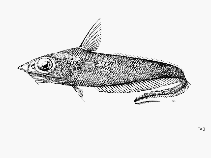
Rückenflossenstacheln (insgesamt) : 2; Rückenflossenweichstrahlen (insgesamt) : 7 - 9; Afterflossenstacheln: 0. Body tapering to a point posteriorly from behind the origin of the first dorsal fin. Head large; the eyes also large; the snout relatively short, its antero-lateral margin incompletely supported by bone, its terminal scute broad, blunt. Head ridges strong but not especially spiny; the underside of the snout, the ventral margins on the suborbital and mandible naked. Light organ large, lens-shaped. Overall color swarthy to grayish; the fins dusky to black; the mouth pallid; the gill cavity blackish, paler inwardly (Ref. 1371). A large, black, naked fossa midventrally on chest; anus at origin of the anal fin. Smooth second dorsal spine at all sizes (Ref. 26798). Branchiostegal rays: 6-6 (Ref. 36385).
Body shape (shape guide): elongated; Cross section: circular.
Stomach contents reveal the ingestion of shrimps and other crustaceans (Ref. 9315). Oviparous, with planktonic larvae (Ref. 36385).
Life cycle and mating behavior
Geschlechtsreife | Fortpflanzung | Ablaichen | Eier | Fecundity | Larven
Cohen, D.M., T. Inada, T. Iwamoto and N. Scialabba, 1990. FAO species catalogue. Vol. 10. Gadiform fishes of the world (Order Gadiformes). An annotated and illustrated catalogue of cods, hakes, grenadiers and other gadiform fishes known to date. FAO Fish. Synop. 125(10). Rome: FAO. 442 p. (Ref. 1371)
IUCN Rote Liste Status (Ref. 130435: Version 2025-1)
Bedrohung für Menschen
Harmless
Nutzung durch Menschen
Fischereien: weniger kommerziell
Tools
Zusatzinformationen
Download XML
Internet Quellen
Estimates based on models
Preferred temperature (Ref.
123201): 8 - 12.8, mean 11.5 °C (based on 10 cells).
Phylogenetic diversity index (Ref.
82804): PD
50 = 0.5000 [Uniqueness, from 0.5 = low to 2.0 = high].
Bayesian length-weight: a=0.00245 (0.00126 - 0.00477), b=3.19 (3.02 - 3.36), in cm total length, based on LWR estimates for this Genus-body shape (Ref.
93245).
Trophic level (Ref.
69278): 3.6 ±0.55 se; based on food items.
Widerstandsfähigkeit (Ref.
120179): niedrig, Verdopplung der Population dauert 4,5 - 14 Jahre. (Preliminary K or Fecundity.).
Fishing Vulnerability (Ref.
59153): Low vulnerability (24 of 100).
🛈