Elasmobranquios (tiburones y rayas) (sharks and rays) >
Carcharhiniformes (Ground sharks) >
Scyliorhinidae (Cat sharks) > Scyliorhininae
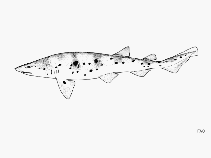
Etymology: Scyliorhinus: skylion, Greek for dogfish or small shark; rhinus, from rhine (Gr.), rasp, alluding to a shark’s jagged, rasp-like skin (See ETYFish); cervigoni: In honor of Venezuelan ichthyologist Fernando Cervigón Marcos (1930-2017), who recognized this shark as a distinct species in 1960 (See ETYFish).
Eponymy: Dr Fernando Cervigón Marcos (1930–2017) was a Spanish-born Venezuelan ichthyologist, who founded (1983) and was president of the Museo del Mar, Margarita Island, Venezuela. [...] (Ref. 128868), visit book page.
Environment: milieu / climate zone / rango de profundidad / distribution range
Ecología
marino demersal; rango de profundidad 45 - 500 m. Deep-water; 11°C - 16°C (Ref. 244); 20°N - 17°S
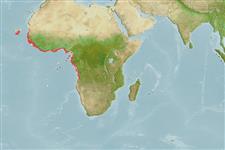
Eastern Atlantic: probably wide-ranging off tropical West Africa, from Mauritania to Angola (Ref. 244). Often previously referred to as Scyliorhinus stellaris (Ref. 244, 127434).
Tamaño / Peso / Age
Madurez: Lm ? range ? - ? cm
Max length : 67.0 cm TL macho / no sexado; (Ref. 244); 76.0 cm TL (female)
Found on rocky and muddy bottoms of the continental shelf and upper slope. Temperature: 11-16°C. Salinity: 30 ppt. Oxygen: 1.0-1.6 ml/l. Feeds on bony fishes. Oviparous (Ref. 50449).
Life cycle and mating behavior
Madurez | Reproducción | Puesta | Huevos | Fecundidad | Larva
Oviparous, paired eggs are laid. Embryos feed solely on yolk (Ref. 50449).
Compagno, L.J.V., 1984. FAO Species Catalogue. Vol. 4. Sharks of the world. An annotated and illustrated catalogue of shark species known to date. Part 2 - Carcharhiniformes. FAO Fish. Synop. 125(4/2):251-655. Rome: FAO. (Ref. 244)
IUCN Red List Status (Ref. 130435: Version 2025-1)
Threat to humans
Harmless
Human uses
Pesquerías: pesquerías de subsistencia
Herramientas
Special reports
Download XML
Fuentes de Internet
Estimates based on models
Preferred temperature (Referencia
123201): 12.4 - 15.8, mean 14.3 °C (based on 29 cells).
Phylogenetic diversity index (Referencia
82804): PD
50 = 0.5000 [Uniqueness, from 0.5 = low to 2.0 = high].
Bayesian length-weight: a=0.00263 (0.00138 - 0.00502), b=3.21 (3.04 - 3.38), in cm total length, based on LWR estimates for this (Sub)family-body shape (Ref.
93245).
Nivel trófico (Referencia
69278): 4.5 ±0.80 se; based on food items.
Resiliencia (Referencia
120179): Muy bajo, población duplicada en un tiempo mínimo superior a 14 años (Fec=2).
Fishing Vulnerability (Ref.
59153): Moderate to high vulnerability (50 of 100).
🛈