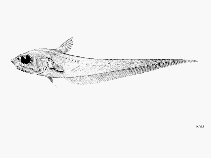
Coryphaenoides ariommus, Humboldt grenadier : fisheries

You can sponsor this page

Coryphaenoides ariommus Gilbert & Thompson, 1916

Humboldt grenadier
Ajouter votre observation dans Fish Watcher
Native range | All suitable habitat | Point map | Year 2050
This map was computer-generated and has not yet been reviewed.
Coryphaenoides ariommus   AquaMaps   Data sources: GBIF OBIS
Envoyez vos Photos et vidéos
Images | Images Google
Image of Coryphaenoides ariommus (Humboldt grenadier)
Coryphaenoides ariommus
Photo de FAO

Classification / Names Noms communs | Synonymes | Catalog of Fishes(Genre, Espèce) | ITIS | CoL | WoRMS | Cloffa

> Gadiformes (Cods) > Macrouridae (Grenadiers or rattails)
Etymology: Coryphaenoides: Greek, koryphaina = dolphin fish + Suffix oides = similar to (Ref. 45335).
More on authors: Gilbert & Thompson.

Environment: milieu / climate zone / profondeur / distribution range Écologie

marin bathydémersal; non migrateur; profondeur 768 - 1860 m (Ref. 1371). Deep-water; 2°S - 40°S, 85°W - 70°W (Ref. 1371)

Distribution Pays | Zones FAO | Écosystèmes | Occurrences | Carte par point | Introductions | Faunafri

Southeast Pacific: northern Peru to southern Chile. Also Eastern Central Pacific (Ref. 9315).

Taille / Poids / Âge

Maturité: Lm ?  range ? - ? cm
Max length : 46.0 cm TL mâle / non sexé; (Ref. 1371)

Description synthétique Clés d'identification | Morphologie | Morphométrie

Épines dorsales (Total) : 2; Épines anales: 0. Eyes large, its diameter 25 to 36 percent of head length; snout short, moderately pointed, its underside and leading edge naked except for scutes at the tip and lateral angles; chin with very small barbel. Scales on body with spinules (conical in young, more triangular and flattened in adults) arranged in divergent longitudinal rows. Overall color is light to medium brown; lips and barbel dark brown; oral cavity blackish.
Body shape (shape guide): elongated; Cross section: circular.

Biologie     Glossaire (ex. epibenthic)

Life cycle and mating behavior Maturité | Reproduction | Frai | Œufs | Fécondité | Larves

Référence principale Upload your references | Références | Coordinateur : Iwamoto, Tomio | Collaborateurs

Cohen, D.M., T. Inada, T. Iwamoto and N. Scialabba, 1990. FAO species catalogue. Vol. 10. Gadiform fishes of the world (Order Gadiformes). An annotated and illustrated catalogue of cods, hakes, grenadiers and other gadiform fishes known to date. FAO Fish. Synop. 125(10). Rome: FAO. 442 p. (Ref. 1371)

Statut dans la liste rouge de l'IUCN (Ref. 130435: Version 2025-1)

  Préoccupation mineure (LC) ; Date assessed: 04 February 2009

CITES

Not Evaluated

CMS (Ref. 116361)

Not Evaluated

Menace pour l'homme

  Harmless


Utilisations par l'homme

Pêcheries: pêcheries vivrières
FAO - Publication: search | FishSource |

Plus d'informations

Écologie trophique
Food items (preys)
Composition du régime alimentaire
Consommation alimentaire
Food rations
Prédateurs
Écologie
Écologie
Home ranges
Population dynamics
Paramètres de croissance
Max. ages / sizes
Length-weight rel.
Length-length rel.
Fréquences de longueurs
Mass conversion
Recrutement
Abondance
Life cycle
Reproduction
Maturité
Maturity/Gills rel.
Fécondité
Frai
Spawning aggregations
Œufs
Développement de l'œuf
Larves
Dynamique des populations larvaires
Distribution
Pays
Zones FAO
Écosystèmes
Occurrences
Introductions
BRUVS - Videos
Anatomy
Surface branchiale
Brain
Otolith
Physiology
Body composition
Nutrients
Consommation d'oxygène
Type de nage
Vitesse de nage
Visual pigments
Fish sound
Diseases & Parasites
Toxicity (LC50s)
Génétique
génôme
Génétique
Heterozygosity
Héritabilité
Human related
Aquaculture systems
Profils d'aquaculture
Souches
Ciguatera cases
Stamps, coins, misc.
Outreach
Collaborateurs
Taxonomy
Noms communs
Synonymes
Morphologie
Morphométrie
Images
Références
Références

Outils

Articles particuliers

Télécharger en XML

Sources Internet

AFORO (otoliths) | Aquatic Commons | BHL | Cloffa | Websites from users | FishWatcher | CISTI | Catalog of Fishes: Genre, Espèce | DiscoverLife | ECOTOX | FAO - Publication: search | Faunafri | Fishipedia | Fishtrace | GloBI | Google Books | Google Scholar | Google | IGFA World Record | OneZoom | Open Tree of Life | Otolith Atlas of Taiwan Fishes | PubMed | Reef Life Survey | Socotra Atlas | TreeBase | Arbre de Vie | Wikipedia: aller à, chercher | Zoobank | Zoological Record

Estimates based on models

Preferred temperature (Réf. 123201): 3.3 - 4.5, mean 3.9 °C (based on 11 cells).
Phylogenetic diversity index (Réf. 82804):  PD50 = 0.5000   [Uniqueness, from 0.5 = low to 2.0 = high].
Bayesian length-weight: a=0.00214 (0.00109 - 0.00421), b=3.20 (3.03 - 3.37), in cm total length, based on LWR estimates for this (Sub)family-body shape (Ref. 93245).
Niveau trophique (Réf. 69278):  3.5   ±0.4 se; based on size and trophs of closest relatives
Résilience (Réf. 120179):  Faible, temps minimum de doublement de population : 4,5 à 14 années (Preliminary K or Fecundity.).
Fishing Vulnerability (Ref. 59153):  Moderate vulnerability (36 of 100). 🛈
Catégorie de prix (Ref. 80766):   Medium.