>
Scombriformes (Mackerels) >
Trichiuridae (Cutlassfishes) > Lepidopodinae
Etymology: Eupleurogrammus: Greek, eu = good + Greek, pleura = near, on the side + Greek, gramma = mark, signal (Ref. 45335).
More on author: Bleeker.
Environment: milieu / climate zone / intervalo de profundidade / distribution range
Ecologia
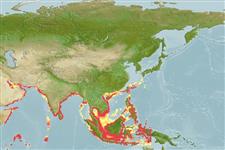
marinhas bentopelágico; intervalo de profundidade 0 - 80 m (Ref. 9688). Tropical; 31°N - 10°S, 47°E - 135°E (Ref. 6181)
Indo-West Pacific: including the Persian Gulf, India, Sri Lanka, Malaysia, Singapore, Indonesia and Thailand.
Tamanho / Peso / Idade
Maturidade: Lm ? range ? - ? cm
Max length : 70.0 cm TL macho/indeterminado; (Ref. 11441); common length : 40.0 cm TL macho/indeterminado; (Ref. 9688)
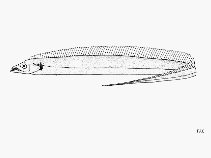
Espinhos dorsais (total) : 0; Raios dorsais moles (total) : 118 - 132. Body extremely elongate, compressed and tapering to a point. Mouth large with a dermal process on the tip of each jaw. The lower hind margin of the gill cover convex. Lateral line running almost straight, closer to the ventral contour. Anal fins reduced to minute spinules buried in skin. Pelvic fins reduced to scale-like spines. Fresh specimens steely blue with metallic reflections, becoming silvery gray after death.
Body shape (shape guide): elongated; Cross section: compressed.
Inhabits coastal waters and often comes near the surface at night. Feeds on crustaceans, squid and fishes (species of Atherina, Stolephorus, Leiognathus, Eupleurogrammus, etc.) in Palk Bay, India. Caught mainly with shore seines, bag nets and bottom trawls in coastal waters down to 50 m depth in West Bengal to Madras, Palk Bay and Gulf of Myanmar. Marketed mostly dried, mixed with other trichiurids, also salted or fresh.
Life cycle and mating behavior
Maturidade | Reprodução | Desova | Ovos | Fecundidade | Larvas
Nakamura, I. and N.V. Parin, 1993. FAO Species Catalogue. Vol. 15. Snake mackerels and cutlassfishes of the world (families Gempylidae and Trichiuridae). An annotated and illustrated catalogue of the snake mackerels, snoeks, escolars, gemfishes, sackfishes, domine, oilfish, cutlassfishes,. scabbardfishes, hairtails, and frostfishes known to date. FAO Fish. Synop. 125(15):136 p. (Ref. 6181)
Categoria na Lista Vermelha da IUCN (Ref. 130435: Version 2025-1)
Ameaça para o homem
Harmless
Utilização humana
Pescarias: espécies comerciais
Ferramentas
Relatórios especiais
Descarregue XML
Fontes da internet
Estimates based on models
Preferred temperature (Ref.
123201): 25.4 - 29.1, mean 28.4 °C (based on 1224 cells).
Phylogenetic diversity index (Ref.
82804): PD
50 = 0.7500 [Uniqueness, from 0.5 = low to 2.0 = high].
Bayesian length-weight: a=0.00275 (0.00104 - 0.00730), b=3.06 (2.83 - 3.29), in cm total length, based on LWR estimates for this (Sub)family-body shape (Ref.
93245).
Nível Trófico (Ref.
69278): 4.5 ±0.80 se; based on food items.
Resiliência (Ref.
120179): Elevada, tempo mínimo de duplicação da população menor que 15 meses (Preliminary K or Fecundity.).
Fishing Vulnerability (Ref.
59153): Moderate to high vulnerability (48 of 100).
🛈