>
Cichliformes (Cichlids, convict blennies) >
Cichlidae (Cichlids) > Pseudocrenilabrinae
Etymology: Julidochromis: Taken from marine wrasse "julidini"; also from Greek, ioulis = a fish dealing with genera Coris or Thalassoma (Ref. 45335).
More on author: Boulenger.
Environment: milieu / climate zone / distribuzione batimetrica / distribution range
Ecologia
; acqua dolce benthopelagico; pH range: 8.0 - 9.0; dH range: 9 - 19, usually 6 - 12 m (Ref. 118184). Tropical; 22°C - 24°C (Ref. 1672); 3°S - 10°S
Africa: Endemic to the northern part of Lake Tanganyika. One variety is endemic in the southern part (near Mpulungu).
Size / Peso / Age
Maturità: Lm ? range ? - ? cm
Max length : 8.5 cm TL maschio/sesso non determinato; (Ref. 5651)
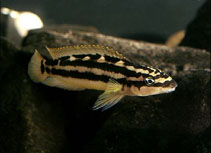
Rock-dwelling. Usually solitary; territorial. Feeds on microorganisms. Breeding in captivity has led to changes in its colors and behaviors. Since there have been few new importations, this dwarf species has generally been available only in a somewhat degenerate form and does not always show its true colors (Ref. 6770). Aquarium keeping: in pairs; minimum aquarium size 60 cm (Ref. 51539).
Life cycle and mating behavior
Maturità | Riproduzione | Deposizione | Uova | Fecundity | Larve
Maréchal, C. and M. Poll, 1991. Julidochromis. p. 202-205. In J. Daget, J.-P. Gosse, G.G. Teugels and D.F.E. Thys van Audenaerde (eds.) Check-list of the freshwater fishes of Africa (CLOFFA). ISNB, Brussels; MRAC, Tervuren; and ORSTOM, Paris. Vol. 4. (Ref. 5651)
IUCN Red List Status (Ref. 130435: Version 2025-1)
Threat to humans
Harmless
Human uses
Pesca: commerciale; Acquario: Commerciale
Strumenti
Special reports
Download XML
Fonti Internet
Estimates based on models
Phylogenetic diversity index (Fonte Biblio.
82804): PD
50 = 0.5156 [Uniqueness, from 0.5 = low to 2.0 = high].
Bayesian length-weight: a=0.01445 (0.00674 - 0.03099), b=2.99 (2.82 - 3.16), in cm total length, based on LWR estimates for this (Sub)family-body shape (Ref.
93245).
Trophic level (Fonte Biblio.
69278): 3.5 ±0.37 se; based on food items.
Resilienza (Fonte Biblio.
120179): Alto, tempo minimo di raddoppiamento della popolazione meno di 15 mesi (tm<1).
Fishing Vulnerability (Ref.
59153): Low vulnerability (10 of 100).
🛈