



Carcharhinus leucas (Valenciennes, 1839)
Bull shark
Aggiungete la vostra osservazione in Fish Watcher
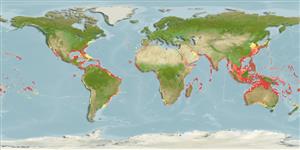
| Native range | All suitable habitat | Point map | Year 2050 |
|
| This map was computer-generated and has not yet been reviewed. |
| Carcharhinus leucas AquaMaps Data sources: GBIF OBIS |
Carica il tuo foto e Video
Immagini | Video | Francobolli, monete, materiale vario. | Google image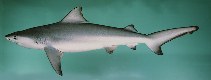 Carcharhinus leucas
Immagine di Randall, J.E.
Immagini | Video | Francobolli, monete, materiale vario. | Google image
Immagine di Randall, J.E.
Classificazione / Nomi Nomi Comuni | Sinonimi | Catalog of Fishes(Genere, Specie) | ITIS | CoL | WoRMS | Cloffa
Elasmobranchi (squali e razze) (sharks and rays) > Carcharhiniformes (Ground sharks) > Carcharhinidae (Requiem sharks)
Etymology: Carcharhinus: karcharos (Gr.), sharp or jagged; rhinus, an ancient name for sharks, from rhine (Gr.), rasp, both words alluding to a shark's jagged, rasp-like skin (See ETYFish); leucas: From leukos (Gr.), white, referring to its body color, usually grayish with white underside [authorship often attributed to Müller & Henle, who published Valenciennes’ description] (See ETYFish).
Etymology: Carcharhinus: karcharos (Gr.), sharp or jagged; rhinus, an ancient name for sharks, from rhine (Gr.), rasp, both words alluding to a shark's jagged, rasp-like skin (See ETYFish); leucas: From leukos (Gr.), white, referring to its body color, usually grayish with white underside [authorship often attributed to Müller & Henle, who published Valenciennes’ description] (See ETYFish).
Ambiente: milieu / zona climatica / distribuzione batimetrica / gamma di distribuzione Ecologia
marino; acqua dolce; salmastro associati a barriera corallina; amfidromo (Ref. 51243); distribuzione batimetrica 1 - 164 m (Ref. 106604), usually 1 - 30 m (Ref. 55183). Subtropical; 42°N - 39°S, 180°W - 180°E (Ref. 55182)
Distribuzione Territories | Aree FAO | Ecosistemi | Presenze | Mappa dei ritrovamenti | Introduzioni | Faunafri
Cosmopolitan in tropical and subtropical waters (Ref. 81283): widespread in warm oceans, rivers and lakes (Ref. 4716). Western Atlantic: Massachusetts, USA to Argentina (Ref. 58839); eastern Atlantic: Morocco, Senegal to Angola (Ref. 81283, 81623); Indo-Pacific: Kenya and South Africa to India, then, Viet Nam to Australia; southern Baja California, Mexico to Ecuador and possibly occurring in Peru. Africa: in freshwater found in rivers of West Africa from Gambia River to Ogowe River (Ref. 81283) and in the Cuanza in Angola (Ref. 120641).
Sympatric with Carcharhinus amboinensis, Glyphis gangeticus.
Lunghezza alla prima maturità / Dimensione / Peso / Età
Maturità: Lm 201.0, range 180 - 230 cm
Max length : 360 cm TL maschio/sesso non determinato; (Ref. 85726); 400.0 cm TL (female); common length : 260 cm TL maschio/sesso non determinato; (Ref. 9253); peso massimo pubblicato: 316.5 kg (Ref. 40637); Età massima riportata: 32 anni (Ref. 42004)
Max length : 360 cm TL maschio/sesso non determinato; (Ref. 85726); 400.0 cm TL (female); common length : 260 cm TL maschio/sesso non determinato; (Ref. 9253); peso massimo pubblicato: 316.5 kg (Ref. 40637); Età massima riportata: 32 anni (Ref. 42004)
Breve descrizione Chiavi di identificazione | Morfologia | Morfometria
Spine dorsali (totale) : 0; Spine anali: 0. Diagnosis: Carcharhinus leucas is a massive shark with a short, broad and blunt snout, small eyes and triangular saw-edged upper teeth, and lack of interdorsal ridge, characters which are sufficient to distinguish this species (Ref. 26938).
Body shape (shape guide): fusiform / normal.
Body shape (shape guide): fusiform / normal.
A coastal and freshwater shark inhabiting shallow waters especially in bays, estuaries, rivers, and lakes (Ref. 244). It readily penetrates far up rivers and hypersaline bays and littoral lagoons (Ref. 9997, 44894, 81283). Capable of covering great distances (up to 180 kilometers in 24 hours), moving between fresh and brackish water at random (Ref. 44894). Adults often found near estuaries and freshwater inflows to the sea; young enter rivers and may be found hundreds of km from the sea (Ref. 4967, 44894, 58304). Feeds on bony fishes, other sharks, rays, mantis shrimps, crabs, squid, sea snails, sea urchins, mammalian carrion, sea turtles, and occasionally garbage (Ref. 244, 5578, 44894). Viviparous (Ref. 50449). Gives birth to litters of up to 13 young (Ref. 26938, 44894). Size at birth is 56-81 cm TL (Ref. 81623). Sexual maturity is attained after 10-15 years (at a length between 160-200 centimeters) (Ref. 44894). Though not commercially important, this species is a good food fish (Ref. 12484). Utilized fresh, fresh-frozen or smoked for human consumption, fins for soup, hide for leather, liver for oil, and carcass for fishmeal (Ref. 244). Very hardy and lives well in captivity (Ref. 244). This large shark is potentially dangerous to man (Ref. 81283), probably the most dangerous species of tropical shark (Ref. 244), and it is repeatedly implicated in attacks on humans (Ref. 4967, 44894); attacks in fresh water are rare (Ref. 44894).
Ciclo vitale e comportamento di accoppiamento Maturità | Riproduzione | Deposizione | Uova | Fecondità | Larve
Viviparpous, with a yolk-sac placenta, 1-13 young in a litter. Size at birth about 60 cm TL (Ref. 9997). In the western North Atlantic off Florida and the Gulf of Mexico, and off South Africa, young are born in late spring or early summer. Off Nicaragua, females may have young throughout the year, with a peak in spring and early summer. Estimated gestation period is 10 to 11 months (Ref. 244). Distinct pairing with embrace (Ref. 205). Females often have courtship scars, but males are rarely seen with fighting scars (Ref. 244).
Riferimento principale
Caricare le referenze | Bibliografia | Coordinatore : Compagno, Leonard J.V. | Collaboratori
Compagno, L.J.V., 1984. FAO Species Catalogue. Vol. 4. Sharks of the world. An annotated and illustrated catalogue of shark species known to date. Part 2 - Carcharhiniformes. FAO Fish. Synop. 125(4/2):251-655. Rome: FAO. (Ref. 244)
Stato della Lista Rossa IUCN (Ref. 130435: Version 2025-2 (Global))
Vulnerabile (VU) (A2bcd); Date assessed: 24 November 2020
Minaccia per l'uomo
Traumatogenic (Ref. 4690)
Usi umani
Pesca: commerciale; Pesce da pesca sportiva: si
FAO - pesca: sbarchi; Publication: search | FishSource | Sea Around Us
Informazioni ulteriori
Ecologia trofica
Articoli alimentari (prede)
Alimentazione
Consumo di cibo
Razioni alimentari
Predatori
Articoli alimentari (prede)
Alimentazione
Consumo di cibo
Razioni alimentari
Predatori
Dinamica della popolazione
Parametri di crescita
Età massima / dimensioni massime
Rapporto lunghezza-peso.
Lunghezza-lunghezza rel.
Lunghezza-frequenze
Conversione di massa
Reclutamento
Abbondanza
Parametri di crescita
Età massima / dimensioni massime
Rapporto lunghezza-peso.
Lunghezza-lunghezza rel.
Lunghezza-frequenze
Conversione di massa
Reclutamento
Abbondanza
Ciclo di vita
Riproduzione
Maturità
Maturità/Gli occhielli sono relativi.
Fecondità
Deposizione
Aggregazioni riproduttive
Uova
Sviluppo delle uova
Larve
Dinamica popolazioni larvali
Riproduzione
Maturità
Maturità/Gli occhielli sono relativi.
Fecondità
Deposizione
Aggregazioni riproduttive
Uova
Sviluppo delle uova
Larve
Dinamica popolazioni larvali
Fisiologia
Composizione corporea
Nutrienti
Consumo di ossigeno
Tipo di nuoto
Velocità di nuoto
Pigmenti visivi
Suono del pesce
Malattie e parassiti
Tossicità (LC50)
Composizione corporea
Nutrienti
Consumo di ossigeno
Tipo di nuoto
Velocità di nuoto
Pigmenti visivi
Suono del pesce
Malattie e parassiti
Tossicità (LC50)
Legato all'uomo
Sistemi di acquacoltura
Profili di acquacoltura
Varietà
Casi di Ciguatera
Francobolli, monete, materiale vario.
Sistemi di acquacoltura
Profili di acquacoltura
Varietà
Casi di Ciguatera
Francobolli, monete, materiale vario.
Strumenti
Libro elettronico | Giuda pratica | Chiavi di identificazione | Generatore frequenze di lunghezza | Strumento Parametri Biologici | Mappa dei ritrovamenti |
Cattura-MSY |
Rapporti speciali
Controllo della manutenzione dell'acquario | Verificare la presenza di schede informative sulle specie | Verifica delle schede informative sull'acquacoltura
Scarica XML
Fonti Internet
AFORO (otoliths) | Aquatic Commons | BHL | Cloffa | Websites from users | Check FishWatcher | CISTI | Catalog of Fishes: Genere, Specie | DiscoverLife | DORIS | ECOTOX | FAO - pesca: sbarchi; Publication: search | Faunafri | Fishipedia | Fishtrace | GloBI | GoMexSI (interaction data) | Google Books | Google Scholar | Google | IGFA World Record | Database Nazionali | OneZoom | Open Tree of Life | Otolith Atlas of Taiwan Fishes | PubMed | Reef Life Survey | Socotra Atlas | TreeBase | Tree of Life | Wikipedia: Go, ricerca | World Records Freshwater Fishing | Record zoologico
Stime basate su modelli
Temperatura preferita (Fonte Biblio. 123201): 23.2 - 29, mean 27.5 °C (based on 2930 cells).
Indice di diversità filogenetica (Fonte Biblio. 82804): PD50 = 0.5000 [Uniqueness, from 0.5 = low to 2.0 = high].
Bayesian length-weight: a=0.00501 (0.00405 - 0.00621), b=3.06 (3.02 - 3.10), in cm total length, based on LWR estimates for this species (Ref. 93245).
Livello trofico (Fonte Biblio. 69278): 4.3 ±0.5 se; based on diet studies.
Resilienza (Fonte Biblio. 120179): Molto basso, tempo minimo di raddoppiamento della popolazione più di 14 anni (K=0.04-0.15; tm=6-21; tmax=32; Fec=1-13).
Nutrienti (Ref. 124155): Calcium = 2.56 [0.48, 14.67] mg/100g; Iron = 0.304 [0.074, 0.932] mg/100g; Protein = 23 [20, 25] %; Omega3 = 0.151 [0.052, 0.397] g/100g; Selenium = 17.1 [5.0, 54.8] μg/100g; VitaminA = 28 [7, 105] μg/100g; Zinc = 0.431 [0.202, 0.866] mg/100g (wet weight);