



Protopterus aethiopicus Heckel, 1851
Marbled lungfish
Carica il tuo foto e Video
Immagini | Francobolli, monete, materiale vario. | Google image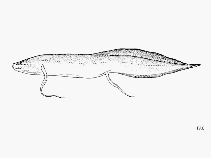 Protopterus aethiopicus
Immagine di FAO
Immagini | Francobolli, monete, materiale vario. | Google image
Immagine di FAO
Classificazione / Nomi Nomi Comuni | Sinonimi | Catalog of Fishes(Genere, Specie) | ITIS | CoL | WoRMS | Cloffa
> Ceratodontiformes (Australian lungfishes) > Protopteridae (African lungfishes)
Etymology: Protopterus: Greek, pro = first, in front of + Greek, pteron = wing, fin (Ref. 45335).
More on author: Heckel.
Etymology: Protopterus: Greek, pro = first, in front of + Greek, pteron = wing, fin (Ref. 45335).
More on author: Heckel.
Ambiente: milieu / zona climatica / distribuzione batimetrica / gamma di distribuzione Ecologia
; acqua dolce demersale; distribuzione batimetrica 0 - 60 m (Ref. 34291), usually 0 - 20 m (Ref. 34291). Tropical; 25°C - 30°C (Ref. 2059)
Distribuzione Territories | Aree FAO | Ecosistemi | Presenze | Mappa dei ritrovamenti | Introduzioni | Faunafri
Africa: subspecies Protopterus aethiopicus aethiopicus distributed in Nile basin and lakes Albert, Edward, Victoria, Nabugabo, Tanganyika, Kyoga and No (Ref. 3498), also in Lake Turkana (Ref. 52331). Subspecies P. a. congicus distributed in Congo basin, from Upper Lualaba to Kinshasa (Ref. 3498). Subspecies P. a. mesmaekersi distributed in Lower Congo River basin (Ref. 3498).
Lunghezza alla prima maturità / Dimensione / Peso / Età
Maturità: Lm 73.0, range 70 - 76 cm
Max length : 200 cm TL maschio/sesso non determinato; (Ref. 34290); common length : 130 cm TL maschio/sesso non determinato; (Ref. 34290); peso massimo pubblicato: 17.0 kg (Ref. 13302)
Max length : 200 cm TL maschio/sesso non determinato; (Ref. 34290); common length : 130 cm TL maschio/sesso non determinato; (Ref. 34290); peso massimo pubblicato: 17.0 kg (Ref. 13302)
Breve descrizione Chiavi di identificazione | Morfologia | Morfometria
Smooth, slimy, cylindrical body with deeply embedded scales (Ref. 28714). Tail pointed and confluent with the long dorsal and anal fins; dorsal fin originating at an equal distance from eye and vent, or nearer to the latter; pectoral and pelvic fins slender and filamentous (Ref. 34290). Perpendicular from dorsal fin origin closer to posterior than to anterior limbs (Bailey 1994). 55-70 scales in a longitudinal series from immediately behind head to above vent; 40-50 scales around body (Ref. 4903, 45485). 37-40 pairs of ribs (Ref. 4903). Dentition consisting of upper and lower tooth plates in the form of sharp cutting ridges (Ref. 34290). Young fish with true external gills, but usually absent in specimens above 15 cm TL (Ref. 34290). Dark slate-grey above, yellowish-grey or pinkish below, often with numerous dark spots or flecks on fins and body; some specimens bright yellow ventrally; sensory canals on head and body outlined in black (Ref. 34290).
Body shape (shape guide): elongated; Cross section: circular.
Body shape (shape guide): elongated; Cross section: circular.
Obligate air-breathing (Ref. 126274); Adults inhabit river and lake fringes, swamps and floodplains (Ref. 28714). In the Lake Victoria basin found in open lakes and marginal swamps, while in the Lake Tanganyika basin only found near rivers and deltas (Ref. 4967). Juveniles occur in matted roots of papyrus (Ref. 34291). Adults able to survive in streams and swamps that are completely dry for long periods of the year, withstanding desiccation on floodplains by aestivating in cocoons until the next rains, breathing air by a small passage leading to the outside (Ref. 45484). Obligate air-breather (Ref. 126274) under laboratory conditions (Ref. 34291), but under certain conditions lungfish in the wild may not be obligate air-breathers and the use of aerial respiration may be a function of ecological as well as physiological factors (Ref. 58531). Mature individuals breed during the flood season (Ref. 28714). One or several females spawn in burrows which are dug and cleaned by the male, who later guards the eggs and the young. Principal diet of adults and sub-adults consists of mollusks, but small fishes and insects are also eaten in small quantities; young individuals less than 35 cm TL feed almost exclusively on insects (Ref. 34291).
Ciclo vitale e comportamento di accoppiamento Maturità | Riproduzione | Deposizione | Uova | Fecondità | Larve
Male parent prepares a pit or hole nest, in which more than one female may spawn; once eggs are laid, female leaves the nest and does not return; male guards eggs and young for nearly eight weeks; male not only attacks any would-be intruders but also constantly aerates the water in the nest (Ref. 4903). A multiple spawner (Ref. 41824).
Riferimento principale
Caricare le referenze | Bibliografia | Coordinatore | Collaboratori
Gosse, J.-P., 1984. Protopteridae. p. 8-17. In J. Daget, J.-P. Gosse and D.F.E. Thys van den Audenaerde (eds.) Check-list of the freshwater fishes of Africa (CLOFFA). Volume I. ORSTOM, Paris and MRAC, Tervuren. 410 p. (Ref. 3498)
Stato della Lista Rossa IUCN (Ref. 130435: Version 2025-2 (Global))
Least Concern (LC) ; Date assessed: 02 March 2018
CITES
Not Evaluated
Minaccia per l'uomo
Harmless
Usi umani
Pesca: scarso interesse commerciale
FAO - Publication: search | FishSource |
Informazioni ulteriori
Ecologia trofica
Articoli alimentari (prede)
Alimentazione
Consumo di cibo
Razioni alimentari
Predatori
Articoli alimentari (prede)
Alimentazione
Consumo di cibo
Razioni alimentari
Predatori
Dinamica della popolazione
Parametri di crescita
Età massima / dimensioni massime
Rapporto lunghezza-peso.
Lunghezza-lunghezza rel.
Lunghezza-frequenze
Conversione di massa
Reclutamento
Abbondanza
Parametri di crescita
Età massima / dimensioni massime
Rapporto lunghezza-peso.
Lunghezza-lunghezza rel.
Lunghezza-frequenze
Conversione di massa
Reclutamento
Abbondanza
Ciclo di vita
Riproduzione
Maturità
Maturità/Gli occhielli sono relativi.
Fecondità
Deposizione
Aggregazioni riproduttive
Uova
Sviluppo delle uova
Larve
Dinamica popolazioni larvali
Riproduzione
Maturità
Maturità/Gli occhielli sono relativi.
Fecondità
Deposizione
Aggregazioni riproduttive
Uova
Sviluppo delle uova
Larve
Dinamica popolazioni larvali
Anatomia
Area branchiale
Cervello
Otolite
Area branchiale
Cervello
Otolite
Fisiologia
Composizione corporea
Nutrienti
Consumo di ossigeno
Tipo di nuoto
Velocità di nuoto
Pigmenti visivi
Suono del pesce
Malattie e parassiti
Tossicità (LC50)
Composizione corporea
Nutrienti
Consumo di ossigeno
Tipo di nuoto
Velocità di nuoto
Pigmenti visivi
Suono del pesce
Malattie e parassiti
Tossicità (LC50)
Genetica
Genome
Genetica
Eterozigosi
Ereditarietà
Diversità genetica
Genome
Genetica
Eterozigosi
Ereditarietà
Diversità genetica
Legato all'uomo
Sistemi di acquacoltura
Profili di acquacoltura
Varietà
Casi di Ciguatera
Francobolli, monete, materiale vario.
Sistemi di acquacoltura
Profili di acquacoltura
Varietà
Casi di Ciguatera
Francobolli, monete, materiale vario.
Strumenti
Libro elettronico | Giuda pratica | Generatore frequenze di lunghezza | Strumento Parametri Biologici | Mappa dei ritrovamenti |
Cattura-MSY |
Rapporti speciali
Controllo della manutenzione dell'acquario | Verificare la presenza di schede informative sulle specie | Verifica delle schede informative sull'acquacoltura
Scarica XML
Fonti Internet
AFORO (otoliths) | Alien/Invasive Species database | Aquatic Commons | BHL | Cloffa | Websites from users | Check FishWatcher | CISTI | Catalog of Fishes: Genere, Specie | DiscoverLife | ECOTOX | FAO - Publication: search | Faunafri | Fishipedia | Fishtrace | GloBI | Google Books | Google Scholar | Google | IGFA World Record | OneZoom | Open Tree of Life | Otolith Atlas of Taiwan Fishes | Acquari pubblici | PubMed | Reef Life Survey | Socotra Atlas | TreeBase | Tree of Life | Wikipedia: Go, ricerca | World Records Freshwater Fishing | Zoobank | Record zoologico
Stime basate su modelli
Indice di diversità filogenetica (Fonte Biblio. 82804): PD50 = 0.6562 [Uniqueness, from 0.5 = low to 2.0 = high].
Bayesian length-weight: a=0.00380 (0.00151 - 0.00959), b=3.10 (2.88 - 3.32), in cm total length, based on LWR estimates for this (Sub)family-body shape (Ref. 93245).
Livello trofico (Fonte Biblio. 69278): 4.4 ±0.2 se; based on diet studies.
Resilienza (Fonte Biblio. 120179): Basso, tempo minimo di raddoppiamento della popolazione 4.5 - 14 anni (Fec=7,800; assumed tm<10; assumed tmax>30).
Nutrienti (Ref. 124155): Calcium = 25.8 [5.5, 74.8] mg/100g; Iron = 0.837 [0.318, 5.003] mg/100g; Protein = 3.82 [0.22, 7.64] %; Omega3 = 0.27 [0.09, 0.82] g/100g; Selenium = 80.5 [25.2, 263.4] μg/100g; VitaminA = 17.4 [6.0, 48.3] μg/100g; Zinc = 0.886 [0.435, 1.682] mg/100g (wet weight);