>
Cichliformes (Cichlids, convict blennies) >
Cichlidae (Cichlids) > Etroplinae
Etymology: Paretroplus: Name from the Greek 'para' meaning 'on the side of'; in taxonomy it is commonly used in generic names to express similarity or relatedness; in the present case it would mean 'next to Etroplus' (S.Kullander, pers.comm. 3/11).
More on author: Bleeker.
Environment: milieu / climate zone / intervalo de profundidade / distribution range
Ecologia
; Água doce; estuarina demersal. Tropical
Africa: eastern coast of Madagascar (Ref. 78623).
Tamanho / Peso / Idade
Maturidade: Lm ? range ? - ? cm
Max length : 18.4 cm SL macho/indeterminado; (Ref. 78623)
Descrição breve
Chaves de identificação | Morfologia | Morfometria
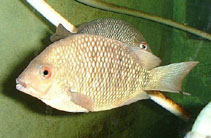
Espinhos dorsais (total) : 16 - 18; Raios dorsais moles (total) : 15 - 18; Espinhos anais: 7 - 10; Raios anais moles: 13 - 15. Diagnosis: Paretroplus polyactis is distinguished from congeners by a unique chainlink, or diamond mesh, pigmentation pattern, owing to contrasting dark scale margins and light centers over the entire flank and portions of the head; it is also the only member of the genus in which the entire series of lateral bars is both strongly pigmented and spotted, due to more darkly pigmented scale margins than centers, regardless of size (Ref. 78623). In life, P. polyactis is unique among deep-bodied members of the genus in possessing a bright red iris, a feature shared only with the elongate P. lamenabe (Ref. 78623).
Body shape (shape guide): fusiform / normal.
Life cycle and mating behavior
Maturidade | Reprodução | Desova | Ovos | Fecundidade | Larvas
Sparks, J.S., 2008. Phylogeny of the cichlid subfamily Etroplinae and taxonomic revision of the Malagasy cichlid genus Paretroplus (Teleostei: Cichlidae). Bull. Am. Mus. Nat. Hist. 314:1-151. (Ref. 78623)
Categoria na Lista Vermelha da IUCN (Ref. 130435: Version 2025-1)
Ameaça para o homem
Harmless
Utilização humana
Ferramentas
Relatórios especiais
Descarregue XML
Fontes da internet
Estimates based on models
Phylogenetic diversity index (Ref.
82804): PD
50 = 0.5001 [Uniqueness, from 0.5 = low to 2.0 = high].
Bayesian length-weight: a=0.01660 (0.00652 - 0.04224), b=2.95 (2.73 - 3.17), in cm total length, based on LWR estimates for this (Sub)family-body shape (Ref.
93245).
Nível Trófico (Ref.
69278): 2.8 ±0.3 se; based on size and trophs of closest relatives
Resiliência (Ref.
120179): Elevada, tempo mínimo de duplicação da população menor que 15 meses (Preliminary K or Fecundity.).
Fishing Vulnerability (Ref.
59153): Low vulnerability (12 of 100).
🛈