



Carcharhinus sealei (Pietschmann, 1913)
Blackspot shark
Aggiungete la vostra osservazione in Fish Watcher
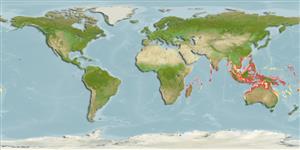
| Native range | All suitable habitat | Point map | Year 2050 |
|
| This map was computer-generated and has not yet been reviewed. |
| Carcharhinus sealei AquaMaps Data sources: GBIF OBIS |
Carica il tuo foto e Video
Immagini | Google image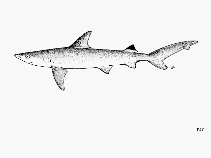 Carcharhinus sealei
Immagine di FAO
Immagini | Google image
Immagine di FAO
Classificazione / Nomi Nomi Comuni | Sinonimi | Catalog of Fishes(Genere, Specie) | ITIS | CoL | WoRMS | Cloffa
Elasmobranchi (squali e razze) (sharks and rays) > Carcharhiniformes (Ground sharks) > Carcharhinidae (Requiem sharks)
Etymology: Carcharhinus: karcharos (Gr.), sharp or jagged; rhinus, an ancient name for sharks, from rhine (Gr.), rasp, both words alluding to a shark's jagged, rasp-like skin (See ETYFish); sealei: In honor of American ichthyologist Alvin Seale (1871-1958), Stanford University, who described this shark in 1910 but used a preoccupied name (C. borneensis) (See ETYFish).
Eponymy: Alvin Seale (1871–1958) was an ichthyologist and designer of aquaria. [...] (Ref. 128868), visit book page.
Etymology: Carcharhinus: karcharos (Gr.), sharp or jagged; rhinus, an ancient name for sharks, from rhine (Gr.), rasp, both words alluding to a shark's jagged, rasp-like skin (See ETYFish); sealei: In honor of American ichthyologist Alvin Seale (1871-1958), Stanford University, who described this shark in 1910 but used a preoccupied name (C. borneensis) (See ETYFish).
Eponymy: Alvin Seale (1871–1958) was an ichthyologist and designer of aquaria. [...] (Ref. 128868), visit book page.
Ambiente: milieu / zona climatica / distribuzione batimetrica / gamma di distribuzione Ecologia
marino associati a barriera corallina; distribuzione batimetrica 0 - 40 m (Ref. 244). Tropical; 24°N - 30°S
Distribuzione Territories | Aree FAO | Ecosistemi | Presenze | Mappa dei ritrovamenti | Introduzioni | Faunafri
Indo-West Pacific: reported to occur throughout the area, from Kenya to Indonesia; north to China. Distribution west of the Indo-Malay Peninsual needs validation.
Lunghezza alla prima maturità / Dimensione / Peso / Età
Maturità: Lm 71.5, range 68 - 75 cm
Max length : 100.0 cm TL maschio/sesso non determinato; (Ref. 3678); 84.6 cm TL (female)
Max length : 100.0 cm TL maschio/sesso non determinato; (Ref. 3678); 84.6 cm TL (female)
Breve descrizione Chiavi di identificazione | Morfologia | Morfometria
A small species which is distinguished by the following characters: snout moderately long and bluntly pointed; upper anterior teeth oblique and blade-like, coarsely serrated laterally, lateral margin deeply notched and with several large and smooth basal cusplets; lower anterior teeth narrower, slightly oblique, lateral margins usually not notched and with several large basal serrae, mostly smooth; total tooth row 24-28/22-27 or 47-55; interdorsal space often without a ridge on midline, 19.0-22.4% TL; first dorsal fin is moderately tall and falcate, origin about opposite pectoral-fin free rear tip, length 14.7-16.0% TL, 1.3-1.7 times height, inner margin 2.1-2.7 in base; second dorsal fin is much smaller, broadly triangular, height 31-37% of first dorsal fin height, its origin slightly posterior to anal-fin origin; anal fin falcate, height 0.9-1.2 times second dorsal height, base 1.0-1.3 times second dorsal-fin base; body colour pale brownish to grey dorsally, whitish ventrally; second dorsal fin with a black blotch covering most of fin and often extending slightly onto upper surface of body, usually diffuse-edged and poorly defined from ground colour of fin; other fins are plain or with pale outer margins; total vertebral 146-163; monospondylous precaudal 42-48; diplospondylous precaudal 26-38; diplospondylous caudal 74-81; precaudal 71-82 (Ref. 89954).
Body shape (shape guide): fusiform / normal; Cross section: oval.
Body shape (shape guide): fusiform / normal; Cross section: oval.
Found on the continental and insular shelves, from the surf line and intertidal region to deeper water (Ref. 244). Feeds on small bony fishes (including sea horses), prawns, and squid (Ref. 9997). Viviparous (Ref. 50449). Specimens caught with size ranging from 37.0-67.4 cm TL were found to be immature, males apparently begin to mature around 71.0 cm TL and birth size is between 32.0 and 37.0 cm TL (Ref. 89954). Often caught by shore anglers (Ref. 5485). Utilized as a food fish (Ref. 244).
Ciclo vitale e comportamento di accoppiamento Maturità | Riproduzione | Deposizione | Uova | Fecondità | Larve
Viviparous, with a yok-sac placenta; 1-2 pups per litter (Ref. 244); after a gestation period of ~ 9 months(Ref.58048). 33-45 cm TL at birth (Ref. 9997). Distinct pairing with embrace (Ref. 205).
Riferimento principale
Caricare le referenze | Bibliografia | Coordinatore : Compagno, Leonard J.V. | Collaboratori
White, W.T., 2012. A redescription of Carcharhinus dussumieri and C. sealei, with resurrection of C. coatesi and C. tjutjot as valid species (Chondrichthyes: Carcharhinidae). Zootaxa 3241:1-34. (Ref. 89954)
Stato della Lista Rossa IUCN (Ref. 130435: Version 2025-2 (Global))
Vulnerabile (VU) (A2d); Date assessed: 19 May 2020
Minaccia per l'uomo
Harmless (Ref. 5485)
Usi umani
Pesca: commerciale; Pesce da pesca sportiva: si
FAO - Publication: search | FishSource |
Informazioni ulteriori
Ecologia trofica
Articoli alimentari (prede)
Alimentazione
Consumo di cibo
Razioni alimentari
Predatori
Articoli alimentari (prede)
Alimentazione
Consumo di cibo
Razioni alimentari
Predatori
Dinamica della popolazione
Parametri di crescita
Età massima / dimensioni massime
Rapporto lunghezza-peso.
Lunghezza-lunghezza rel.
Lunghezza-frequenze
Conversione di massa
Reclutamento
Abbondanza
Parametri di crescita
Età massima / dimensioni massime
Rapporto lunghezza-peso.
Lunghezza-lunghezza rel.
Lunghezza-frequenze
Conversione di massa
Reclutamento
Abbondanza
Ciclo di vita
Riproduzione
Maturità
Maturità/Gli occhielli sono relativi.
Fecondità
Deposizione
Aggregazioni riproduttive
Uova
Sviluppo delle uova
Larve
Dinamica popolazioni larvali
Riproduzione
Maturità
Maturità/Gli occhielli sono relativi.
Fecondità
Deposizione
Aggregazioni riproduttive
Uova
Sviluppo delle uova
Larve
Dinamica popolazioni larvali
Anatomia
Area branchiale
Cervello
Otolite
Area branchiale
Cervello
Otolite
Fisiologia
Composizione corporea
Nutrienti
Consumo di ossigeno
Tipo di nuoto
Velocità di nuoto
Pigmenti visivi
Suono del pesce
Malattie e parassiti
Tossicità (LC50)
Composizione corporea
Nutrienti
Consumo di ossigeno
Tipo di nuoto
Velocità di nuoto
Pigmenti visivi
Suono del pesce
Malattie e parassiti
Tossicità (LC50)
Legato all'uomo
Sistemi di acquacoltura
Profili di acquacoltura
Varietà
Casi di Ciguatera
Francobolli, monete, materiale vario.
Sistemi di acquacoltura
Profili di acquacoltura
Varietà
Casi di Ciguatera
Francobolli, monete, materiale vario.
Strumenti
Libro elettronico | Giuda pratica | Chiavi di identificazione | Generatore frequenze di lunghezza | Strumento Parametri Biologici | Mappa dei ritrovamenti |
Cattura-MSY |
Rapporti speciali
Controllo della manutenzione dell'acquario | Verificare la presenza di schede informative sulle specie | Verifica delle schede informative sull'acquacoltura
Scarica XML
Fonti Internet
AFORO (otoliths) | Aquatic Commons | BHL | Cloffa | Websites from users | Check FishWatcher | CISTI | Catalog of Fishes: Genere, Specie | DiscoverLife | ECOTOX | FAO - Publication: search | Faunafri | Fishipedia | Fishtrace | GloBI | Google Books | Google Scholar | Google | IGFA World Record | Database Nazionali | OneZoom | Open Tree of Life | Otolith Atlas of Taiwan Fishes | PubMed | Reef Life Survey | Socotra Atlas | TreeBase | Tree of Life | Wikipedia: Go, ricerca | World Records Freshwater Fishing | Record zoologico
Stime basate su modelli
Temperatura preferita (Fonte Biblio. 123201): 24.9 - 29.1, mean 28.2 °C (based on 1150 cells).
Indice di diversità filogenetica (Fonte Biblio. 82804): PD50 = 0.5000 [Uniqueness, from 0.5 = low to 2.0 = high].
Bayesian length-weight: a=0.00417 (0.00208 - 0.00835), b=3.06 (2.89 - 3.23), in cm total length, based on LWR estimates for this species & Genus-body shape (Ref. 93245).
Livello trofico (Fonte Biblio. 69278): 4.2 ±0.4 se; based on diet studies.
Resilienza (Fonte Biblio. 120179): Molto basso, tempo minimo di raddoppiamento della popolazione più di 14 anni (Fec=1).
Nutrienti (Ref. 124155): Calcium = 11.3 [2.2, 59.9] mg/100g; Iron = 0.466 [0.118, 1.294] mg/100g; Protein = 22.1 [19.4, 24.4] %; Omega3 = 0.109 [0.045, 0.251] g/100g; Selenium = 22.9 [6.0, 62.6] μg/100g; VitaminA = 72.1 [27.9, 181.4] μg/100g; Zinc = 0.669 [0.319, 1.284] mg/100g (wet weight);