>
Pleuronectiformes (Flatfishes) >
Bothidae (Lefteye flounders)
Etymology: Neolaeops: Greek, neos = new + Greek, leios = flat + Greek, ops = appearance (Ref. 45335).
Environment: milieu / climate zone / rango de profundidad / distribution range
Ecología
marino batidemersal; rango de profundidad 275 - 400 m (Ref. 9824). Deep-water
Indo-West Pacific: southern Japan, Taiwan, Indo-Australian Archipelago and Natal, South Africa (based on one specimen).
Tamaño / Peso / Age
Madurez: Lm ? range ? - ? cm
Max length : 21.0 cm SL macho / no sexado; (Ref. 9824)
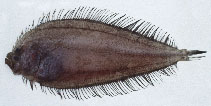
Espinas dorsales (total) : 0; Radios blandos dorsales (total) : 108 - 110; Espinas anales: 0; Radios blandos anales: 83 - 87. Dorsal contour of head with a deep concavity. Snout protruding upward. Mouth rather large, 2.6 to 2.7 times in head length; maxillary extending slightly beyond anterior margin of lower eye. Eyes very small, diameter contained .3 to 4.7 times in head length.
Body shape (shape guide): short and / or deep; Cross section: compressed.
Inhabits sand and mud bottoms (Ref. 9824).
Life cycle and mating behavior
Madurez | Reproducción | Puesta | Huevos | Fecundidad | Larva
Hensley, D.A., 1986. Bothidae. p. 854-863. In M.M. Smith and P.C. Heemstra (eds.) Smiths' sea fishes. Springer-Verlag, Berlin. (Ref. 4417)
IUCN Red List Status (Ref. 130435: Version 2025-1)
Threat to humans
Harmless
Human uses
Pesquerías: sin interés
Herramientas
Special reports
Download XML
Fuentes de Internet
Estimates based on models
Preferred temperature (Referencia
123201): 8.6 - 17.1, mean 12 °C (based on 90 cells).
Phylogenetic diversity index (Referencia
82804): PD
50 = 1.0000 [Uniqueness, from 0.5 = low to 2.0 = high].
Bayesian length-weight: a=0.00912 (0.00408 - 0.02036), b=3.04 (2.85 - 3.23), in cm total length, based on LWR estimates for this (Sub)family-body shape (Ref.
93245).
Nivel trófico (Referencia
69278): 3.6 ±0.4 se; based on size and trophs of closest relatives
Resiliencia (Referencia
120179): Medio, población duplicada en un tiempo mínimo de 1.4-4.4 años (Assuming tmax>3).
Fishing Vulnerability (Ref.
59153): Low vulnerability (16 of 100).
🛈