



Lägg till din observation i Fish Watcher
| Native range | All suitable habitat | Point map | Year 2050 |

|
| This map was computer-generated and has not yet been reviewed. |
| Aetobatus flagellum AquaMaps Data sources: GBIF OBIS |
Ladda upp din foton och Videor
Bilder | Google image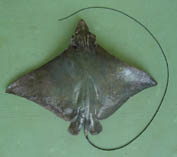 Aetobatus flagellum
Bild av Khan, M.M.
Bilder | Google image
Bild av Khan, M.M.
Klassificering / Namn Populärnamn | synonymer | Catalog of Fishes(Släkte, Arter) | ITIS | CoL | WoRMS | Cloffa
Elasmobranchii (hajar och rockor) (sharks and rays) > Myliobatiformes (Stingrays) > Aetobatidae (Pacific eagle rays)
Etymology: Aetobatus: Greek, aetos = eagle + Greek, batis, batidos = a ray (Raja sp.) (Ref. 45335).
More on authors: Bloch & Schneider.
Etymology: Aetobatus: Greek, aetos = eagle + Greek, batis, batidos = a ray (Raja sp.) (Ref. 45335).
More on authors: Bloch & Schneider.
Miljö: miljö / Klimatzon / djupintervall / distributionsområde Ekologi
marina; brackvatten bentopelagisk; amfidrom (Ref. 51243). Tropical
Utbredning Territorier | FAO områden | Ekosystem | Förekomster | Prickkarta | Utplanteringar | Faunafri
Indo-West: Persian Gulf to Borneo (patchy distribution).
Storlek / Vikt / Ålder
Könsmognad: Lm ? range ? - ? cm
Max length : 72.0 cm WD hane/ej könsbestämd; (Ref. 4440); publicerad maxvikt: 13.9 kg (Ref. 40637)
Max length : 72.0 cm WD hane/ej könsbestämd; (Ref. 4440); publicerad maxvikt: 13.9 kg (Ref. 40637)
Kort beskrivning Bestämningsnycklar | Morfologi | Morfometri
This species is characterized by the following: dorsal without spots or rings; long rostral lobe (longest in adult males) and narrowly pointed; disc very broad and short, its length 55-70% WD; pectoral fins weakly falcate and joining head at eye level, separate from rostral lobe; posterior margins moderately concave, rear tips free and broadly rounded; spiracles large, dorsolateral and visible in dorsal view; mouth ventral, its width narrower than preoral length; nasal curtain large, deeply notched centrally and with a curtain-like fringe; teeth plate-like in a single row, the upper teeth transverse, lower chevron-shaped; disc entirely smooth, no denticles or thorns; tail elongate, whip-like, ca. 1.2-2.8 times WD when undamaged; dorsal-fin small and raked back, apex broadly rounded, free rear tip short with origin behind pelvic-fin insertions; caudal stings 1 or 2, longest greater than preoral length. Colour uniform brownish or greenish brown, mostly white ventrally, pectoral tips and posterior margins of disc mostly pale brownish (Ref. 114953).
Body shape (shape guide): other; Cross section: flattened.
Body shape (shape guide): other; Cross section: flattened.
Inhabits inshore waters (Ref. 9862). Probably feeds on hard-shelled and bottom-dwelling invertebrates (Ref. 114953). Often found in brackish waters (Ref. 4832). Ovoviviparous (Ref. 50449). Caught occasionally by bottom trawl and inshore demersal gillnet fisheries off Jakarta. Utilized for its meat, but of limited value due to its rarity and small size (Ref.58048).
Livscykel och parningsbeteende Könsmognad | Reproduktion | Lek | Ägg | Fekunditet | Larver
Exhibit ovoviparity (aplacental viviparity), with embryos feeding initially on yolk, then receiving additional nourishment from the mother by indirect absorption of uterine fluid enriched with mucus, fat or protein through specialised structures (Ref. 50449).
Huvudreferens
Ladda upp dina referenser | referenser | Koordinator | Medarbetare
McEachran, J.D. and B. Séret, 1990. Myliobatididae. p. 67-70. In J.C. Quero, J.C. Hureau, C. Karrer, A. Post and L. Saldanha (eds.) Check-list of the fishes of the eastern tropical Atlantic (CLOFETA). JNICT, Lisbon; SEI, Paris; and UNESCO, Paris. Vol. 1. (Ref. 4440)
Status på IUCN:s rödlista (Ref. 130435: Version 2025-2 (Global))
Endangered (EN) (A2d); Date assessed: 30 April 2020
CITES
Not Evaluated
Hot mot människor
Harmless
Mänskliga användningsområden
Fiskeri: mindre kommeriell
FAO - Publication: search | FishSource |
Ytterligare information
Trofisk ekologi
Livsmedelsartiklar (preys)
Födosammansättning
Födointag
Matransoner
Predatorer
Livsmedelsartiklar (preys)
Födosammansättning
Födointag
Matransoner
Predatorer
Ekologi
Ekologi
Ekologi
Populationsdynamik
Tillväxtparametrar
Max. åldrar / storlekar
Längd-vikt rel.
Längd-längd rel.
Längd-frekvenser
Massakonvertering
Rekrytering
Abundans
Tillväxtparametrar
Max. åldrar / storlekar
Längd-vikt rel.
Längd-längd rel.
Längd-frekvenser
Massakonvertering
Rekrytering
Abundans
Livscykel
Reproduktion
Könsmognad
Mognad/Gills rel.
Fekunditet
Lek
Lekande aggregat
Ägg
Utveckling av ägg
Larver
Larvdynamik
Reproduktion
Könsmognad
Mognad/Gills rel.
Fekunditet
Lek
Lekande aggregat
Ägg
Utveckling av ägg
Larver
Larvdynamik
Anatomi
Gälyta
Hjärna
Otolit
Gälyta
Hjärna
Otolit
Fysiologi
Kroppssammansättning
Näringsämnen
Syreförbrukning
Typ av simning
Simhastighet
Visuella pigment
Ljud från fisk
Sjukdomar & Parasiter
Toxicitet (LC50)
Kroppssammansättning
Näringsämnen
Syreförbrukning
Typ av simning
Simhastighet
Visuella pigment
Ljud från fisk
Sjukdomar & Parasiter
Toxicitet (LC50)
Människorelaterad
Vattenbrukssystem
Vattenbruksprofiler
Avelslinjer
Ciguatera-fall
Frimärken, mynt, diverse.
Vattenbrukssystem
Vattenbruksprofiler
Avelslinjer
Ciguatera-fall
Frimärken, mynt, diverse.
Verktyg
E-bok | Fälthandbok | Bestämningsnycklar | Längdfördelnings-verktyg | Livshistorie-verktyg | Prickkarta |
Fångst-MSY |
Särskilda rapporter
Kontrollera för underhåll av akvarium | Kontrollera om det finns faktablad om arter | Kontrollera om det finns faktablad om vattenbruk
Ladda ner XML
Internet-källor
AFORO (otoliths) | Aquatic Commons | BHL | Cloffa | Websites from users | Check FishWatcher | CISTI | Catalog of Fishes: Släkte, Arter | DiscoverLife | ECOTOX | FAO - Publication: search | Faunafri | Fishipedia | Fishtrace | GloBI | Google Books | Google Scholar | Google | IGFA World Record | Nationella databaser | OneZoom | Open Tree of Life | Otolith Atlas of Taiwan Fishes | PubMed | Reef Life Survey | Socotra Atlas | TreeBase | Tree of Life | Wikipedia: Go, sök | World Records Freshwater Fishing | Zoologiskt register
Uppskattningar baserade på modeller
Önskad temperatur (Ref. 123201): 24.2 - 29.2, mean 28.2 °C (based on 1688 cells).
Index för fylogenetisk mångfald (Ref. 82804): PD50 = 0.5625 [Uniqueness, from 0.5 = low to 2.0 = high].
Bayesian length-weight: a=0.01000 (0.00244 - 0.04107), b=3.04 (2.81 - 3.27), in cm total length, based on all LWR estimates for this body shape (Ref. 93245).
Trofisk nivå (Ref. 69278): 3.6 ±0.5 se; based on size and trophs of closest relatives
Resiliens (Ref. 120179): Låg, lägsta populationsfördubblingstid 4,5-14 år (Fec assumed to be <100).