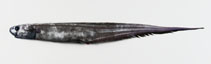
Teleostei (teleosts) >
Notacanthiformes (Halosaurs and deep-sea spiny eels) >
Notacanthidae (Deep-sea spiny eels)
Etymology: Notacanthus: Greek, noton = back + Greek, akantha = thorn (Ref. 45335).
Eponymy: Prince Charles Lucien Bonaparte (originally Jules Laurent Lucien) (1803–1857) was a nephew of Napoleon Bonaparte and a renowned biologist and zoologist. [...] (Ref. 128868), visit book page.
More on author: Risso.
Environment: milieu / climate zone / depth range / distribution range
Ecology
Marine; benthopelagic; depth range 487 - 2000 m (Ref. 56504). Deep-water; 55°N - 20°N, 25°W - 17°E
Western North Atlantic on Bear Seamount, and eastern North Atlantic from the Faroe Islands to North Africa and the Mediterranean.
Size / Weight / Age
Maturity: Lm ? range ? - ? cm
Max length : 26.0 cm TL male/unsexed; (Ref. 26178)
Short description
Identification keys | Morphology | Morphometrics
Hovers and swims along at slight head-down angle. Often caught in large numbers and possibly gregarious. Depth range from 700-2000 m and from 487-1034 m in the eastern Ionian Sea (Ref. 56504). Feeds on sessile and motile invertebrates such as bryozoans, ophiuroids, amphipods and sponges. Spawns in June-July in the Mediterranean. Sexually dimorphic, males generally smaller and with enlarged nasal rosettes (Ref. 4449).
Life cycle and mating behavior
Maturity | Reproduction | Spawning | Eggs | Fecundity | Larvae
Sulak, K.J., 1990. Notacanthidae. p. 133-135. In J.C. Quero, J.C. Hureau, C. Karrer, A. Post and L. Saldanha (eds.) Check-list of the fishes of the eastern tropical Atlantic (CLOFETA). JNICT, Lisbon; SEI, Paris; and UNESCO, Paris. Vol. 1. (Ref. 4449)
IUCN Red List Status (Ref. 130435: Version 2025-2)
Threat to humans
Harmless
Human uses
Fisheries: of no interest
Tools
Special reports
Download XML
Internet sources