Elasmobranchii (Haie und Rochen) (sharks and rays) >
Rajiformes (Skates and rays) >
Rajidae (Skates)
Etymology: Amblyraja: Greek, amblys = darkness + Latin, raja, -ae = ray (Raja sp.) (Ref. 45335).
Environment: milieu / climate zone / Tiefenbereich / distribution range
Ökologie
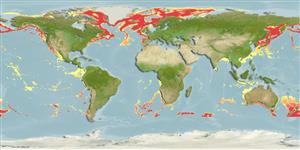
seewasser bathydemersal; tiefenbereich 92 - 2925 m (Ref. 119696), usually 300 - 2300 m (Ref. 9261). Deep-water; -1°C - 4°C (Ref. 119696); 82°N - 50°S, 180°W - 180°E
Arctic, Indian, Pacific and Atlantic oceans: in cold and deep waters.
Length at first maturity / Size / Gewicht / Alter
Geschlechtsreife: Lm ?, range 94 - ? cm
Max length : 112 cm TL Männchen/unbestimmt; (Ref. 114953); 100.0 cm TL (female)
Kurzbeschreibung
Bestimmungsschlüssel | Morphologie | Morphometrie
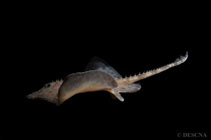
Grey-brown with large dark blotches (Ref. 26346). Tail very short (Ref. 26346). Mid-dorsal row of stout thorns which extend from nuchal region to first dorsal fin. Thorns close posterior to the pelvic girdle larger than along the tail (Ref. 6902). Upper surface dark mouse gray, dark blue gray or dark brown with small rounded spots. Lower surface white and sooty in variable patterns (Ref. 6902).
Body shape (shape guide): other.
Found on the lower continental slope (Ref. 6871), probably most common on deep slopes and at abyssal depths (Ref. 114953). Benthic (Ref. 58426); meso- to bathybenthic, on muddy substrate (Ref. 119696). Adults feed on all kinds of bottom animals (Ref. 3167). Prefer polar temperatures from hatching to maturity and eggs are incubated successfully and regularly in water as cold as 0°C (Ref. 6902). Oviparous. Distinct pairing with embrace. Young may tend to follow large objects, such as their mother (Ref. 205). Eggs are oblong capsules with stiff pointed horns at the corners deposited in sandy or muddy flats (Ref. 205). Egg capsule measures 81-125 mm long and 50-80 mm wide (Ref. 41251). Hatching size at 16-18 cm TL (Ref. 114953) (15 cm long in Ref. 119696).
Life cycle and mating behavior
Geschlechtsreife | Fortpflanzung | Ablaichen | Eier | Fecundity | Larven
Oviparous, paired eggs are laid. Embryos feed solely on yolk (Ref. 50449). Distinct pairing with embrace. Young may tend to follow large objects, such as their mother (Ref. 205).
McEachran, J.D. and K.A. Dunn, 1998. Phylogenetic analysis of skates, a morphologically conservative clade of elasmobranchs (Chondrichthyes: Rajidae). Copeia 1998(2):271-290. (Ref. 27314)
IUCN Rote Liste Status (Ref. 130435: Version 2025-1)
Bedrohung für Menschen
Harmless
Nutzung durch Menschen
Fischereien: nicht kommerziell
Tools
Zusatzinformationen
Download XML
Internet Quellen
Estimates based on models
Preferred temperature (Ref.
123201): 0.3 - 8.8, mean 3.3 °C (based on 3242 cells).
Phylogenetic diversity index (Ref.
82804): PD
50 = 0.5039 [Uniqueness, from 0.5 = low to 2.0 = high].
Bayesian length-weight: a=0.00302 (0.00141 - 0.00645), b=3.24 (3.07 - 3.41), in cm total length, based on LWR estimates for this (Sub)family-body shape (Ref.
93245).
Trophic level (Ref.
69278): 4.3 ±0.5 se; based on diet studies.
Widerstandsfähigkeit (Ref.
120179): niedrig, Verdopplung der Population dauert 4,5 - 14 Jahre. (Fec assumed to be <100).
Fishing Vulnerability (Ref.
59153): High to very high vulnerability (67 of 100).
🛈
Climate Vulnerability (Ref.
125649): Moderate vulnerability (38 of 100).
🛈
Nutrients (Ref.
124155): Calcium = 3.31 [0.50, 67.94] mg/100g; Iron = 0.302 [0.029, 4.121] mg/100g; Protein = 15.3 [13.3, 17.3] %; Omega3 = 0.494 [0.199, 1.207] g/100g; Selenium = 20.6 [3.6, 97.8] μg/100g; VitaminA = 6.37 [0.45, 85.10] μg/100g; Zinc = 0.206 [0.013, 2.410] mg/100g (wet weight);