>
Siluriformes (Catfishes) >
Auchenoglanididae (Flatnose catfishes)
Etymology: Parauchenoglanis: Greek, para = near + Greek, auchen = neck + Greek, glanis = a fish that can eat the bait without touching the hook; a cat fish (Ref. 45335); ngamensis: Named after the country of its type locality, Lake Ngami, Botswana.
More on author: Boulenger.
Environment: milieu / climate zone / profondeur / distribution range
Écologie
; eau douce benthopélagique; pH range: 6.2 - 7.5; dH range: 4 - 25. Tropical; 22°C - 26°C (Ref. 2059)
Africa: Okavango and upper Zambezi (sub)basins): Angola, Botswana, Namibia, and Zambia.
Taille / Poids / Âge
Maturité: Lm ? range ? - ? cm
Max length : 38.0 cm SL mâle / non sexé; (Ref. 52193)
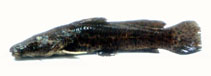
Rayons mous dorsaux (Total) : 7 - 8; Rayons mous anaux: 8 - 11; Vertèbres: 34 - 36. This species is distinguished from its congeners ahli, altipinnis, balayi, buettikoferi, longiceps, monkei, pantherinus, punctatus by having a broad humeral process (vs. pointed); further differs from altipinnis, balayi, pantherinus, punctatus by having a coarse skin (vs. smooth); further differs from buettikoferi, monkei with the anterior margin of the pectoral-fin spine being mostly smooth (vs. serrated from base to tip); further differs from ahli, punctatus by having shorter barbels, with external mandibular barbel not reaching the distal tip of the pectoral fin (vs. barbels long, with external mandibular barbel reaching distal tip of pectoral fin or beyond); differs from zebratus by the broad humeral process which is clearly visible through the skin and presence of five to seven bars on small specimens (?100 mm SL) and vertical rows of spots on larger-sized specimens (vs. broad humeral process embedded under the skin and four to five vertical rows of spots on small specimens, and bars on larger-sized specimens); differs from stiassnyae by having vertical rows of black spots interspaced by scattered smaller black spots (vs. irregularly scattered large blotches and absence of smaller spots on the flank), and having shorter barbels, external mandibular barbel not reaching the distal tip of the pectoral-fin spine (vs. longer barbels, external mandibular extending beyond tip of the pectoral-fin spine).Parauchenoglanis ngamensis is distinguished from the other members of the P. ngamensis group, i.e. patersoni, dolichorhinus, luendaensis, chiumbeensis, by the presence of scattered black spots in between the vertical rows of black spots (vs. absent); further distinguished from these species by having a heavily spotted head and fins (vs. unspotted head and fins in luendaensis; few black spots or unspotted head and fins in patersoni, dolichorhinus, and head and fins with faint black spots in chiumbeensis); further distinguished from chiumbeensis, luendaensis by having a round caudal fin (vs. truncated); differs from ernstswartzi, megalasma by the vertical rows of black spots (vs. vertical rows of black blotches) and bluntly triangular snout (vs. round in ernstswartzi and partly round in megalasma); differs further from ernstswartzi by the eyes situated dorsolateral (vs. eyes situated dorsally, i.e. high on the head towards its upper edge) and absence of black spots at the base of pectoral fin (vs. present); differs from lueleensis by the presence of numerous black spots in between vertical rows (vs. one or two spots present in between vertical rows); differs from poikilos by having a rounded caudal fin (vs. truncated) and the absence of crescent-shaped marking on the caudal-fin base (vs. presence) (Ref. 132425).
Cross section: oval.
It prfers rocky habitats or marginal vegetation in slow-flowing rivers and lagoons, often taking shelter under trees (Ref. 52193). It feeds on small fishes and invertebrates like snails, shrimps and insects (Ref. 52193). Eggs are large and relatively few, suggesting parental care, but no details are know (Ref. 52193). It 'grunts' when removed from the water (Ref. 7248, 52193).
Life cycle and mating behavior
Maturité | Reproduction | Frai | Œufs | Fécondité | Larves
Sithole, Y., E.J.W.M.N. Vreven, P.H.N. Bragança, T. Musschoot and A. Chakona, 2024. Nine in one: integrative taxonomic evidence of hidden species diversity in the widespread Zambezi grunter, Parauchenoglanis ngamensis (Siluriformes: Auchenoglanididae), from southern and south-central Africa. Zool. J. Linn. Soc. 202:1-33. (Ref. 132425)
Statut dans la liste rouge de l'IUCN (Ref. 130435: Version 2025-1)
Menace pour l'homme
Harmless
Utilisations par l'homme
Pêcheries: intérêt commercial mineur; Aquarium: potentiel
Outils
Articles particuliers
Télécharger en XML
Sources Internet
Estimates based on models
Phylogenetic diversity index (Réf.
82804): PD
50 = 0.5000 [Uniqueness, from 0.5 = low to 2.0 = high].
Bayesian length-weight: a=0.00617 (0.00276 - 0.01377), b=3.09 (2.88 - 3.30), in cm total length, based on LWR estimates for this species & (Sub)family-body (Ref.
93245).
Niveau trophique (Réf.
69278): 3.6 ±0.58 se; based on food items.
Résilience (Réf.
120179): Milieu, temps minimum de doublement de population : 1,4 à 4,4 années (Preliminary K or Fecundity.).
Fishing Vulnerability (Ref.
59153): Moderate vulnerability (36 of 100).
🛈