>
Siluriformes (Catfishes) >
Amphiliidae (Loach catfishes) > Leptoglaninae
Etymology: Leptoglanis: Greek,leptos = thin + Greek, glanis = a fish that can eat the bait without touching the hook; a cat fish (Ref. 45335).
More on author: Boulenger.
Environment: milieu / climate zone / пределы глубины / distribution range
экология
; пресноводный демерсальный. Tropical
Africa: Pool Malebo (= Stanley Pool)(Ref. 51287), middle Congo River main course (Ref. 106245), Aruwimi River (Ref. 51287, 106290) and Wagenia Falls (Ref. 51287, 106245) in Democratic Republic of the Congo, as well as the Ubangi in Democratic Republic of the Congo and Central African Republic (Ref. 51287).
Size / Вес / Возраст
половая зрелость: Lm ? range ? - ? cm
Max length : 7.8 cm TL самец/пол неопределен; (Ref. 3236)
Краткое описание
определительные ключи | морфология | морфометрия
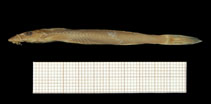
позвонки: 38 - 41. Anterior margin of mouth with a single large medial fleshy lobe and several lateral fleshy lobes of variable size (Ref. 51287). Premaxillary with toothless anterior portion, posterior portion with slender conical teeth (Ref. 51287). Lower jaw toothless and exceptionally elongate (Ref. 51287). Coronomeckelian bone exceptionally large and well defined (Ref. 51287). Hyomandibular and quadrate joined by a complex joint consisting of a cartilaginous ball partially enclosed by bony sockets (Ref. 51287). An exceptionally short braincase (Ref. 51287). Pharynx and gill arches with numerous soft fleshy fingerlike or digitiform structures (Ref. 51287). Pectoral and pelvic fins excessively branched (Ref. 51287). Number of principal caudal fin rays: 7+8 (Ref. 51287). In life this species has a milk-white body, with fine, faint melanophores concentrated just above and below lateral line canal and in dorsal portions of myoseptal troughs (Ref. 51287). Two broad oblique bands on the dorsal fin, two broad vertical bands on the caudal fin and a single broad band in the middle of the pectoral fin, all composed of brownish melanophores (Ref. 51287); anal fin with a few fine melanophores on some rays, otherwise colorless (Ref. 51287); adipose and pelvic fins without notable color features (Ref. 51287).
Body shape (shape guide): elongated.
Life cycle and mating behavior
половая зрелость | размножение | нерест | икра | Fecundity | личинки
Roberts, T.R., 2003. Systematics and osteology of Leptoglaninae a new subfamily of the African catfish family Amphiliidae, with descriptions of three new genera and six new species. Proc. Calif. Acad. Sci. 54(5):81-132. (Ref. 51287)
Статус Красного Списка МСОП (Ref. 130435: Version 2025-1)
Угроза для людей
Harmless
Использование человеком
дополнительная информация
инструменты
Специальные отчеты
Скачать в формате XML
ресурсы в Интернет
Estimates based on models
Phylogenetic diversity index (ссылка
82804): PD
50 = 0.7500 [Uniqueness, from 0.5 = low to 2.0 = high].
Bayesian length-weight: a=0.00389 (0.00180 - 0.00842), b=3.12 (2.94 - 3.30), in cm total length, based on all LWR estimates for this body shape (Ref.
93245).
Trophic level (ссылка
69278): 3.1 ±0.4 se; based on size and trophs of closest relatives
устойчивость к внешним воздействиям (ссылка
120179): высокий, минимальное время удвоения популяции до 15 месяцев (Preliminary K or Fecundity.).
Fishing Vulnerability (Ref.
59153): Low vulnerability (10 of 100).
🛈