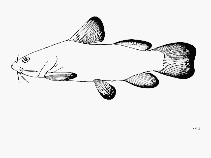
Classification / Names
Nombres comunes | Sinónimos | Catalog of Fishes(Género, Especie) | ITIS | CoL | WoRMS | Cloffa
>
Siluriformes (Catfishes) >
Claroteidae (Claroteid catfishes)
Etymology: Lophiobagrus: Greek, lophos = crest + Mozarabic, bagre, Greek, pagros = a fish (Dentex sp.) (Ref. 45335).
Environment: milieu / climate zone / rango de profundidad / distribution range
Ecología
; agua dulce demersal. Tropical
Africa: only known from the type locality (Lake Tanganyika).
Tamaño / Peso / Age
Madurez: Lm ? range ? - ? cm
Max length : 8.0 cm TL macho / no sexado; (Ref. 3236)
Short description
Claves de identificación | Morfología | Morfometría
Concealed mostly among rocks during daytime. Nocturnal habits prevail (Ref. 45232). Of no food value (Ref. 4967).
Life cycle and mating behavior
Madurez | Reproducción | Puesta | Huevos | Fecundidad | Larva
Pairing comes near the gonadal maturation of the female, then separation occurs after spawning (Ref. 45232). Paired females showed higher GSI values and larger oocytes in their ovaries than solitary females (Ref. 45232). Oviparous (Ref. 205). Previously thought that care of the eggs and young is done by mouthbrooding solitary males (Ref. 45232); new findings describe the genus Lophiobagrus to be hiding its brood in caves (Ref. 89712).
Risch, L.M., 1986. Bagridae. p. 2-35. In J. Daget, J.-P. Gosse and D.F.E. Thys van den Audenaerde (eds.) Check-list of the freshwater fishes of Africa (CLOFFA). ISNB, Brussels; MRAC, Tervuren; and ORSTOM, Paris. Vol. 2. (Ref. 3236)
IUCN Red List Status (Ref. 130435: Version 2025-1)
Threat to humans
Harmless
Human uses
Pesquerías: de interés potencial; Acuario: Potencial
Herramientas
Special reports
Download XML
Fuentes de Internet
Estimates based on models
Phylogenetic diversity index (Referencia
82804): PD
50 = 0.5625 [Uniqueness, from 0.5 = low to 2.0 = high].
Bayesian length-weight: a=0.00891 (0.00399 - 0.01990), b=3.00 (2.81 - 3.19), in cm total length, based on LWR estimates for this (Sub)family-body shape (Ref.
93245).
Nivel trófico (Referencia
69278): 3.2 ±0.5 se; based on size and trophs of closest relatives
Resiliencia (Referencia
120179): Alto, población duplicada en un tiempo mínimo inferior a 15 meses (Preliminary K or Fecundity.).
Fishing Vulnerability (Ref.
59153): Low vulnerability (10 of 100).
🛈