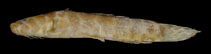
Classificação / Names
Nomes comuns | Sinónimos | Catalog of Fishes(Género, Espécies) | ITIS | CoL | WoRMS | Cloffa
>
Siluriformes (Catfishes) >
Auchenoglanididae (Flatnose catfishes)
Etymology: Notoglanidium: Greek, noton = back + Greek, glanis = a fish that can eat the bait without touching the hook; a cat fish; diminutive (Ref. 45335); thomasi: Named in honour of N.W. Thomas, collector of the type specimens (Ref. 94168).
Eponymy: Northcote Whitridge Thomas (1868–1936) was a British Government anthropologist who conducted field research in Nigeria (1909–1913) and Sierra Leone (1914–1915) particularly among the Edo, Yoruba, Kukuruku, Esa and Igbo people. [...] (Ref. 128868), visit book page.
More on author: Boulenger.
Environment: milieu / climate zone / intervalo de profundidade / distribution range
Ecologia
; Água doce demersal. Tropical; 10°N - 6°N
Africa: north and east of the Sierra Leone river estuary, including Tai River and Kasewe Forest, in Sierra Leone (Ref. 57126, 94168).
Tamanho / Peso / Idade
Maturidade: Lm ? range ? - ? cm
Max length : 4.4 cm SL macho/indeterminado; (Ref. 94168)
Raios dorsais moles (total) : 12 - 16; Espinhos anais: 0; Raios anais moles: 9 - 12; Vértebras: 34. Diagnosis: Notoglanidium thomasi differs from all congeners in the large interorbital distance, 41.0-46.7% of head length vs. less than 37% in all other species (Ref. 94168). It differs from other species in the genus in having: a rather large eye diameter, 9.1-12.5% of head length vs. smaller in N. depierrei, N. maculatum and N. pallidum; a small combined premaxillary tooth plate width, 11.9-18.2% of head length vs. larger in N. akiri, N. boutchangai, N. macrostoma and N. pembetadi; and a relatively large number of soft dorsal-fin rays, 12-16 vs. less in N. akiri, N. boutchangai, N. depierrei and N. macrostoma (Ref. 94168).
Body shape (shape guide): elongated.
Life cycle and mating behavior
Maturidade | Reprodução | Desova | Ovos | Fecundidade | Larvas
Geerinckx, T., E. Vreven, M. Dierick, L.V. Hoorebeke and D. Adriaens, 2013. Revision of Notoglanidium and related genera (Siluriformes: Claroteidae) based on morphology and osteology. Zootaxa 3691(1):165-191. (Ref. 94168)
Categoria na Lista Vermelha da IUCN (Ref. 130435: Version 2025-1)
Ameaça para o homem
Harmless
Utilização humana
Ferramentas
Relatórios especiais
Descarregue XML
Fontes da internet
Estimates based on models
Phylogenetic diversity index (Ref.
82804): PD
50 = 0.5020 [Uniqueness, from 0.5 = low to 2.0 = high].
Bayesian length-weight: a=0.00525 (0.00218 - 0.01265), b=3.09 (2.88 - 3.30), in cm total length, based on LWR estimates for this (Sub)family-body shape (Ref.
93245).
Nível Trófico (Ref.
69278): 3.2 ±0.5 se; based on size and trophs of closest relatives
Resiliência (Ref.
120179): Elevada, tempo mínimo de duplicação da população menor que 15 meses (Preliminary K or Fecundity.).
Fishing Vulnerability (Ref.
59153): Low vulnerability (10 of 100).
🛈