>
Siluriformes (Catfishes) >
Auchenoglanididae (Flatnose catfishes)
Etymology: Parauchenoglanis: Greek, para = near + Greek, auchen = neck + Greek, glanis = a fish that can eat the bait without touching the hook; a cat fish (Ref. 45335).
Eponymy: Dr H Monke collected the holotype in Cameroon. No further details are known. (Ref. 128868), visit book page.
Environment: milieu / climate zone / rango de profundidad / distribution range
Ecología
; agua dulce demersal. Tropical; 15°N - 13°S
Africa: from the Ouémé River in Benin to the rivers Sanaga (Ref. 50834, 78218, 81642) and Dja (middle Congo River basin) (Ref. 51193) in Cameroon. Also present in the middle Congo River basin in Democratic Republic of the Congo (Ref. 41580, 41585, 41590, 41591, 46861).
Tamaño / Peso / Age
Madurez: Lm ? range ? - ? cm
Max length : 15.1 cm SL macho / no sexado; (Ref. 81642)
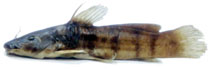
Espinas dorsales (total) : 2; Radios blandos dorsales (total) : 7; Espinas anales: 0; Radios blandos anales: 7 - 8. Diagnosis: caudal peduncle short and broad, its depth more than 2 times the horizontal distance between anal and adipose fin bases, rarely even deeper; anterior edge of pectoral spine coarsely serrated, with numerous small serrations, more numerous than those along the posterior edge (Ref. 81642). Barbels generally short: maxillary barbel reaching a little beyond pectoral spine base, external mandibular barbel not reaching tip of spine (Ref. 81642) but up to level of dorsal-fin spine, and inner mandibular barbel up to beginning of opercula (Ref. 57126), but it should however be noted that some juvenile specimens have slightly longer barbels (Ref. 81642). Adipose fin not always high and solid; colour pattern usually with 5-7 vertical bands (Ref. 81642).
Body shape (shape guide): elongated.
Nocturnal and crepuscular; preys on insect larvae, crustaceans, and small fishes (Ref. 6868). Maximum reported total length 24.5cm (Ref. 3236).
Life cycle and mating behavior
Madurez | Reproducción | Puesta | Huevos | Fecundidad | Larva
Risch, L.M., 1986. Bagridae. p. 2-35. In J. Daget, J.-P. Gosse and D.F.E. Thys van den Audenaerde (eds.) Check-list of the freshwater fishes of Africa (CLOFFA). ISNB, Brussels; MRAC, Tervuren; and ORSTOM, Paris. Vol. 2. (Ref. 3236)
IUCN Red List Status (Ref. 130435: Version 2025-1)
Threat to humans
Harmless
Human uses
Pesquerías: sin interés
Herramientas
Special reports
Download XML
Fuentes de Internet
Estimates based on models
Phylogenetic diversity index (Referencia
82804): PD
50 = 0.5000 [Uniqueness, from 0.5 = low to 2.0 = high].
Bayesian length-weight: a=0.00741 (0.00405 - 0.01357), b=3.08 (2.91 - 3.25), in cm total length, based on LWR estimates for this species & (Sub)family-body (Ref.
93245).
Nivel trófico (Referencia
69278): 3.7 ±0.57 se; based on food items.
Resiliencia (Referencia
120179): Alto, población duplicada en un tiempo mínimo inferior a 15 meses (Preliminary K or Fecundity.).
Fishing Vulnerability (Ref.
59153): Low vulnerability (10 of 100).
🛈