



Phyllonemus typus Boulenger, 1906
Spatula-barbeled catfish
muatnaik fotos/gambar dan video
Gambar | imej Google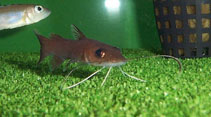 Phyllonemus typus
foto/gambar oleh Germeau, G./ Doumont, Y.
Gambar | imej Google
foto/gambar oleh Germeau, G./ Doumont, Y.
klasifikasi / Nama Nama-nama umum | Sinonim (persamaan) | Catalog of Fishes(Marga, Jenis) | ITIS | CoL | WoRMS | Cloffa
> Siluriformes (Catfishes) > Claroteidae (Claroteid catfishes)
Etymology: Phyllonemus: Greek, phyhllon = leaf + Greek, nema = filament (Ref. 45335).
More on author: Boulenger.
Etymology: Phyllonemus: Greek, phyhllon = leaf + Greek, nema = filament (Ref. 45335).
More on author: Boulenger.
Lingkungan: lingkungan / zona iklim / kisaran kedalaman / jangkauan distribusi Ekologi
; air tawar dasar (demersal); kisaran kedalaman ? - 20 m (Ref. 3236). Tropical; 3°S - 9°S
Penyebaran Wilayah | Daerah-daerah FAO | Ekosistem | Kemunculan | peta titik | Introduksi | Faunafri
Africa: Lake Tanganyika.
Ukuran / Berat / umur
Inhabit inshore waters to 20 m deep (Ref. 3236), and restricted to the rocky littoral zone (Ref. 38677). Rest on the bottom with the modified maxillary barbels (Ref. 6868). Nocturnally active meanwhile resting beneath rocks and within interstices in the rock or rubble substrata during the day (Ref. 38677). Oviparous (Ref. 205). First report of bi-parental mouthbrooding among catfishes (Ref. 38677). No value as food (Ref. 4967). Stomach contents examined consist of shrimps, occasionally debris from larval insects, and fish remains which apparently are clupeids (possibly Limnothrissa. Aquarium conditions: pH7.6; hardness of water 12; temperature tolerance 25°C; tank capacity, 60L; food, e.g. live worms, Daphnia; aquarium lighting, as dark as possible as long as fishes are visible; a peaceful, bottom-swimming fish which prefers a set-up with rocks, plants, and driftwood in an aquarium (Ref. 6398).
Siklus hidup dan perilaku kawin Kematangan | Reproduksi, perkembang biakan | Pemijahan | telur-telur | Fekunditas | Larva
First report of biparental mouthbrooding among catfishes (Ref. 38677). Either or both parents rear their eggs and yolk-sac larvae inside the mouth (Ref. 38677). Young are released from the mouth after the yolk-sac has been absorbed and kept guarded by both parents while feeding beneath rocks (Ref. 38677). After feeding, young return to the parent's mouth (Ref. 38677). No evidence of brooding was found among solitary individuals, additionally, females in this group have low gonadosomatic index (Ig) indicating that a strong bonding of pairs precede egg laying (Ref. 38677).
rujukan utama
Unggah referensi Anda | Acuan | Koordinator | mitra
Risch, L.M., 1986. Bagridae. p. 2-35. In J. Daget, J.-P. Gosse and D.F.E. Thys van den Audenaerde (eds.) Check-list of the freshwater fishes of Africa (CLOFFA). ISNB, Brussels; MRAC, Tervuren; and ORSTOM, Paris. Vol. 2. (Ref. 3236)
Status IUCN Red List (Ref. 130435: Version 2025-2 (Global))
kurang bimbang (LC) ; Date assessed: 07 April 2021
CITES
Not Evaluated
ancaman kepada manusia
Harmless
penggunaan manusia
Perikanan: memiliki potensi kepentingan; Akuarium: potensial
FAO - Publication: search | FishSource |
informasi lanjut
Dinamika populasi
Parameter pertumbuhan
Maks. usia / ukuran
Panjang-berat rel.
Panjang-panjang rel.
ukuran frekuensi
Konversi massa
pemulihan
Kelimpahan
Parameter pertumbuhan
Maks. usia / ukuran
Panjang-berat rel.
Panjang-panjang rel.
ukuran frekuensi
Konversi massa
pemulihan
Kelimpahan
Siklus hidup
Reproduksi, perkembang biakan
Kematangan
Kedewasaan / insang rel.
Fekunditas
Pemijahan
Agregasi pemijahan
telur-telur
pekembangan telor
Larva
Dinamika larva
Reproduksi, perkembang biakan
Kematangan
Kedewasaan / insang rel.
Fekunditas
Pemijahan
Agregasi pemijahan
telur-telur
pekembangan telor
Larva
Dinamika larva
Anatomi
Area insang
Otak
Otolith
Area insang
Otak
Otolith
Fisiologi
Komposisi tubuh
Nutrisi
Konsumsi oksigen
Jenis renang
Kecepatan berenang
Pigmen visual
Suara ikan
Penyakit & Parasit
Toksisitas (LC50)
Komposisi tubuh
Nutrisi
Konsumsi oksigen
Jenis renang
Kecepatan berenang
Pigmen visual
Suara ikan
Penyakit & Parasit
Toksisitas (LC50)
Genetika
genom
Genetika
Heterozigositas
Diturunkan
Keanekaragaman Genetik
genom
Genetika
Heterozigositas
Diturunkan
Keanekaragaman Genetik
Yang berhubungan dengan manusia
Sistem akuakultur
profil budidaya air
Strain
Kasus Ciguatera
Perangko, koin, dll.
Sistem akuakultur
profil budidaya air
Strain
Kasus Ciguatera
Perangko, koin, dll.
Alat, peralatan
Kuis organik | E-book | Penuntun lapangan | tanda freqkuenci panjang | peringkat sejarah hidup | peta titik |
Tangkap-MSY |
laporan khas
muat turun XML
Sumber internet
AFORO (otoliths) | Aquatic Commons | BHL | Cloffa | Websites from users | semak peneliti ikan | CISTI | Catalog of Fishes: Marga, Jenis | DiscoverLife | ECOTOX | FAO - Publication: search | Faunafri | Fishipedia | Fishtrace | GloBI | Google Books | Google Scholar | Google | IGFA World Record | OneZoom | Open Tree of Life | Otolith Atlas of Taiwan Fishes | PubMed | Reef Life Survey | Socotra Atlas | TreeBase | Tree of Life | Wikipedia: pergi, Cari | World Records Freshwater Fishing | Zoobank | Catatan Zoologi
Estimasi berdasarkan model
Indeks keanekaragaman filogenetik (Acuan 82804): PD50 = 0.6250 [Uniqueness, from 0.5 = low to 2.0 = high].
Bayesian length-weight: a=0.00912 (0.00416 - 0.02000), b=3.00 (2.81 - 3.19), in cm total length, based on LWR estimates for this (Sub)family-body shape (Ref. 93245).
Tingkat Trofik (Acuan 69278): 4.0 ±0.70 se; based on food items.
Daya lenting (Acuan 120179): Tinggi, Waktu penggandaan populasi minimum kurang dari 15 bulan (Preliminary K or Fecundity.).