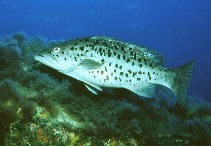
Environment: milieu / climate zone / intervalo de profundidade / distribution range
Ecologia
marinhas demersal; intervalo de profundidade 1 - 200 m (Ref. 27000), usually 20 - 30 m. Subtropical; 39°N - 12°N, 27°W - 12°W (Ref. 5222)
Eastern Atlantic: known with certainty only from the Azores, Madeira, Cape Verde, and the Canary Islands.
Tamanho / Peso / Idade
Maturidade: Lm ? range ? - ? cm
Max length : 80.0 cm TL macho/indeterminado; (Ref. 5222); peso máx. Publicado: 3.0 kg (Ref. 5222)
Descrição breve
Chaves de identificação | Morfologia | Morfometria
Espinhos dorsais (total) : 11; Raios dorsais moles (total) : 14 - 16; Espinhos anais: 3; Raios anais moles: 10 - 12. Distinguished by the following characteristics: brownish or dark grey body color of adults with irregular pale blotches and spots and prominent maxillary streak (capable of reversing body color pattern when under stress); juveniles mottled greenish brown, with prominent white spots on head and body, median fins with white streaks and hyaline golden pectoral fins; oblong and compressed body, depth 3.0-3.3 times in SL; head length 2.6-2.9 times in SL; convex interorbital area; enlarged serrae of preopercle at the angle, forming rounded lobe below shallow indentation on vertical limb; few small serrae on subopercle and interopercle; subequal sizes of anterior and posterior nostrils in juveniles, adults with 3 times larger posterior nostrils compared to anterior ones; lower jaws extends well in front of upper jaw (Ref. 89707).
Body shape (shape guide): fusiform / normal; Cross section: oval.
Adults occur near the bottom in rocky areas; juveniles are found in tide pools (Ref. 89707). Two specimens collected from the Cape Verde by J. Cadenat were from a depth of '50' m (Ref. 27000). Observed to have a homing behaviour leaving the bay of Garajau on the south coast of Madeira Island in spring and returning every year in autumn (Ref. 75147).
Life cycle and mating behavior
Maturidade | Reprodução | Desova | Ovos | Fecundidade | Larvas
Heemstra, P.C. and J.E. Randall, 1993. FAO Species Catalogue. Vol. 16. Groupers of the world (family Serranidae, subfamily Epinephelinae). An annotated and illustrated catalogue of the grouper, rockcod, hind, coral grouper and lyretail species known to date. Rome: FAO. FAO Fish. Synop. 125(16):382 p. (Ref. 5222)
Categoria na Lista Vermelha da IUCN (Ref. 130435: Version 2025-1)
Ameaça para o homem
Harmless
Utilização humana
Pescarias: espécies comerciais
Ferramentas
Relatórios especiais
Descarregue XML
Fontes da internet
Estimates based on models
Preferred temperature (Ref.
123201): 16.7 - 25.3, mean 19.9 °C (based on 56 cells).
Phylogenetic diversity index (Ref.
82804): PD
50 = 0.5000 [Uniqueness, from 0.5 = low to 2.0 = high].
Bayesian length-weight: a=0.00933 (0.00426 - 0.02047), b=3.05 (2.88 - 3.22), in cm total length, based on LWR estimates for this Genus-body shape (Ref.
93245).
Nível Trófico (Ref.
69278): 4.3 ±0.8 se; based on size and trophs of closest relatives
Resiliência (Ref.
120179): Baixo, tempo mínimo de duplicação da população 4,5 - 14 anos (Preliminary K or Fecundity.).
Fishing Vulnerability (Ref.
59153): Moderate to high vulnerability (52 of 100).
🛈
Nutrients (Ref.
124155): Calcium = 48.1 [19.8, 93.7] mg/100g; Iron = 0.889 [0.481, 1.676] mg/100g; Protein = 18.5 [16.6, 20.2] %; Omega3 = 0.377 [0.243, 0.607] g/100g; Selenium = 33.8 [17.2, 66.8] μg/100g; VitaminA = 20 [6, 74] μg/100g; Zinc = 0.519 [0.366, 0.765] mg/100g (wet weight);