Klassifizierung / Names
Namen | Synonyme | Catalog of Fishes(Gattung, Arten) | ITIS | CoL | WoRMS | Cloffa
>
Galaxiiformes (Southern smelts) >
Galaxiidae (Galaxiids) > Galaxiinae
Etymology: Galaxiella: Greek, galaxias, ou = a kind of fish, diminutive (Ref. 45335).
Environment: milieu / climate zone / Tiefenbereich / distribution range
Ökologie
; süßwasser benthopelagisch. Temperate; 8°C - 24°C (Ref. 2060); 31°S - 35°S
Oceania: endemic to Australia. Known only from the southwestern part in coastal streams between Albany and Ellen Brook.
Length at first maturity / Size / Gewicht / Alter
Geschlechtsreife: Lm 4.7 range ? - ? cm
Max length : 6.0 cm SL Männchen/unbestimmt; (Ref. 44894); common length : 3.5 cm SL Männchen/unbestimmt; (Ref. 5259)
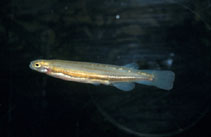
Rückenflossenstacheln (insgesamt) : 0; Rückenflossenweichstrahlen (insgesamt) : 6 - 8; Afterflossenstacheln: 0; Afterflossenweichstrahlen: 9 - 12; Wirbelzahl: 38 - 43. Adults are brown-grey dorsally and white ventrally with several whitish blotches near the dorsal midline, and a broad brown stripe just below midline from behind eye to caudal-fin base.
Body shape (shape guide): elongated.
Facultative air-breathing (Ref. 126274); Occur in swift-flowing, tea-colored streams coursing through karri forests. Also found in swamps, ponds and roadside ditches. Usually lives in small flowing streams near submerged vegetation. Water inhabited is darkly tannin-stained and acidic (pH 3.0-6.0) (Ref. 44894). Feed on insects and their larvae in water; also on micro-crustaceans. Spawning has been recorded from July to October, peaking between August and September when water temperatures and day length are on the rise. Multiple-spawning females deposit several clutches of eggs over a protracted period of a few weeks in flooded vegetation. Sexual maturity is attained in the first year. Spent adults usually die a few months after spawning (Ref. 44894).
Allen, G.R., 1989. Freshwater fishes of Australia. T.F.H. Publications, Inc., Neptune City, New Jersey. (Ref. 5259)
IUCN Rote Liste Status (Ref. 130435: Version 2025-1)
Bedrohung für Menschen
Harmless
Nutzung durch Menschen
Tools
Zusatzinformationen
Download XML
Internet Quellen
Estimates based on models
Phylogenetic diversity index (Ref.
82804): PD
50 = 0.5625 [Uniqueness, from 0.5 = low to 2.0 = high].
Bayesian length-weight: a=0.00490 (0.00206 - 0.01165), b=3.12 (2.91 - 3.33), in cm total length, based on LWR estimates for this (Sub)family-body shape (Ref.
93245).
Trophic level (Ref.
69278): 3.2 ±0.36 se; based on food items.
Widerstandsfähigkeit (Ref.
120179): mittel, Verdopplung der Population dauert 1,4 - 4,4 Jahre. (K=3.70; tm=1; tmax=1; mean Fec=65).
Fishing Vulnerability (Ref.
59153): Low vulnerability (10 of 100).
🛈