Issue
Junior synonym Notarius parmocassis is valid according to Marceniuk et al, 2023 (Ref. 130933:440)
Environment: milieu / Klimaatzone / Diepte / distribution range
Ecologie
marien; brak water demersaal; diepte 1 - 20 m (Ref. 5217). Tropical; 12°N - 23°S, 77°W - 34°W
South America: Rivers and estuaries from Gulf of Venezuela to mouth of the Amazon River.
Grootte / Gewicht / Leeftijd
Maturiteit: Lm ? range ? - ? cm
Max length : 63.0 cm TL mannelijk / geslacht onbekend; (Ref. 5217); common length : 40.0 cm TL mannelijk / geslacht onbekend; (Ref. 5217)
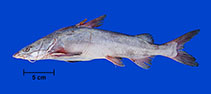
Dorsale stekels (totaal) : 1. Three pairs of barbels on rostral region, two pairs on lower jaw, one pair on posterior end of maxilla; end of maxilla barbel reaching insertion of pectoral fin; body yellow-brown, whitish ventrally; each fin membrane blackish distally (Ref. 13608).
Body shape (shape guide): elongated.
Found on muddy bottoms of shallow brackish waters; also in marine waters. Reproduction seems to occur between May and June. The female lays down 20-30 eggs having a diameter of 10-12 mm, agglutinated in mucus. The male guards the eggs for 10-12 days until hatching (Ref. 35381). Marketed fresh.
Levenscyclus en paargedrag
Maturiteit | Voortplanting | Paaien | Eieren | Fecunditeit | Larven
Taylor, W.R. and N.A. Menezes, 1978. Ariidae. In W. Fischer (ed.) FAO species identification sheets for fishery purposes. West Atlantic (Fishing Area 31). volume 1. [pag. var.]. FAO, Rome. (Ref. 3265)
Status op de Rode Lijst van het IUCN (Ref. 130435: Version 2025-1)
Gevaar voor de mens
Traumatogenic (Ref. 58010)
Gebruik door de mens
Visserij: van minder commercieel belang
Tools
Speciale rapporten
Download XML
Internetbronnen
Estimates based on models
Preferred temperature (Ref.
123201): 26.9 - 28.2, mean 27.5 °C (based on 253 cells).
Fylogenetische diversiteitsindex (Ref.
82804): PD
50 = 0.5000 [Uniqueness, from 0.5 = low to 2.0 = high].
Bayesian length-weight: a=0.00631 (0.00381 - 0.01046), b=3.14 (2.99 - 3.29), in cm total length, based on LWR estimates for this species & (Sub)family-body (Ref.
93245).
Trofisch niveau (Ref.
69278): 3.5 ±0.4 se; based on size and trophs of closest relatives
Weerstandsvermogen (Ref.
120179): Gemiddeld, minimale populatieverdubbelingstijd 1,4-4,4 jaar (Preliminary K or Fecundity.).
Prior r = 0.28, 95% CL = 0.18 - 0.42, Based on 1 data-limited stock assessment.
Fishing Vulnerability (Ref.
59153): Moderate to high vulnerability (45 of 100).
🛈
Nutrients (Ref.
124155): Calcium = 107 [57, 214] mg/100g; Iron = 0.926 [0.592, 1.507] mg/100g; Protein = 17 [15, 19] %; Omega3 = 0.152 [0.086, 0.257] g/100g; Selenium = 50.2 [27.5, 103.3] μg/100g; VitaminA = 19 [9, 42] μg/100g; Zinc = 1.24 [0.86, 1.87] mg/100g (wet weight);