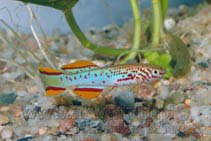
>
Cyprinodontiformes (Rivulines, killifishes and live bearers) >
Nothobranchiidae (African rivulines)
Etymology: Fundulopanchax: Latin, fundus = bottom; a peculiar name for a topminnow, coined for a bottom species of Atlantic coast being "the abode of the fundulus mudfish" + Greek, soma = body.
Eponymy: Captain R D Gardner collected the types at Okwoga on a small tributary of the Cross River in Nigeria. We have been unable to find any further biographical data. (Ref. 128868), visit book page.
More on author: Boulenger.
Environment: milieu / climate zone / rango de profundidad / distribution range
Ecología
; agua dulce bentopelágico; pH range: 6.0 - 7.2; dH range: 5 - 8; no migratorio. Tropical; 22°C - 25°C (Ref. 31267)
Africa: Cross River and the lower part of the Beno.
Tamaño / Peso / Age
Madurez: Lm ? range ? - ? cm
Max length : 6.5 cm TL macho / no sexado; (Ref. 3788)
Occurs in brooks, swamps, polls and streams in the humid forested and highland savanna and rainforest (Ref. 3788). Not a seasonal killifish. Bottom spawner, 1 month incubation (Ref. 27139). Aquarium keeping: minimum aquarium size 60 cm (Ref. 51539).
Life cycle and mating behavior
Madurez | Reproducción | Puesta | Huevos | Fecundidad | Larva
Collier, G.E., 2010. The genus Fundulopanchax: taxonomic history and molecular phylogeny. J. Am. Killifish Ass. 43(1):3-26. (Ref. 87109)
IUCN Red List Status (Ref. 130435: Version 2025-1)
Threat to humans
Harmless
Human uses
Pesquerías: sin interés; Acuario: Comercial
Herramientas
Special reports
Download XML
Fuentes de Internet
Estimates based on models
Phylogenetic diversity index (Referencia
82804): PD
50 = 0.5000 [Uniqueness, from 0.5 = low to 2.0 = high].
Bayesian length-weight: a=0.00955 (0.00430 - 0.02123), b=2.89 (2.70 - 3.08), in cm total length, based on LWR estimates for this species & (Sub)family-body (Ref.
93245).
Nivel trófico (Referencia
69278): 3.3 ±0.5 se; based on size and trophs of closest relatives
Fishing Vulnerability (Ref.
59153): Low vulnerability (10 of 100).
🛈