>
Beloniformes (Needle fishes) >
Belonidae (Needlefishes)
Etymology: Tylosurus: Greek, tylos = callus + Greek, oura = tail (Ref. 45335).
More on authors: Péron & Lesueur.
Environment: milieu / climate zone / Tiefenbereich / distribution range
Ökologie
seewasser riff-verbunden; ozeanodrom (Ref. 51243); tiefenbereich 0 - 13 m (Ref. 58302). Tropical; 26°C - 29°C (Ref. 4959); 21°N - 1°N
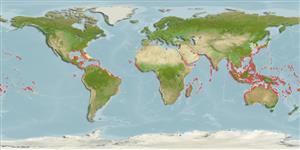
Indo-West Pacific: Red Sea and South Africa (Ref. 5317) and Persian Gulf (Ref. 68964) to French Polynesia (Ref. 6784), north to Japan (Ref. 559), south to New South Wales, Australia (Ref. 33390). Replaced by Tylosurus crocodilus fodiator in the eastern Pacific. Western Atlantic: New Jersey, USA to Brazil (Ref. 7251). Eastern Atlantic: Fernando Poo, Cameroon, Liberia, and Ascension Island (Ref. 5757); from Senegal and Guinea (Ref. 28587); and Cape Verde (Ref. 27000). Recorded from the Mediterranean Sea (Ref. 83387).
Length at first maturity / Size / Gewicht / Alter
Geschlechtsreife: Lm 51.7, range 50 - 55 cm
Max length : 150 cm TL Männchen/unbestimmt; (Ref. 30573); common length : 90.0 cm SL Männchen/unbestimmt; (Ref. 9682); max. veröff. Gewicht: 6.4 kg (Ref. 40637)
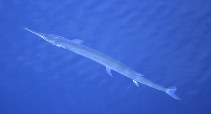
Rückenflossenstacheln (insgesamt) : 0; Rückenflossenweichstrahlen (insgesamt) : 21 - 24; Afterflossenstacheln: 0; Afterflossenweichstrahlen: 19 - 22; Wirbelzahl: 75 - 80. This species with is distinguished by the following characters: body elongate, circular in cross-section; D 21-24 with anterior rays forming a relatively high lobe, 5.4-10.6 body length (excluding the head and caudal fin); dorsal fin origin about equal with or slightly in front to anal fin origin; A 19-22 with anterior rays forming a relatively high lobe, in 5.5-8.0 in BL; pectoral-fin rays 13 to 15 (usually 14 or 15); 270-340 predorsal scales; 75-80 vertebrae; jaws extremely long, forming a stout beak armed with very sharp teeth; no gill rakers absent; caudal fin deeply emarginate, the lower lobe much longer than the upper one and the caudal peduncle with a distinct, black lateral keel; body colour dark bluish green above, silvery below; juveniles (to 20 cm body length) with elevated black lobe in posterior part of dorsal fin which is lost with growth; scales and bones green (Ref. 9682, 90102).
Body shape (shape guide): elongated; Cross section: circular.
A pelagic species (Ref. 26340) found over lagoon and seaward reefs. Solitary or in small groups. Feeds on fishes (Ref. 11889). Oviparous (Ref. 205). Eggs may be found attached to objects in the water by tendrils on the egg's surface (Ref. 205). Feared by fishers because they can cause puncture wounds with their sharp snouts when jumping out of the water, e.g. when alarmed or attracted to lights at night. Although sold fresh and considered a good food fish, its market is limited due to the green-colored flesh (Ref. 5217). Widespread in tropical Indo-Pacific, divisible in two subspecies (Ref 90102). Caught by casting or trolling surface or near-surface lures; also with purse seines and drift nets (Ref. 9682).
Randall, J.E., G.R. Allen and R.C. Steene, 1990. Fishes of the Great Barrier Reef and Coral Sea. University of Hawaii Press, Honolulu, Hawaii. 506 p. (Ref. 2334)
IUCN Rote Liste Status (Ref. 130435: Version 2025-1)
Bedrohung für Menschen
Traumatogenic (Ref. 4690)
Nutzung durch Menschen
Fischereien: kommerziell; Sportfisch: ja
Tools
Zusatzinformationen
Download XML
Internet Quellen
Estimates based on models
Preferred temperature (Ref.
123201): 27.1 - 29.2, mean 28.5 °C (based on 1591 cells).
Phylogenetic diversity index (Ref.
82804): PD
50 = 0.5010 [Uniqueness, from 0.5 = low to 2.0 = high].
Bayesian length-weight: a=0.00112 (0.00093 - 0.00136), b=3.10 (3.04 - 3.16), in cm total length, based on LWR estimates for this species (Ref.
93245).
Trophic level (Ref.
69278): 4.4 ±0.4 se; based on diet studies.
Generation time: 3.7 ( na - na) years. Estimated as median ln(3)/K based on 1
growth studies.
Widerstandsfähigkeit (Ref.
120179): mittel, Verdopplung der Population dauert 1,4 - 4,4 Jahre. (Preliminary K or Fecundity.).
Prior r = 0.57, 95% CL = 0.38 - 0.86, Based on 1 data-limited stock assessment.
Fishing Vulnerability (Ref.
59153): Moderate to high vulnerability (47 of 100).
🛈
Climate Vulnerability (Ref.
125649): Very high vulnerability (91 of 100).
🛈
Nutrients (Ref.
124155): Calcium = 45.3 [13.1, 198.8] mg/100g; Iron = 0.475 [0.220, 1.403] mg/100g; Protein = 16.4 [13.7, 19.6] %; Omega3 = 0.109 [0.046, 0.331] g/100g; Selenium = 39.2 [19.0, 90.4] μg/100g; VitaminA = 176 [28, 893] μg/100g; Zinc = 0.644 [0.414, 1.036] mg/100g (wet weight); based on
nutrient studies.