Environment: milieu / Klimaatzone / Diepte / distribution range
Ecologie
marien; zoet water; brak water pelagic-neritic; katadroom (Ref. 46888). Tropical
Eastern Atlantic: West African coast, from the outlet of the River Senegal (Ref. 57400) to Congo, and on the islands of Bioko (Fernando Poo) and Sao Tome (Ref. 81659). Also reported from Mauritania (Ref. 5377).
Lengte bij maturiteit / Grootte / Gewicht / Leeftijd
Maturiteit: Lm 15.0, range 13 - 24 cm
Max length : 40.0 cm TL mannelijk / geslacht onbekend; (Ref. 2683); common length : 25.0 cm SL mannelijk / geslacht onbekend; (Ref. 7399)
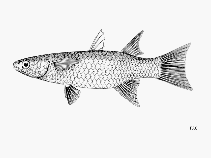
Anale zachte stralen: 8 - 9. Diagnosis: 8-9 anal soft rays; anal fin and lower lobe of caudal fin yellowish (Ref. 57400). Scales large, 25-30 (usually 27-29) in a longitudinal series (excluding scales on caudal fin base)(Ref. 57400, 81659), 8-10.5 scale rows between pelvic and first dorsal fins (Ref. 81659). Body with ctenoid scales, except for anterior predorsal scales which are cycloid and extend to anterior nostril or slightly beyond; scales usually with only 1 groove (some predorsal scales with 2 or rarely 3 small grooves); posterior end of maxilla sigmoid, curved down over premaxilla; serrate, anteroventral edge of lachrymal distinctly concave; pharyngobranchial organ with 2 valves, anteroventral valve usually a small, finger-like process, sometimes with fringe of smaller processes or papillae positioned ventrally at base, posterodorsal valve usually a small, squarish flap which is fimbriate, terminating in 2-3 short filaments (Ref. 81659).
Body shape (shape guide): fusiform / normal.
Very common in lagoons and estuaries; an extremely euryhaline species (from 0-66‰), but preferring areas close to the sea in estuaries and lagoons (Ref. 57400), often with muddy substrates (Ref. 81659). Inhabits shallow coastal waters, estuaries and brackish lagoons (Ref. 2683), including mangroves (Ref. 2683, 81659), creeks, estuaries, inundated mudflats (Ref. 81659) and freshwater rivers (Ref. 7399). Oviparous, eggs are pelagic and non-adhesive (Ref. 205). Maximum reported size 297 mm FL, but possibly up to 400 mm (Ref. 57400, 81659).
Thomson, J.M., 1990. Mugilidae. p. 855-859. In J.C. Quero, J.C. Hureau, C. Karrer, A. Post and L. Saldanha (eds.) Check-list of the fishes of the eastern tropical Atlantic (CLOFETA). JNICT, Lisbon; SEI, Paris; and UNESCO, Paris. Vol. 2. (Ref. 7399)
Status op de Rode Lijst van het IUCN (Ref. 130435: Version 2025-1)
Gevaar voor de mens
Harmless
Gebruik door de mens
Visserij: commercieel
Tools
Speciale rapporten
Download XML
Internetbronnen
Estimates based on models
Preferred temperature (Ref.
123201): 23.4 - 27.9, mean 26.5 °C (based on 66 cells).
Fylogenetische diversiteitsindex (Ref.
82804): PD
50 = 1.0000 [Uniqueness, from 0.5 = low to 2.0 = high].
Bayesian length-weight: a=0.01148 (0.00995 - 0.01325), b=2.95 (2.91 - 2.99), in cm total length, based on LWR estimates for this species (Ref.
93245).
Trofisch niveau (Ref.
69278): 2.0 ±0.0 se; based on diet studies.
Generation time: 5.9 ( na - na) years. Estimated as median ln(3)/K based on 1
growth studies.
Weerstandsvermogen (Ref.
120179): Gemiddeld, minimale populatieverdubbelingstijd 1,4-4,4 jaar (K=0.18-0.27;).
Fishing Vulnerability (Ref.
59153): Moderate vulnerability (43 of 100).
🛈
Nutrients (Ref.
124155): Calcium = 161 [60, 429] mg/100g; Iron = 1.4 [0.6, 3.0] mg/100g; Protein = 18.2 [16.4, 19.9] %; Omega3 = 0.317 [0.149, 0.698] g/100g; Selenium = 38.4 [16.8, 93.2] μg/100g; VitaminA = 21.1 [5.3, 84.7] μg/100g; Zinc = 2.19 [1.44, 3.38] mg/100g (wet weight);