>
Ophidiiformes (Cusk eels) >
Carapidae (Pearlfishes) > Hypopleuroninae
Etymology: Hypopleuron: Greek, hypo = under + greek ,pleura = in the side of (Ref. 45335).
More on authors: Smith & Radcliffe.
Issue
Previously in Ophidiidae, Neobythitinae. Changed in 2024 by Wong et al. (2024; Ref. 133041).
Environment: milieu / climate zone / distribuzione batimetrica / distribution range
Ecologia
marino batidemersale; distribuzione batimetrica 300 - 575 m (Ref. 34024). Deep-water
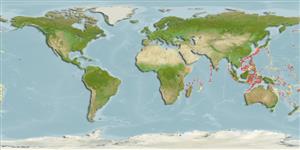
Indo-West Pacific: Arabian Sea, Andaman Sea and the Philippines.
Size / Peso / Age
Maturità: Lm ? range ? - ? cm
Max length : 57.0 cm SL maschio/sesso non determinato; (Ref. 34024)
Short description
Chiavi di identificazione | Morfologia | Morfometria
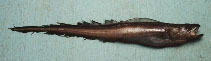
Jaws equal in length or lower jaw slightly protruding; no spines on opercle or subopercle; a canine tooth at the front of each upper jaw bone; median basibranchial tooth patch 1; branchiostegal rays 8; lateral line with small scales that overlie an inner series of larger scales that bear neuromasts; precaudal centra 22, parapophyses broad and inflated, inclosing the swim bladder (Ref. 34024).
Body shape (shape guide): eel-like.
A benthic species found on the continental slope (Ref. 75154). Common species (Ref. 34024). Oviparous, with oval pelagic eggs floating in a gelatinous mass (Ref. 205).
Life cycle and mating behavior
Maturità | Riproduzione | Deposizione | Uova | Fecundity | Larve
Nielsen, J.G., D.M. Cohen, D.F. Markle and C.R. Robins, 1999. Ophidiiform fishes of the world (Order Ophidiiformes). An annotated and illustrated catalogue of pearlfishes, cusk-eels, brotulas and other ophidiiform fishes known to date. FAO Fish. Synop. 125(18):178p. Rome: FAO. (Ref. 34024)
IUCN Red List Status (Ref. 130435: Version 2025-1)
Threat to humans
Harmless
Human uses
Pesca: di nessun interesse
Strumenti
Special reports
Download XML
Fonti Internet
Estimates based on models
Preferred temperature (Fonte Biblio.
123201): 6.6 - 12.9, mean 10.2 °C (based on 176 cells).
Phylogenetic diversity index (Fonte Biblio.
82804): PD
50 = 1.0000 [Uniqueness, from 0.5 = low to 2.0 = high].
Bayesian length-weight: a=0.00110 (0.00040 - 0.00297), b=3.08 (2.85 - 3.31), in cm total length, based on LWR estimates for this (Sub)family-body shape (Ref.
93245).
Trophic level (Fonte Biblio.
69278): 3.9 ±0.6 se; based on size and trophs of closest relatives
Fishing Vulnerability (Ref.
59153): Moderate to high vulnerability (48 of 100).
🛈