



Distichodus fasciolatus Boulenger, 1898
Sharktail distichodus
アップロード 写真 そして ビデオ
画像 | グーグルの画像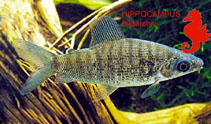 Distichodus fasciolatus
画像によって Hippocampus-Bildarchiv
画像 | グーグルの画像
画像によって Hippocampus-Bildarchiv
分類 / 名前 共通名の | 類義語 | Catalog of Fishes(部類, 種) | ITIS | CoL | WoRMS | Cloffa
> Characiformes (Characins) > Distichodontidae (Distichodus)
Etymology: Distichodus: Greek, di = two + Greek, stix, stichos = line, row (Ref. 45335); fasciolatus: The species name "fasciolatus" is derived from the Latin word "fascia", meaning "band, bandage, girdle, zone, strip, stripe" with "fasciola" as a diminutive and most probably refers to the well-marked transverse bars on the flanks (Ref. 96324).
More on author: Boulenger.
Etymology: Distichodus: Greek, di = two + Greek, stix, stichos = line, row (Ref. 45335); fasciolatus: The species name "fasciolatus" is derived from the Latin word "fascia", meaning "band, bandage, girdle, zone, strip, stripe" with "fasciola" as a diminutive and most probably refers to the well-marked transverse bars on the flanks (Ref. 96324).
More on author: Boulenger.
環境:環境 / 気候帯 / 深さの範囲 / 分布範囲 生態学
; 新鮮な水 外洋の; pH range: 6.0 - 8.0; dH range: ? - 25. Tropical; 23°C - 27°C (Ref. 13371)
分布 領土 | 国連食糧農業機関の区域 | エコシステム | 事件 | 目的のマップ | 導入 | Faunafri
Africa: widespread in the Congo River basin, from the marine Lower Congo up to the upper Lualaba (Ref. 96324), but absent from the Luapula-Moero (Ref. 2970, 96324). Reports from Lake Tanganyika (Ref. 4967, 6770, 36901) are questionable and probably incorrect (Ref. 96324).
サイズ / 重さ / 年齢
成熟: Lm ? range ? - ? cm
Max length : 60.0 cm TL オス/雌雄の選別がない; (Ref. 7094); 最大公表体重: 3.0 kg (Ref. 7094)
Max length : 60.0 cm TL オス/雌雄の選別がない; (Ref. 7094); 最大公表体重: 3.0 kg (Ref. 7094)
簡単な記述 検索表 | 形態学 | 形態計測学
背面の脊椎 (合計) : 0; 背鰭 (合計) : 24 - 26; 肛門の骨: 0; 臀鰭: 12 - 16. Diagnosis: Within the Congo River basin, Distichodus fasciolatus can be distinguished from D. affinis, D. altus, D. decemmaculatus, D. noboli, D. notospilus and D. teugelsi by its higher total number of lateral lina scales, 61-70 vs. less than 46 in the six other species, and from D. maculatus by the absence of large, dark spots all over the body, instead of 13-20 vertical dark bars, and a higher number of dorsal fin rays, 24-26, vs. 19-21 (Ref. 96324). It can be distinguished from D. antonii by its inferior mouth, vs. terminal, and its higher number of scales between the lateral line and the dorsal fin, 13-16 vs. 10-12; from D. lusosso by its inferior mouth, vs. terminal, its feebly compressed snout, vs. distinctively prolonged, and its higher number of dark vertical bars along the body, at least in specimens larger than 150 mm standard length, 13-20 vs. 6-8; from D. sexfasciatus by its higher number of teeth on the outer row of both jaws, 20-30 vs. 12-18, its higher number of dark vertical bars on the flanks, at least in specimens larger than 150 mm standard length, 13-20 vs. 6-8, and its brownish-yellowish colouration vs. orange-reddish to red (Ref. 96324). Moreover, Distichodus fasciolatus can be differentiated from both the D. atroventralis complex and D. langi by its lower number of pelvic fin rays, 10, exceptionally 11, vs. 11, exceptionally 10 for the D. atroventralis complex and always 11 for D. langi; from the D. atroventralis complex by its higher number of dark vertical bars, at least in specimens larger than 150 mm standard length, 13-20 vs. 6-9, and presence of pale pelvic fins, at least in specimens larger than 200 mm standard length, vs. blackish; and from D. langi by a combination of characteristics: 24-26 total dorsal fin rays, vs. 26-28, and a lower head depth, 35.9-62.9% of head length for specimens of comparable size, vs. 67.4-69.4% of head length (Ref. 96324).
Body shape (shape guide): short and / or deep.
Body shape (shape guide): short and / or deep.
Distichodus fasciolatus is a bottom-dweller in streams, found near the muddy bottom in lakes, large rivers and their dead-ending branches (Ref. 96324). This species is mainly herbivorous, though insects and nematodes were also found in the stomachs (Ref. 96324). The fry are born near the river banks just before the April or December floods and feed on zooplankton and insect larvae in the flooded zones; adults mainly feed on insect larvae, aquatic plants, leaves and seeds (Ref. 96324).
ライフサイクルと交尾行動 成熟 | 繁殖 | 放精 | 卵 | 生産力 | 幼生
主な参考文献
参考文献のアップロード | 参考文献 | コーディネーター | 協力者
Moelants, T., V. Mbadu Zebe, J. Snoeks and E. Vreven, 2014. A review of the Distichodus antonii assemblage (Characiformes: Distichodontidae) from the Congo basin. J. Nat. Hist. 48(27-28):1707-1735. (Ref. 96324)
CITES
Not Evaluated
人間に対する脅威
Harmless
人間の用途
水産業: 興味がない
FAO - Publication: search | FishSource |
より多くの情報
ライフサイクル
繁殖
成熟
成熟度/エラ
生産力
放精
産卵群
卵
卵の開発
幼生
幼生の動力
繁殖
成熟
成熟度/エラ
生産力
放精
産卵群
卵
卵の開発
幼生
幼生の動力
解剖学
カマ
脳
オトリス
カマ
脳
オトリス
生理学
体組成
栄養素
酸素消費
水泳タイプ
泳ぐ速さ
視覚色素
フィッシュ・サウンド
病気と寄生虫
毒性(LC50)
体組成
栄養素
酸素消費
水泳タイプ
泳ぐ速さ
視覚色素
フィッシュ・サウンド
病気と寄生虫
毒性(LC50)
遺伝子の
ゲノム
遺伝子の
ヘテロ接合性
遺伝
遺伝的多様性
ゲノム
遺伝子の
ヘテロ接合性
遺伝
遺伝的多様性
用具
オーガニック・クイズ | 電子書籍 | 野外観察図鑑 | 長さ-周波数ウィザード | 生活史の基盤ツール | 目的のマップ |
キャッチ-MSY |
特記事項
XMLをダウンロードして下さい
インターネットの情報源
AFORO (otoliths) | Aquatic Commons | BHL | Cloffa | Websites from users | Check FishWatcher | CISTI | Catalog of Fishes: 部類, 種 | DiscoverLife | ECOTOX | FAO - Publication: search | Faunafri | Fishipedia | Fishtrace | GloBI | Google Books | Google Scholar | Google | IGFA World Record | OneZoom | Open Tree of Life | Otolith Atlas of Taiwan Fishes | 公共の水族館 | PubMed | Reef Life Survey | Socotra Atlas | TreeBase | 生命の木 | Wikipedia: 行く, 検索する | World Records Freshwater Fishing | Zoobank | 動物に関する記録