



Distichodus fasciolatus Boulenger, 1898
Sharktail distichodus
Sube tu fotos y Vídeos
Imágenes | Google image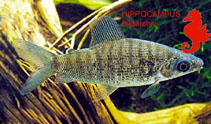 Distichodus fasciolatus
Foto de Hippocampus-Bildarchiv
Imágenes | Google image
Foto de Hippocampus-Bildarchiv
Clasificación / Nombres Nombres comunes | Sinónimos | Catalog of Fishes(Género, Especie) | ITIS | CoL | WoRMS | Cloffa
> Characiformes (Characins) > Distichodontidae (Distichodus)
Etymology: Distichodus: Greek, di = two + Greek, stix, stichos = line, row (Ref. 45335); fasciolatus: The species name "fasciolatus" is derived from the Latin word "fascia", meaning "band, bandage, girdle, zone, strip, stripe" with "fasciola" as a diminutive and most probably refers to the well-marked transverse bars on the flanks (Ref. 96324).
More on author: Boulenger.
Etymology: Distichodus: Greek, di = two + Greek, stix, stichos = line, row (Ref. 45335); fasciolatus: The species name "fasciolatus" is derived from the Latin word "fascia", meaning "band, bandage, girdle, zone, strip, stripe" with "fasciola" as a diminutive and most probably refers to the well-marked transverse bars on the flanks (Ref. 96324).
More on author: Boulenger.
Entorno: milieu / zona climática / rango de profundidad / gama de distribución Ecología
; agua dulce pelágico; pH range: 6.0 - 8.0; dH range: ? - 25. Tropical; 23°C - 27°C (Ref. 13371)
Distribución Territorios | Áreas FAO | Ecosistemas | Ocurrencias, apariciones | Mapa de puntos | Introducciones | Faunafri
Africa: widespread in the Congo River basin, from the marine Lower Congo up to the upper Lualaba (Ref. 96324), but absent from the Luapula-Moero (Ref. 2970, 96324). Reports from Lake Tanganyika (Ref. 4967, 6770, 36901) are questionable and probably incorrect (Ref. 96324).
Tamaño / Peso / Edad
Madurez: Lm ? range ? - ? cm
Max length : 60.0 cm TL macho / no sexado; (Ref. 7094); peso máximo publicado: 3.0 kg (Ref. 7094)
Max length : 60.0 cm TL macho / no sexado; (Ref. 7094); peso máximo publicado: 3.0 kg (Ref. 7094)
Descripción breve Claves de identificación | Morfología | Morfometría
Espinas dorsales (total) : 0; Radios blandos dorsales (total) : 24 - 26; Espinas anales: 0; Radios blandos anales: 12 - 16. Diagnosis: Within the Congo River basin, Distichodus fasciolatus can be distinguished from D. affinis, D. altus, D. decemmaculatus, D. noboli, D. notospilus and D. teugelsi by its higher total number of lateral lina scales, 61-70 vs. less than 46 in the six other species, and from D. maculatus by the absence of large, dark spots all over the body, instead of 13-20 vertical dark bars, and a higher number of dorsal fin rays, 24-26, vs. 19-21 (Ref. 96324). It can be distinguished from D. antonii by its inferior mouth, vs. terminal, and its higher number of scales between the lateral line and the dorsal fin, 13-16 vs. 10-12; from D. lusosso by its inferior mouth, vs. terminal, its feebly compressed snout, vs. distinctively prolonged, and its higher number of dark vertical bars along the body, at least in specimens larger than 150 mm standard length, 13-20 vs. 6-8; from D. sexfasciatus by its higher number of teeth on the outer row of both jaws, 20-30 vs. 12-18, its higher number of dark vertical bars on the flanks, at least in specimens larger than 150 mm standard length, 13-20 vs. 6-8, and its brownish-yellowish colouration vs. orange-reddish to red (Ref. 96324). Moreover, Distichodus fasciolatus can be differentiated from both the D. atroventralis complex and D. langi by its lower number of pelvic fin rays, 10, exceptionally 11, vs. 11, exceptionally 10 for the D. atroventralis complex and always 11 for D. langi; from the D. atroventralis complex by its higher number of dark vertical bars, at least in specimens larger than 150 mm standard length, 13-20 vs. 6-9, and presence of pale pelvic fins, at least in specimens larger than 200 mm standard length, vs. blackish; and from D. langi by a combination of characteristics: 24-26 total dorsal fin rays, vs. 26-28, and a lower head depth, 35.9-62.9% of head length for specimens of comparable size, vs. 67.4-69.4% of head length (Ref. 96324).
Body shape (shape guide): short and / or deep.
Body shape (shape guide): short and / or deep.
Distichodus fasciolatus is a bottom-dweller in streams, found near the muddy bottom in lakes, large rivers and their dead-ending branches (Ref. 96324). This species is mainly herbivorous, though insects and nematodes were also found in the stomachs (Ref. 96324). The fry are born near the river banks just before the April or December floods and feed on zooplankton and insect larvae in the flooded zones; adults mainly feed on insect larvae, aquatic plants, leaves and seeds (Ref. 96324).
Ciclo vital y comportamiento de apareamiento Madurez | Reproducción | Puesta | Huevos | Fecundidad | Larva
Referencia principal
Suba sus referencias | Referencias | Coordinador | Colaboradores
Moelants, T., V. Mbadu Zebe, J. Snoeks and E. Vreven, 2014. A review of the Distichodus antonii assemblage (Characiformes: Distichodontidae) from the Congo basin. J. Nat. Hist. 48(27-28):1707-1735. (Ref. 96324)
Situación en la Lista Roja de la UICN (Ref. 130435: Version 2025-2 (Global))
Least Concern (LC) ; Date assessed: 16 February 2009
CITES
Not Evaluated
Amenaza para el ser humano
Harmless
Usos humanos
Pesquerías: sin interés
FAO - Publication: search | FishSource |
Más información
Ecología Trófica
Alimentos (presas)
Composición de la dieta
consumo de alimento
Raciones de comida
Despredadores
Alimentos (presas)
Composición de la dieta
consumo de alimento
Raciones de comida
Despredadores
Dinámica de la población
Coeficiente del crecimiento para
Edades / tallas máximas
Longitud-peso rel.
Longitud-longitud rel.
Longitud-frecuencias
Conversión de masas
Reclutamiento
Abundancia
Coeficiente del crecimiento para
Edades / tallas máximas
Longitud-peso rel.
Longitud-longitud rel.
Longitud-frecuencias
Conversión de masas
Reclutamiento
Abundancia
Ciclo de vida
Reproducción
Madurez
Madurez/Gills rel.
Fecundidad
Puesta
Agregaciones de desove
Huevos
Desarrollo de los huevos
Larva
Dinámica larvaria
Reproducción
Madurez
Madurez/Gills rel.
Fecundidad
Puesta
Agregaciones de desove
Huevos
Desarrollo de los huevos
Larva
Dinámica larvaria
Distribución
Territorios
Áreas FAO
Ecosistemas
Ocurrencias, apariciones
Introducciones
BRUVS - Vídeos
Territorios
Áreas FAO
Ecosistemas
Ocurrencias, apariciones
Introducciones
BRUVS - Vídeos
Anatomía
Superficie branquial
Cerebro
Otolito
Superficie branquial
Cerebro
Otolito
Fisiología
Composición corporal
Nutrientes
Consumo del oxígeno
Tipo de natación
Velocidad de natación
Pigmentos visuales
Sonido de peces
Enfermedades y parásitos
Toxicidad (CL50)
Composición corporal
Nutrientes
Consumo del oxígeno
Tipo de natación
Velocidad de natación
Pigmentos visuales
Sonido de peces
Enfermedades y parásitos
Toxicidad (CL50)
Genética
Genoma
Genética
Heterocigosidad
heritabilidad
Diversidad genética
Genoma
Genética
Heterocigosidad
heritabilidad
Diversidad genética
Relacionados con el ser humano
Sistemas de acuicultura
Perfiles de acuicultura
Razas
Ciguatera cases
Sellos, monedas, varios
Sistemas de acuicultura
Perfiles de acuicultura
Razas
Ciguatera cases
Sellos, monedas, varios
Herramientas
Cuestionario orgánico | Libro electrónico | Guía de campo | Asistente para frecuencias de tallas | Herramienta de ciclo de vida | Mapa de puntos |
Catch-MSY |
Informes especiales
Comprobar el mantenimiento del acuario | Buscar fichas sobre especies | Consulte las hojas informativas sobre acuicultura
Descargar XML
Fuentes de Internet
AFORO (otoliths) | Aquatic Commons | BHL | Cloffa | Websites from users | Check FishWatcher | CISTI | Catalog of Fishes: Género, Especie | DiscoverLife | ECOTOX | FAO - Publication: search | Faunafri | Fishipedia | Fishtrace | GloBI | Google Books | Google Scholar | Google | IGFA World Record | OneZoom | Open Tree of Life | Otolith Atlas of Taiwan Fishes | Acuarios públicos | PubMed | Reef Life Survey | Socotra Atlas | TreeBase | Árbol de la vida | Wikipedia: Go, búsqueda | World Records Freshwater Fishing | Zoobank | Expediente Zoológico
Estimaciones basadas en modelos
Índice de diversidad filogenética (Referencia 82804): PD50 = 0.5000 [Uniqueness, from 0.5 = low to 2.0 = high].
Bayesian length-weight: a=0.01445 (0.00602 - 0.03469), b=3.05 (2.86 - 3.24), in cm total length, based on LWR estimates for this Genus-body shape (Ref. 93245).
Nivel trófico (Referencia 69278): 2.0 ±0.00 se; based on food items.