



Azurina multilineata (Guichenot, 1853)
Brown chromis
muatnaik fotos/gambar dan video
Gambar | video | Perangko, koin, dll. | imej Google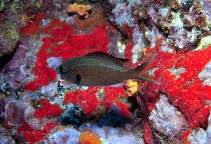 Azurina multilineata
foto/gambar oleh Wirtz, P.
Gambar | video | Perangko, koin, dll. | imej Google
foto/gambar oleh Wirtz, P.
klasifikasi / Nama Nama-nama umum | Sinonim (persamaan) | Catalog of Fishes(Marga, Jenis) | ITIS | CoL | WoRMS | Cloffa
> Ovalentaria/misc (Various families in series Ovalentaria) > Pomacentridae (Damselfishes) > Chrominae
Etymology: Azurina: Latin, azurinus = blue, pale blue; the name of Leuciscus caeruleus, blue Roach; 1600 (Ref. 45335).
More on author: Guichenot.
Etymology: Azurina: Latin, azurinus = blue, pale blue; the name of Leuciscus caeruleus, blue Roach; 1600 (Ref. 45335).
More on author: Guichenot.
Taxonomic Remarks
The Ascension I. population differs from the St. Helena I. population in having a bright spot at the rear end of the base of the dorsal fin. No genetic differences were found between the two populations that seem closest to the population from Brazil (Rocha et al., 2008).
Lingkungan: lingkungan / zona iklim / kisaran kedalaman / jangkauan distribusi Ekologi
laut berasosiasi dengan karang; nir-ruaya; kisaran kedalaman 0 - 60 m (Ref. 58047). Subtropical; 33°N - 31°S, 100°W - 19°E
Penyebaran Wilayah | Daerah-daerah FAO | Ekosistem | Kemunculan | peta titik | Introduksi | Faunafri
Western Atlantic: Florida and Texas (USA) and throughout the Caribbean Sea to Brazil (Ref. 9626, 35834). Eastern Atlantic: St. Helena and Ascension islands and from São Tomé.
Ukuran / Berat / umur
Kematangan: Lm ? range ? - ? cm
Max length : 20.0 cm TL jantan/; (Ref. 3139); common length : 12.0 cm TL jantan/; (Ref. 3139)
Max length : 20.0 cm TL jantan/; (Ref. 3139); common length : 12.0 cm TL jantan/; (Ref. 3139)
deskripsi pendek Kunci identifiaksi (pengenalan) | Morfologi | Morfometrik
Duri punggung (Keseluruhan (total)) : 12; duri punggung lunak (Keseluruhan (total)) : 12 - 13; Duri dubur: 2; Sirip dubur lunak: 11 - 13. A prominent black spot at the pectoral-fin base, and a white spot just behind the posterior base of the soft dorsal fin (Ref. 7247). Grayish brown on back, shading to silvery gray on sides; dorsal fin broadly edged with bright yellow; upper and lower edges of caudal fin narrowly yellow with a submarginal dark band (Ref. 13442).
Body shape (shape guide): fusiform / normal; Cross section: compressed.
Body shape (shape guide): fusiform / normal; Cross section: compressed.
Adults generally occur in steep slopes and patch reefs. Diurnal species (Ref. 9626), they most commonly form moderate-sized feeding-schools over reef tops, rising above the bottom to feed on plankton, mainly copepods. Often seen with Chromis cyanea (Ref. 9710). Oviparous, distinct pairing during breeding (Ref. 205). Eggs are demersal and adhere to the substrate (Ref. 205). Males guard and aerate the eggs (Ref. 205). Rarely marketed (Ref. 3139).
Siklus hidup dan perilaku kawin Kematangan | Reproduksi, perkembang biakan | Pemijahan | telur-telur | Fekunditas | Larva
Oviparous, distinct pairing during breeding (Ref. 205). Eggs are demersal and adhere to the substrate (Ref. 205). Males guard and aerate the eggs (Ref. 205).
rujukan utama
Unggah referensi Anda | Acuan | Koordinator : Allen, Gerald R. | mitra
Allen, G.R., 1991. Damselfishes of the world. Mergus Publishers, Melle, Germany. 271 p. (Ref. 7247)
Status IUCN Red List (Ref. 130435: Version 2025-2 (Global))
kurang bimbang (LC) ; Date assessed: 15 November 2010
CITES
Not Evaluated
ancaman kepada manusia
Harmless
penggunaan manusia
Perikanan: perikanan swasembada; Akuarium: Komersial
FAO - Publication: search | FishSource |
informasi lanjut
Dinamika populasi
Parameter pertumbuhan
Maks. usia / ukuran
Panjang-berat rel.
Panjang-panjang rel.
ukuran frekuensi
Konversi massa
pemulihan
Kelimpahan
Parameter pertumbuhan
Maks. usia / ukuran
Panjang-berat rel.
Panjang-panjang rel.
ukuran frekuensi
Konversi massa
pemulihan
Kelimpahan
Siklus hidup
Reproduksi, perkembang biakan
Kematangan
Kedewasaan / insang rel.
Fekunditas
Pemijahan
Agregasi pemijahan
telur-telur
pekembangan telor
Larva
Dinamika larva
Reproduksi, perkembang biakan
Kematangan
Kedewasaan / insang rel.
Fekunditas
Pemijahan
Agregasi pemijahan
telur-telur
pekembangan telor
Larva
Dinamika larva
Fisiologi
Komposisi tubuh
Nutrisi
Konsumsi oksigen
Jenis renang
Kecepatan berenang
Pigmen visual
Suara ikan
Penyakit & Parasit
Toksisitas (LC50)
Komposisi tubuh
Nutrisi
Konsumsi oksigen
Jenis renang
Kecepatan berenang
Pigmen visual
Suara ikan
Penyakit & Parasit
Toksisitas (LC50)
Yang berhubungan dengan manusia
Sistem akuakultur
profil budidaya air
Strain
Kasus Ciguatera
Perangko, koin, dll.
Sistem akuakultur
profil budidaya air
Strain
Kasus Ciguatera
Perangko, koin, dll.
Alat, peralatan
Kuis organik | E-book | Penuntun lapangan | tanda freqkuenci panjang | peringkat sejarah hidup | peta titik |
Tangkap-MSY |
laporan khas
muat turun XML
Sumber internet
AFORO (otoliths) | Aquatic Commons | BHL | Cloffa | Websites from users | semak peneliti ikan | CISTI | Catalog of Fishes: Marga, Jenis | DiscoverLife | ECOTOX | FAO - Publication: search | Faunafri | Fishipedia | Fishtrace | GloBI | Google Books | Google Scholar | Google | IGFA World Record | Pangkalan data nasional | OneZoom | Open Tree of Life | Otolith Atlas of Taiwan Fishes | Akuarium publik | PubMed | Reef Life Survey | Socotra Atlas | TreeBase | Tree of Life | Wikipedia: pergi, Cari | World Records Freshwater Fishing | Catatan Zoologi
Estimasi berdasarkan model
Suhu yang disukai (Acuan 123201): 24.5 - 28, mean 26.9 °C (based on 374 cells).
Indeks keanekaragaman filogenetik (Acuan 82804): PD50 = 0.5010 [Uniqueness, from 0.5 = low to 2.0 = high].
Bayesian length-weight: a=0.01259 (0.00569 - 0.02786), b=3.03 (2.84 - 3.22), in cm total length, based on LWR estimates for this (Sub)family-body shape (Ref. 93245).
Tingkat Trofik (Acuan 69278): 3.0 ±0.0 se; based on diet studies.
Daya lenting (Acuan 120179): sedang, Waktu penggandaan populasi minimum 1.4 - 4.4 tahun (Preliminary K or Fecundity.).
Nutrisi (Ref. 124155): Calcium = 46.6 [20.8, 84.9] mg/100g; Iron = 0.752 [0.445, 1.242] mg/100g; Protein = 19.3 [18.2, 20.3] %; Omega3 = 0.222 [0.129, 0.370] g/100g; Selenium = 12.8 [6.4, 25.7] μg/100g; VitaminA = 106 [35, 310] μg/100g; Zinc = 1.01 [0.65, 1.50] mg/100g (wet weight);