



Azurina multilineata (Guichenot, 1853)
Brown chromis
Ladda upp din foton och Videor
Bilder | Videor | Frimärken, mynt, diverse. | Google image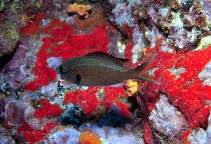 Azurina multilineata
Bild av Wirtz, P.
Bilder | Videor | Frimärken, mynt, diverse. | Google image
Bild av Wirtz, P.
Klassificering / Namn Populärnamn | synonymer | Catalog of Fishes(Släkte, Arter) | ITIS | CoL | WoRMS | Cloffa
> Ovalentaria/misc (Various families in series Ovalentaria) > Pomacentridae (Damselfishes) > Chrominae
Etymology: Azurina: Latin, azurinus = blue, pale blue; the name of Leuciscus caeruleus, blue Roach; 1600 (Ref. 45335).
More on author: Guichenot.
Etymology: Azurina: Latin, azurinus = blue, pale blue; the name of Leuciscus caeruleus, blue Roach; 1600 (Ref. 45335).
More on author: Guichenot.
Taxonomic Remarks
The Ascension I. population differs from the St. Helena I. population in having a bright spot at the rear end of the base of the dorsal fin. No genetic differences were found between the two populations that seem closest to the population from Brazil (Rocha et al., 2008).
Miljö: miljö / Klimatzon / djupintervall / distributionsområde Ekologi
marina revassocierade; ej vandrande; djupintervall 0 - 60 m (Ref. 58047). Subtropical; 33°N - 31°S, 100°W - 19°E
Utbredning Territorier | FAO områden | Ekosystem | Förekomster | Prickkarta | Utplanteringar | Faunafri
Western Atlantic: Florida and Texas (USA) and throughout the Caribbean Sea to Brazil (Ref. 9626, 35834). Eastern Atlantic: St. Helena and Ascension islands and from São Tomé.
Storlek / Vikt / Ålder
Könsmognad: Lm ? range ? - ? cm
Max length : 20.0 cm TL hane/ej könsbestämd; (Ref. 3139); common length : 12.0 cm TL hane/ej könsbestämd; (Ref. 3139)
Max length : 20.0 cm TL hane/ej könsbestämd; (Ref. 3139); common length : 12.0 cm TL hane/ej könsbestämd; (Ref. 3139)
Kort beskrivning Bestämningsnycklar | Morfologi | Morfometri
Taggstrålar i ryggfenan (totalt) : 12; Mjukstrålar i ryggfenan (totalt) : 12 - 13; Taggstrålar i analfenan: 2; Mjukstrålar i analfenan: 11 - 13. A prominent black spot at the pectoral-fin base, and a white spot just behind the posterior base of the soft dorsal fin (Ref. 7247). Grayish brown on back, shading to silvery gray on sides; dorsal fin broadly edged with bright yellow; upper and lower edges of caudal fin narrowly yellow with a submarginal dark band (Ref. 13442).
Body shape (shape guide): fusiform / normal; Cross section: compressed.
Body shape (shape guide): fusiform / normal; Cross section: compressed.
Adults generally occur in steep slopes and patch reefs. Diurnal species (Ref. 9626), they most commonly form moderate-sized feeding-schools over reef tops, rising above the bottom to feed on plankton, mainly copepods. Often seen with Chromis cyanea (Ref. 9710). Oviparous, distinct pairing during breeding (Ref. 205). Eggs are demersal and adhere to the substrate (Ref. 205). Males guard and aerate the eggs (Ref. 205). Rarely marketed (Ref. 3139).
Livscykel och parningsbeteende Könsmognad | Reproduktion | Lek | Ägg | Fekunditet | Larver
Oviparous, distinct pairing during breeding (Ref. 205). Eggs are demersal and adhere to the substrate (Ref. 205). Males guard and aerate the eggs (Ref. 205).
Huvudreferens
Ladda upp dina referenser | referenser | Koordinator : Allen, Gerald R. | Medarbetare
Allen, G.R., 1991. Damselfishes of the world. Mergus Publishers, Melle, Germany. 271 p. (Ref. 7247)
Status på IUCN:s rödlista (Ref. 130435: Version 2025-2 (Global))
Least Concern (LC) ; Date assessed: 15 November 2010
CITES
Not Evaluated
Hot mot människor
Harmless
Mänskliga användningsområden
Fiskeri: husbehovsfiske; Akvarium: Kommersiell
FAO - Publication: search | FishSource |
Ytterligare information
Populationsdynamik
Tillväxtparametrar
Max. åldrar / storlekar
Längd-vikt rel.
Längd-längd rel.
Längd-frekvenser
Massakonvertering
Rekrytering
Abundans
Tillväxtparametrar
Max. åldrar / storlekar
Längd-vikt rel.
Längd-längd rel.
Längd-frekvenser
Massakonvertering
Rekrytering
Abundans
Livscykel
Reproduktion
Könsmognad
Mognad/Gills rel.
Fekunditet
Lek
Lekande aggregat
Ägg
Utveckling av ägg
Larver
Larvdynamik
Reproduktion
Könsmognad
Mognad/Gills rel.
Fekunditet
Lek
Lekande aggregat
Ägg
Utveckling av ägg
Larver
Larvdynamik
Fysiologi
Kroppssammansättning
Näringsämnen
Syreförbrukning
Typ av simning
Simhastighet
Visuella pigment
Ljud från fisk
Sjukdomar & Parasiter
Toxicitet (LC50)
Kroppssammansättning
Näringsämnen
Syreförbrukning
Typ av simning
Simhastighet
Visuella pigment
Ljud från fisk
Sjukdomar & Parasiter
Toxicitet (LC50)
Människorelaterad
Vattenbrukssystem
Vattenbruksprofiler
Avelslinjer
Ciguatera-fall
Frimärken, mynt, diverse.
Vattenbrukssystem
Vattenbruksprofiler
Avelslinjer
Ciguatera-fall
Frimärken, mynt, diverse.
Verktyg
Organisk frågesport | E-bok | Fälthandbok | Längdfördelnings-verktyg | Livshistorie-verktyg | Prickkarta |
Fångst-MSY |
Särskilda rapporter
Kontrollera för underhåll av akvarium | Kontrollera om det finns faktablad om arter | Kontrollera om det finns faktablad om vattenbruk
Ladda ner XML
Internet-källor
AFORO (otoliths) | Aquatic Commons | BHL | Cloffa | Websites from users | Check FishWatcher | CISTI | Catalog of Fishes: Släkte, Arter | DiscoverLife | ECOTOX | FAO - Publication: search | Faunafri | Fishipedia | Fishtrace | GloBI | Google Books | Google Scholar | Google | IGFA World Record | Nationella databaser | OneZoom | Open Tree of Life | Otolith Atlas of Taiwan Fishes | Offentliga akvarier | PubMed | Reef Life Survey | Socotra Atlas | TreeBase | Tree of Life | Wikipedia: Go, sök | World Records Freshwater Fishing | Zoologiskt register
Uppskattningar baserade på modeller
Önskad temperatur (Ref. 123201): 24.5 - 28, mean 26.9 °C (based on 374 cells).
Index för fylogenetisk mångfald (Ref. 82804): PD50 = 0.5010 [Uniqueness, from 0.5 = low to 2.0 = high].
Bayesian length-weight: a=0.01259 (0.00569 - 0.02786), b=3.03 (2.84 - 3.22), in cm total length, based on LWR estimates for this (Sub)family-body shape (Ref. 93245).
Trofisk nivå (Ref. 69278): 3.0 ±0.0 se; based on diet studies.
Resiliens (Ref. 120179): Mellan, lägsta populationsfördubblingstid 1,4-4,4 år (Preliminary K or Fecundity.).
Näringsämnen (Ref. 124155): Calcium = 46.6 [20.8, 84.9] mg/100g; Iron = 0.752 [0.445, 1.242] mg/100g; Protein = 19.3 [18.2, 20.3] %; Omega3 = 0.222 [0.129, 0.370] g/100g; Selenium = 12.8 [6.4, 25.7] μg/100g; VitaminA = 106 [35, 310] μg/100g; Zinc = 1.01 [0.65, 1.50] mg/100g (wet weight);