>
Eupercaria/misc (Various families in series Eupercaria) >
Scaridae (Parrotfishes) > Scarinae
Etymology: Scarus: Greek, skaros = a fish described by anciente writers as a parrot fish; 1601 (Ref. 45335).
Environment: milieu / Zona climática / intervalo de profundidade / distribution range
Ecologia
marinhas associadas(os) a recifes; intervalo de profundidade 3 - 25 m (Ref. 9710). Tropical; 39°N - 24°S, 98°W - 31°W
Western Atlantic: Maryland in the USA, Bermuda and Bahamas to Rio de Janeiro, Brazil (Ref. 13628), including the West Indies (Ref. 3802); absent in the northern Gulf of Mexico.
Comprimento de primeira maturação / Tamanho / Peso / Idade
Maturidade: Lm ?, range 31 - ? cm
Max length : 120 cm TL macho/indeterminado; (Ref. 7251); common length : 35.0 cm TL macho/indeterminado; (Ref. 3802)
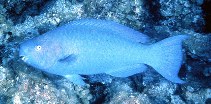
Espinhos dorsais (total) : 9; Raios dorsais (total) : 10; Espinhos anais: 2; Raios anais : 9. Adults uniformly blue, with yellow area on top of head that disappears in larger fish. Large fish develop prominent bulging snout and extended upper and lower caudal fin lobes. No other species has this uniform blue color in adults. (Ref. 26938).
Body shape (shape guide): fusiform / normal.
Inhabits coral reefs. Juveniles found on Thalassia beds (Ref. 13628). Feeds on benthic plants and small organisms in the sand (Ref. 5521). Forms large spawning aggregations (Ref. 9710).
Ciclo de vida ou comportamento de acasalamento
Maturidade | Reprodução | Desova | Ovos | Fecundidade | Larvas
Oviparous, distinct pairing during breeding (Ref. 205).
Parenti, P. and J.E. Randall, 2000. An annotated checklist of the species of the labroid fish families Labridae and Scaridae. Ichthyol. Bull. J.L.B. Smith Inst. Ichthyol. (68):1-97. (Ref. 35918)
Status na Lista Vermelha da UICN (Ref. 130435: Version 2025-1)
Ameaça para os humanos
Reports of ciguatera poisoning (Ref. 4690)
Uso pelos humanos
Pescarias: pouco comercial; peixe esportivo: sim; Aquário: Espécies comerciais
Ferramentas
Relatórios especiais
Baixar XML
Fontes da internet
Estimates based on models
Preferred temperature (Ref.
123201): 26.1 - 28.2, mean 27.4 °C (based on 685 cells).
Índice de diversidade filogenética (Ref.
82804): PD
50 = 0.5000 [Uniqueness, from 0.5 = low to 2.0 = high].
Bayesian length-weight: a=0.01288 (0.00726 - 0.02285), b=3.04 (2.89 - 3.19), in cm total length, based on LWR estimates for this species & Genus-body shape (Ref.
93245).
Nível Trófico (Ref.
69278): 2.0 ±0.00 se; based on food items.
Generation time: 3.4 ( na - na) years. Estimated as median ln(3)/K based on 1
growth studies.
Resiliência (Ref.
120179): médio(a), tempo mínimo de duplicação da população 1,4 - 4,4 anos (Preliminary K or Fecundity.).
Fishing Vulnerability (Ref.
59153): Moderate vulnerability (42 of 100).
🛈
Nutrients (Ref.
124155): Calcium = 21.2 [13.4, 36.4] mg/100g; Iron = 0.618 [0.415, 0.940] mg/100g; Protein = 18.9 [16.7, 20.7] %; Omega3 = 0.0733 [, ] g/100g; Selenium = 24.4 [14.4, 40.4] μg/100g; VitaminA = 26.2 [7.6, 89.8] μg/100g; Zinc = 1.64 [1.22, 2.15] mg/100g (wet weight);