



Cephalopholis cruentata (Lacepède, 1802)
Graysby
Ajouter votre observation dans Fish Watcher
| Native range | All suitable habitat | Point map | Year 2050 |

|
| This map was computer-generated and has not yet been reviewed. |
| Cephalopholis cruentata AquaMaps Data sources: GBIF OBIS |
Envoyez vos Photos et vidéos
Images | vidéos | Sons | Images Google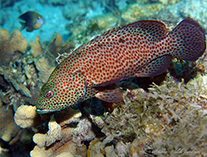 Cephalopholis cruentata
Photo de Jacobson, P.W.
Images | vidéos | Sons | Images Google
Photo de Jacobson, P.W.
Classification / Noms Noms communs | Synonymes | Catalog of Fishes(Genre, Espèce) | ITIS | CoL | WoRMS | Cloffa
> Perciformes/Serranoidei (Groupers) > Epinephelidae (Groupers)
Etymology: Cephalopholis: Greek, kephale = head + Greek, pholis = scale (Ref. 45335).
More on author: Lacepède.
Etymology: Cephalopholis: Greek, kephale = head + Greek, pholis = scale (Ref. 45335).
More on author: Lacepède.
Environnement : milieu / zone climatique / profondeur / gamme de distribution Écologie
marin récifal; non migrateur (Ref. 56524); profondeur 0 - 170 m (Ref. 9710). Subtropical; 36°N - 6°N, 98°W - 58°W (Ref. 5222)
Distribution Territoires | Zones FAO | Écosystèmes | Occurrences | Carte par point | Introductions | Faunafri
Western Central Atlantic: North Carolina to southern Florida (USA), Bermuda, Gulf of Mexico, Bahamas, and the Caribbean; including the Antilles (Ref. 26938).
Longueur à la première maturité / Taille / Poids / Âge
Maturité: Lm 16.0, range 14 - ? cm
Max length : 42.6 cm TL mâle / non sexé; (Ref. 40637); common length : 20.0 cm TL mâle / non sexé; (Ref. 3708); poids max. publié: 1.1 kg (Ref. 40637); âge max. reporté: 13 années (Ref. 36271)
Max length : 42.6 cm TL mâle / non sexé; (Ref. 40637); common length : 20.0 cm TL mâle / non sexé; (Ref. 3708); poids max. publié: 1.1 kg (Ref. 40637); âge max. reporté: 13 années (Ref. 36271)
Description synthétique Clés d'identification | Morphologie | Morphométrie
Épines dorsales (Total) : 9; Rayons mous dorsaux (Total) : 13 - 15; Épines anales: 3; Rayons mous anaux: 8. Distinguished by having the following characteristics: body depth 2.5-2.9 times in SL; head length 2.4-2.6 times in SL (Ref. 089707); opercle with 3 flat spines, middle one the largest and upper spine longer than the lowest; pelvic fins shorter than pectorals; bases of soft dorsal and anal fins covered with scales and thick skin; has 4 contrasting spots, white or black, along body below dorsal fin base (Ref. 26938); color in market: pale orange, grey or brown with reddish spots; black spots on the upper body below the dorsal fin (Ref. 089707).
Body shape (shape guide): fusiform / normal; Cross section: oval.
Body shape (shape guide): fusiform / normal; Cross section: oval.
Inhabits Thalassia beds and coral reefs. In the Gulf of Mexico, they are found on rocky reef ledge in depths greater than 27 m. Solitary (Ref. 26340) and secretive, they usually stay near hiding places during the day. Prefer to remain within a small area of the home range of about 2,120 square m especially during the day (Ref. 56524). Nocturnal predators, adults feed mainly on fishes, with preference on Chromis multilineata, while juveniles feed on shrimps. Due to its small size, this is not a particularly sought-after species. Easily approached and fed by divers (Ref. 9710). Protogynous (Ref. 26938). Between 1995 and 2000, at least 10 specimens have been traded as aquarium fish at Ceará, Brazil (Ref. 49392).
Cycle de vie et comportement reproducteur Maturité | Reproduction | Frai | Œufs | Fécondité | Larves
Most change sex between 20 and 23 cm (ages 4 and 5), with sexual transition occurring immediately after spawning in August and September (Ref. 3092).
Référence principale
Téléchargez vos références | Références | Coordinateur | Collaborateurs
Heemstra, P.C. and J.E. Randall, 1993. FAO Species Catalogue. Vol. 16. Groupers of the world (family Serranidae, subfamily Epinephelinae). An annotated and illustrated catalogue of the grouper, rockcod, hind, coral grouper and lyretail species known to date. Rome: FAO. FAO Fish. Synop. 125(16):382 p. (Ref. 5222)
Statut dans la liste rouge de l'IUCN (Ref. 130435: Version 2025-2 (Global))
Préoccupation mineure (LC) ; Date assessed: 12 November 2017
CITES
Not Evaluated
Menace pour l'homme
Reports of ciguatera poisoning (Ref. 30303)
Utilisations par l'homme
Pêcheries: intérêt commercial mineur
FAO - Publication: search | FishSource | Sea Around Us
Plus d'informations
Écologie trophique
Aliments (proies)
Composition du régime alimentaire
Consommation alimentaire
Rations alimentaires
Prédateurs
Aliments (proies)
Composition du régime alimentaire
Consommation alimentaire
Rations alimentaires
Prédateurs
Dynamique des populations
Paramètres de croissance
Âges / tailles maximales
Longueur-poids rel.
Rel. longueur-longueur.
Fréquences de longueurs
Conversion de masse
Recrutement
Abondance
Paramètres de croissance
Âges / tailles maximales
Longueur-poids rel.
Rel. longueur-longueur.
Fréquences de longueurs
Conversion de masse
Recrutement
Abondance
Cycle de vie
Reproduction
Maturité
Maturité/épines rel.
Fécondité
Frai
Agrégats de frai
Œufs
Développement de l'œuf
Larves
Dynamique des populations larvaires
Reproduction
Maturité
Maturité/épines rel.
Fécondité
Frai
Agrégats de frai
Œufs
Développement de l'œuf
Larves
Dynamique des populations larvaires
Physiologie
Composition corporelle
Nutriments
Consommation d'oxygène
Type de natation
Vitesse de nage
Pigments visuels
Son de poisson
Maladies et parasites
Toxicité (CL50)
Composition corporelle
Nutriments
Consommation d'oxygène
Type de natation
Vitesse de nage
Pigments visuels
Son de poisson
Maladies et parasites
Toxicité (CL50)
Liées à l'homme
Systèmes d'aquaculture
Profils d'aquaculture
Souches
Cas de ciguatera
Timbres, pièces de monnaie, divers
Systèmes d'aquaculture
Profils d'aquaculture
Souches
Cas de ciguatera
Timbres, pièces de monnaie, divers
Outils
Quiz bio | E-book | Guide de terrain | Clés d'identification | Générateur de fréquences de longueur | Outil de dynamique de population | Carte par point |
Capture-MSY |
Articles particuliers
Télécharger en XML
Sources Internet
AFORO (otoliths) | Aquatic Commons | BHL | Cloffa | Websites from users | FishWatcher | CISTI | Catalog of Fishes: Genre, Espèce | DiscoverLife | ECOTOX | FAO - Publication: search | Faunafri | Fishipedia | Fishtrace | GloBI | Google Books | Google Scholar | Google | IGFA World Record | Bases de données nationales | OneZoom | Open Tree of Life | Otolith Atlas of Taiwan Fishes | Aquariums publics | PubMed | Reef Life Survey | Socotra Atlas | TreeBase | Arbre de Vie | Wikipedia: aller à, chercher | World Records Freshwater Fishing | Zoological Record
Estimations basées sur des modèles
Température préférée (Réf. 123201): 22.7 - 28, mean 26.4 °C (based on 328 cells).
Indice de diversité phylogénétique (Réf. 82804): PD50 = 0.5000 [Uniqueness, from 0.5 = low to 2.0 = high].
Bayesian length-weight: a=0.01148 (0.00671 - 0.01964), b=3.07 (2.93 - 3.21), in cm total length, based on LWR estimates for this species & Genus-body shape (Ref. 93245).
Niveau trophique (Réf. 69278): 4.3 ±0.6 se; based on diet studies.
Résilience (Réf. 120179): Milieu, temps minimum de doublement de population : 1,4 à 4,4 années (K=0.34-0.35; tm=3.5-5.5; tmax=9; Fec=260,000).
Nutriments (Ref. 124155): Calcium = 28.1 [12.8, 57.6] mg/100g; Iron = 0.548 [0.279, 1.129] mg/100g; Protein = 19.3 [17.4, 20.9] %; Omega3 = 0.285 [0.157, 0.507] g/100g; Selenium = 21.1 [9.8, 42.1] μg/100g; VitaminA = 86.8 [30.2, 314.7] μg/100g; Zinc = 0.479 [0.320, 0.816] mg/100g (wet weight);