



Cephalopholis cruentata (Lacepède, 1802)
Graysby
Lägg till din observation i Fish Watcher
| Native range | All suitable habitat | Point map | Year 2050 |

|
| This map was computer-generated and has not yet been reviewed. |
| Cephalopholis cruentata AquaMaps Data sources: GBIF OBIS |
Ladda upp din foton och Videor
Bilder | Videor | Ljud | Google image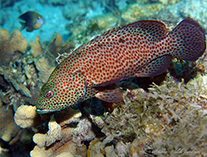 Cephalopholis cruentata
Bild av Jacobson, P.W.
Bilder | Videor | Ljud | Google image
Bild av Jacobson, P.W.
Klassificering / Namn Populärnamn | synonymer | Catalog of Fishes(Släkte, Arter) | ITIS | CoL | WoRMS | Cloffa
> Perciformes/Serranoidei (Groupers) > Epinephelidae (Groupers)
Etymology: Cephalopholis: Greek, kephale = head + Greek, pholis = scale (Ref. 45335).
More on author: Lacepède.
Etymology: Cephalopholis: Greek, kephale = head + Greek, pholis = scale (Ref. 45335).
More on author: Lacepède.
Miljö: miljö / Klimatzon / djupintervall / distributionsområde Ekologi
marina revassocierade; ej vandrande (Ref. 56524); djupintervall 0 - 170 m (Ref. 9710). Subtropical; 36°N - 6°N, 98°W - 58°W (Ref. 5222)
Utbredning Territorier | FAO områden | Ekosystem | Förekomster | Prickkarta | Utplanteringar | Faunafri
Western Central Atlantic: North Carolina to southern Florida (USA), Bermuda, Gulf of Mexico, Bahamas, and the Caribbean; including the Antilles (Ref. 26938).
Längd vid första mognad / Storlek / Vikt / Ålder
Könsmognad: Lm 16.0, range 14 - ? cm
Max length : 42.6 cm TL hane/ej könsbestämd; (Ref. 40637); common length : 20.0 cm TL hane/ej könsbestämd; (Ref. 3708); publicerad maxvikt: 1.1 kg (Ref. 40637); rapporterad maxålder: 13 år (Ref. 36271)
Max length : 42.6 cm TL hane/ej könsbestämd; (Ref. 40637); common length : 20.0 cm TL hane/ej könsbestämd; (Ref. 3708); publicerad maxvikt: 1.1 kg (Ref. 40637); rapporterad maxålder: 13 år (Ref. 36271)
Kort beskrivning Bestämningsnycklar | Morfologi | Morfometri
Taggstrålar i ryggfenan (totalt) : 9; Mjukstrålar i ryggfenan (totalt) : 13 - 15; Taggstrålar i analfenan: 3; Mjukstrålar i analfenan: 8. Distinguished by having the following characteristics: body depth 2.5-2.9 times in SL; head length 2.4-2.6 times in SL (Ref. 089707); opercle with 3 flat spines, middle one the largest and upper spine longer than the lowest; pelvic fins shorter than pectorals; bases of soft dorsal and anal fins covered with scales and thick skin; has 4 contrasting spots, white or black, along body below dorsal fin base (Ref. 26938); color in market: pale orange, grey or brown with reddish spots; black spots on the upper body below the dorsal fin (Ref. 089707).
Body shape (shape guide): fusiform / normal; Cross section: oval.
Body shape (shape guide): fusiform / normal; Cross section: oval.
Inhabits Thalassia beds and coral reefs. In the Gulf of Mexico, they are found on rocky reef ledge in depths greater than 27 m. Solitary (Ref. 26340) and secretive, they usually stay near hiding places during the day. Prefer to remain within a small area of the home range of about 2,120 square m especially during the day (Ref. 56524). Nocturnal predators, adults feed mainly on fishes, with preference on Chromis multilineata, while juveniles feed on shrimps. Due to its small size, this is not a particularly sought-after species. Easily approached and fed by divers (Ref. 9710). Protogynous (Ref. 26938). Between 1995 and 2000, at least 10 specimens have been traded as aquarium fish at Ceará, Brazil (Ref. 49392).
Livscykel och parningsbeteende Könsmognad | Reproduktion | Lek | Ägg | Fekunditet | Larver
Most change sex between 20 and 23 cm (ages 4 and 5), with sexual transition occurring immediately after spawning in August and September (Ref. 3092).
Huvudreferens
Ladda upp dina referenser | referenser | Koordinator | Medarbetare
Heemstra, P.C. and J.E. Randall, 1993. FAO Species Catalogue. Vol. 16. Groupers of the world (family Serranidae, subfamily Epinephelinae). An annotated and illustrated catalogue of the grouper, rockcod, hind, coral grouper and lyretail species known to date. Rome: FAO. FAO Fish. Synop. 125(16):382 p. (Ref. 5222)
Status på IUCN:s rödlista (Ref. 130435: Version 2025-2 (Global))
Least Concern (LC) ; Date assessed: 12 November 2017
CITES
Not Evaluated
Hot mot människor
Reports of ciguatera poisoning (Ref. 30303)
Mänskliga användningsområden
Fiskeri: mindre kommeriell
FAO - Publication: search | FishSource | Havet omkring oss
Ytterligare information
Populationsdynamik
Tillväxtparametrar
Max. åldrar / storlekar
Längd-vikt rel.
Längd-längd rel.
Längd-frekvenser
Massakonvertering
Rekrytering
Abundans
Tillväxtparametrar
Max. åldrar / storlekar
Längd-vikt rel.
Längd-längd rel.
Längd-frekvenser
Massakonvertering
Rekrytering
Abundans
Livscykel
Reproduktion
Könsmognad
Mognad/Gills rel.
Fekunditet
Lek
Lekande aggregat
Ägg
Utveckling av ägg
Larver
Larvdynamik
Reproduktion
Könsmognad
Mognad/Gills rel.
Fekunditet
Lek
Lekande aggregat
Ägg
Utveckling av ägg
Larver
Larvdynamik
Fysiologi
Kroppssammansättning
Näringsämnen
Syreförbrukning
Typ av simning
Simhastighet
Visuella pigment
Ljud från fisk
Sjukdomar & Parasiter
Toxicitet (LC50)
Kroppssammansättning
Näringsämnen
Syreförbrukning
Typ av simning
Simhastighet
Visuella pigment
Ljud från fisk
Sjukdomar & Parasiter
Toxicitet (LC50)
Människorelaterad
Vattenbrukssystem
Vattenbruksprofiler
Avelslinjer
Ciguatera-fall
Frimärken, mynt, diverse.
Vattenbrukssystem
Vattenbruksprofiler
Avelslinjer
Ciguatera-fall
Frimärken, mynt, diverse.
Verktyg
Organisk frågesport | E-bok | Fälthandbok | Bestämningsnycklar | Längdfördelnings-verktyg | Livshistorie-verktyg | Prickkarta |
Fångst-MSY |
Särskilda rapporter
Kontrollera för underhåll av akvarium | Kontrollera om det finns faktablad om arter | Kontrollera om det finns faktablad om vattenbruk
Ladda ner XML
Internet-källor
AFORO (otoliths) | Aquatic Commons | BHL | Cloffa | Websites from users | Check FishWatcher | CISTI | Catalog of Fishes: Släkte, Arter | DiscoverLife | ECOTOX | FAO - Publication: search | Faunafri | Fishipedia | Fishtrace | GloBI | Google Books | Google Scholar | Google | IGFA World Record | Nationella databaser | OneZoom | Open Tree of Life | Otolith Atlas of Taiwan Fishes | Offentliga akvarier | PubMed | Reef Life Survey | Socotra Atlas | TreeBase | Tree of Life | Wikipedia: Go, sök | World Records Freshwater Fishing | Zoologiskt register
Uppskattningar baserade på modeller
Önskad temperatur (Ref. 123201): 22.7 - 28, mean 26.4 °C (based on 328 cells).
Index för fylogenetisk mångfald (Ref. 82804): PD50 = 0.5000 [Uniqueness, from 0.5 = low to 2.0 = high].
Bayesian length-weight: a=0.01148 (0.00671 - 0.01964), b=3.07 (2.93 - 3.21), in cm total length, based on LWR estimates for this species & Genus-body shape (Ref. 93245).
Trofisk nivå (Ref. 69278): 4.3 ±0.6 se; based on diet studies.
Resiliens (Ref. 120179): Mellan, lägsta populationsfördubblingstid 1,4-4,4 år (K=0.34-0.35; tm=3.5-5.5; tmax=9; Fec=260,000).
Näringsämnen (Ref. 124155): Calcium = 28.1 [12.8, 57.6] mg/100g; Iron = 0.548 [0.279, 1.129] mg/100g; Protein = 19.3 [17.4, 20.9] %; Omega3 = 0.285 [0.157, 0.507] g/100g; Selenium = 21.1 [9.8, 42.1] μg/100g; VitaminA = 86.8 [30.2, 314.7] μg/100g; Zinc = 0.479 [0.320, 0.816] mg/100g (wet weight);