>
Perciformes/Scorpaenoidei (Scorpionfishes) >
Scorpaenidae (Scorpionfishes or rockfishes) > Scorpaeninae
Etymology: Scorpaena: Latin, scorpaena = a kind of fish, 1706 (Ref. 45335).
Eponymy: Charles Plumier (1646–1704) was a Franciscan monk, botanist and naturalist. [...] (Ref. 128868), visit book page.
More on author: Bloch.
Environment: milieu / climate zone / пределы глубины / distribution range
экология
морской ассоциированный с рифами; пределы глубины 1 - 70 m (Ref. 126840), usually 5 - 55 m (Ref. 5288). Subtropical; 43°N - 30°S, 98°W - 5°W
Western Atlantic: Bermuda, Massachusetts, and northern Gulf of Mexico to southern Brazil. Eastern Atlantic: Ascension and St. Helena.
Size / Вес / Возраст
половая зрелость: Lm ? range ? - ? cm
Max length : 45.0 cm TL самец/пол неопределен; (Ref. 5288); common length : 30.0 cm TL самец/пол неопределен; (Ref. 3812); наибольший вес (опубликованные данные): 1.6 kg (Ref. 40637)
колючие лучи спинного плавника (общее число) : 12; членистые (мягкие) лучи спинного плавника (общее число) : 10; колючие лучи анального плавника: 3; членистые (мягкие) лучи анального плавника: 5. Occipital pit present; three to four spines on part of preorbital overlapping maxillary; large white spots on dark background on inner basal part of pectoral fin (unclear in specimens smaller than 3 cm SL) (Ref. 13608).
Body shape (shape guide): fusiform / normal.
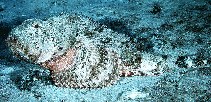
Found mostly in shallow coral reef and rocky areas. Lies motionless on the bottom (Ref. 9710). Feeds mostly on other fishes and crustaceans. Moderately common below about 5 m depth to at least 55 m. Displays characteristic bright white spots on dark background of pectoral axil when disturbed (Ref. 49392). Anterolateral glandular groove with venom gland (Ref. 57406). Eaten locally and said to taste a bit like chicken. Traded as an aquarium fish at Ceará, Brazil (Ref. 49392).
Life cycle and mating behavior
половая зрелость | размножение | нерест | икра | Fecundity | личинки
Smith-Vaniz, W.F., B.B. Collette and B.E. Luckhurst, 1999. Fishes of Bermuda: history, zoogeography, annotated checklist, and identification keys. American Society of Ichthyologists and Herpetologists Special Publication No. 4. 424 p. (Ref. 35505)
Статус Красного Списка МСОП (Ref. 130435: Version 2025-1)
Использование человеком
рыболовство: не имеет хозяйственного значения; аквариум: коммерческий
дополнительная информация
инструменты
Специальные отчеты
Скачать в формате XML
ресурсы в Интернет
Estimates based on models
Preferred temperature (ссылка
123201): 21.9 - 28, mean 25.6 °C (based on 770 cells).
Phylogenetic diversity index (ссылка
82804): PD
50 = 0.5000 [Uniqueness, from 0.5 = low to 2.0 = high].
Bayesian length-weight: a=0.01514 (0.00977 - 0.02344), b=2.99 (2.86 - 3.12), in cm total length, based on LWR estimates for this species & Genus-body shape (Ref.
93245).
Trophic level (ссылка
69278): 3.6 ±0.3 se; based on diet studies.
устойчивость к внешним воздействиям (ссылка
120179): низкий, минимальное время удвоения популяции 4.5-14 лет (Preliminary K or Fecundity.).
Fishing Vulnerability (Ref.
59153): Low to moderate vulnerability (35 of 100).
🛈
Nutrients (Ref.
124155): Calcium = 26.5 [10.7, 67.5] mg/100g; Iron = 0.53 [0.27, 1.47] mg/100g; Protein = 19.3 [17.6, 21.0] %; Omega3 = 0.293 [0.127, 0.806] g/100g; Selenium = 16.8 [7.9, 40.6] μg/100g; VitaminA = 58.3 [19.9, 179.9] μg/100g; Zinc = 0.815 [0.541, 1.238] mg/100g (wet weight);